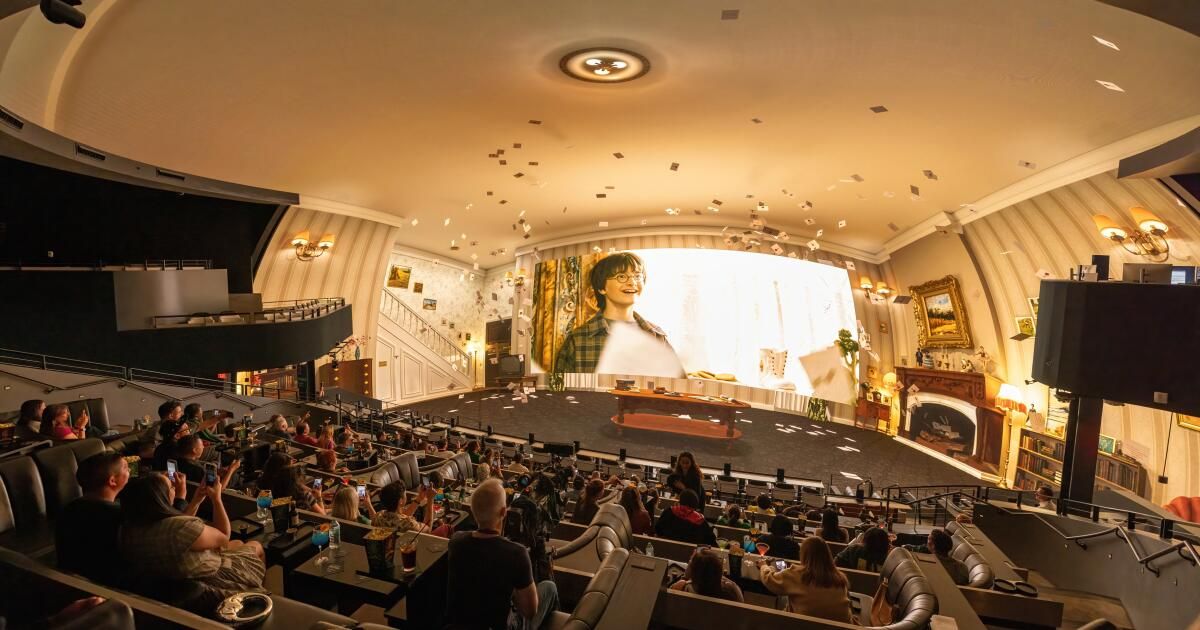
A pivotal moment at the beginning of “Harry Potter and the Sorcerer's Stone” comes when Harry's suburban home is invaded and inundated with acceptance letters to Hogwarts School of Witchcraft and Wizardry. Harry's uncles have been preventing such messages from reaching the young wizard-to-be, but the boarding school's messenger owls are having none of it.
The letters come from the fireplace and the windows and almost seem to blow up the house. And as I watched the film recently at Inglewood's Cosm, home to an all-encompassing high-definition spherical screen, I half expected a letter to fall into my lap. Cosm specializes in sports, but has released three collaborations with Warner Bros. for what it considers “experiential film.” A framed screen showing director Chris Columbus' original 2001 work is intact, but around it are newly added digital animations designed to envelop guests.
And in this first scene of “The Philosopher's Stone,” the letters flew in any direction I looked. Up, down, left, and right: mail missives shot toward the center screen. As the world moved closer to Potter and Daniel Radcliffe's family, so did Cosm. I've seen Cosm's version of “The Matrix” and “Willy Wonka and the Chocolate Factory,” so I knew I wouldn't get a letter, but one could be forgiven for protecting their cocktail (thematic, of course) from getting knocked down.
The famous “sorting hat” scene in Cosm's interpretation of “Harry Potter and the Sorcerer's Stone.”
(Stefan Silvers/Cosmo)
Such is the power of Cosm's curved screen, it brings a sense of dimension, and sometimes even movement, to the film. Think of Cosm, perhaps, as a mini version of Las Vegas's Sphere, but smaller doesn't mean less spacious. No, “Harry Potter and the Sorcerer's Stone” in Cosm's hands is usually pretty grand, as the first glimpse of Hogwarts Castle inspired applause from the opening night audience, its cliffside towers, a romantic twist on medieval architecture, towering over us in such a way that we'll crane our necks. Only in the Universal theme parks does the palace seem more real and welcoming.
“Harry Potter and the Philosopher's Stone” comes to Cosm during what is a big year for the franchise. It's the 25th anniversary, of course, of the first film in the series, and later this year, on Christmas Day, a new TV series based on author JK Rowling's popular book series will premiere on HBO Max. This summer, Harry Potter: A Hogwarts Express Adventure will open at the Southern California Railroad Museum for visitors to experience the Wizarding World's rite of passage aboard an actual moving train in the Inland Empire.
All of this activity occurs while Rowling has become the center of a heated debate over her controversial views on trans women. However, none of this seems to reduce fan interest in the series. The 2023 video game “Hogwarts Legacy” became a huge hit despite calls for a boycott, and Universal Studios last year in Florida opened a new theme park based on the franchise at its Epic Universe park, with its central attraction, Harry Potter and the Battle at the Ministry, often causing some of the longest waits in the park.
At the film's early May premiere at Cosm, there was little mention of Rowling and she was not among the huge list of names thanked by the studio and Cosm executives. “Harry Potter” in 2026 is perhaps best seen as a franchise that has outgrown its creator to take on a life of its own, and Cosm's approach is that of a love letter to its many fans, acknowledging that this is a magical, enchanting world that generations have long wanted to be immersed in.

A climatic scene from “Harry Potter and the Sorcerer's Stone” is equipped with additional effects in Cosm.
(Stefan Silvers/Cosmo)
To that end, I would rank “Harry Potter and the Philosopher’s Stone” as the most successful of Cosm’s three film interpretations. Certainly, theme plays an important role, and while Cosm has managed to match the high energy of “The Matrix” or the hallucination of “Willy Wonka,” here Cosm and his partners (experiential firm Little Cinema and effects house MakeMake) can simply revel in the atmosphere. The train to Hogwarts, for example, is especially well done, seemingly extended to infinity. Also the famous “sorting hat” scene, in which Cosm's wizards contrast the internal anxiety of being assigned a role with the external anxiety of doing so in front of an audience, exaggeratedly bringing Hogwarts' cavernous assembly hall to life.
'Harry Potter and the Philosopher's Stone'
Cosm works best when it can use its location to create the illusion of no longer being a spectator, when the space itself begins to feel like a living theater. Feel this, for example, when Harry and his friends climb the moving staircase. The screen frame can move, creating a slight feeling of disorientation as the stairs move. The portraits on the wall, whose characters come to life from time to time, begin to envelop us. Cosm used some restraint here, keeping us guessing which framed images might try to speak or nod in our direction.
If there is any qualm with Cosm's work, it is that at times there could be a nuance of greater self-control in letting the film do its work. Entering the magical hidden corner of London's Diagon Alley is a highlight in Columbus' film, and sometimes so is Cosm's performance. On the street, shops surround us, further conveying the tight nature of the neighborhood. It feels, more than ever, like a real-life space. However, within an intimate pub, filling the scene with empty tables could distract from the rushed and nervous nature of the filmmaker's original intention.
But we live in an era of immersion. Art, more and more, is maximized to encompass us, and Cosm understands this moment well. Once again, the venue has argued that cinema can feel like live community entertainment.