On a 75-mile stretch of highway that hugs cliffs in California, traffic is increasing, despite rising gas prices. And locals are expecting the busiest summer in years.
The road is Highway 1 in Big Sur, which reopened in January after three years of repair and reconstruction following a pair of mudslides. Drivers can once again embark on the state's most famous road trip, covering the 100 miles between Cambria to the south and Carmel to the north without leaving the two-lane coastal highway. And they are coming out in large quantities.
Caltrans estimates that as of May, Big Sur's restaurant and retail guest numbers are up 40% over last year, and that northbound traffic at Ragged Point, Big Sur's southern gateway, is up 900% year over year.
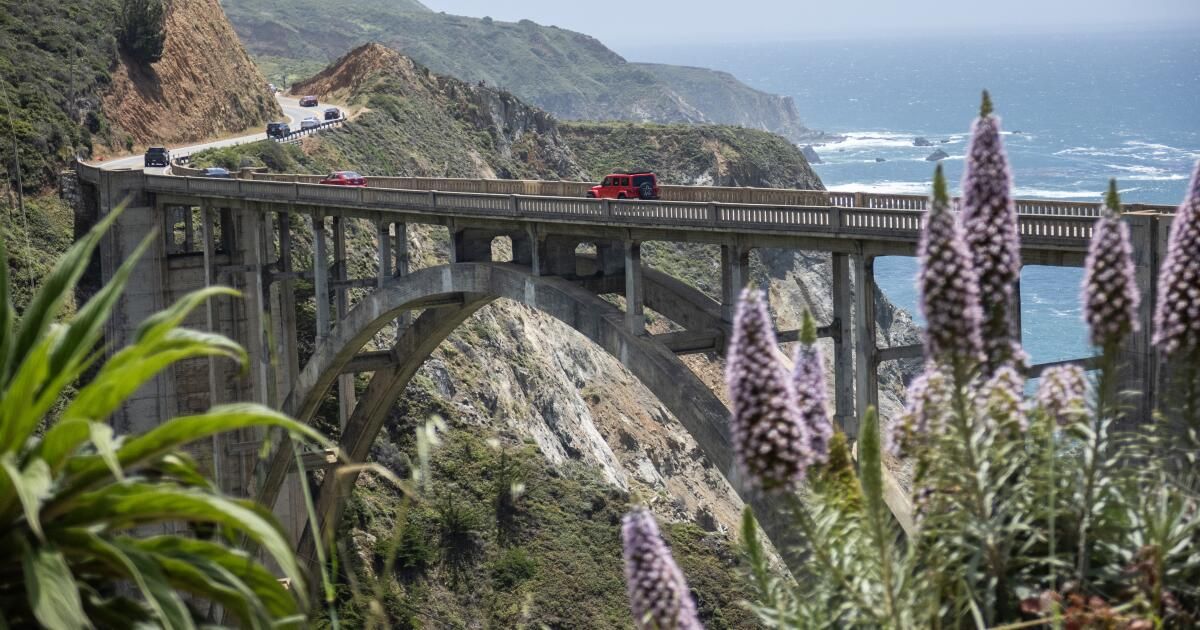
People pose for photographs near the Bixby Bridge. The Monterey County Board of Supervisors voted to explore a 12-month ban on parking around the bridge.

Safety cones prevent parking along Coast Road near the Bixby Bridge.
“Take your time,” said Kirk Gafill, co-owner of popular restaurant Nepenthe and president of the Big Sur Chamber of Commerce, offering advice to travelers. “You are going to share the path with several people.”
As travelers rediscover the road, the cost of driving has skyrocketed. The average gas price in California ($6.11 per gallon as of May 26) has increased 26% from a year ago. In early April, rates hit $9.99 at the isolated gas station in the Big Sur community of Gorda.
For spring and summer travelers, these numbers seem to raise a stark question: Stay home and save money, or head to the coast because the road is finally open and it's still cheaper than flying?
So far, the latter answer is winning big.

Fog persists off the coast of Highway 1.
“We're definitely seeing a big increase in our bookings,” said Megan Handy, assistant general manager of the exclusive Treebones resort. She estimated that bookings are 30% or more ahead of last year and rates have not changed since then. But “it still doesn't feel very crowded, which is good. It still feels a little quiet.”
But the added traffic has generated some anxiety. On May 19, the Monterey County Board of Supervisors voted to explore a 12-month parking ban at Bixby Bridge, one of the region's top photo spots.
Over the years, the number of cars parking near the bridge has increased (often illegally, sometimes impeding emergency vehicles). The proposed parking moratorium will not go into effect until supervisors discuss it further.

-
Share via
Despite how busy things are, several business owners noted that many international travelers have yet to return, perhaps because most make their plans more than six months in advance, perhaps because of global politics, perhaps a little of each.
The biggest challenge for businesses during this resurgence? “Staff turnover and retention,” Handy said at Treetops.
In Nepenthe, Gafill said his business has seen a 45% increase in guest volume since the road reopened. Gafill said he would have expected a 35% rebound, “simply by virtue of the highway reopening.” The additional 10%, he said, could be “all that pent-up demand,” helped by “a very beautiful, very dry winter,” followed by a mild spring.

A crowd has lunch at the popular Nepenthe restaurant.
Another possible factor: No one can be sure how long the road will remain open.
To cope with the influx of people, Gafill said, “everyone is trying to recruit and retain existing staff.”
At the Ragged Point Inn, where rates dropped to $149 a night last fall, rates are back above $200, and the staff suggests guests book at least six months in advance. The inn has reopened its snack bar for the first time since early 2023 and management is investing in capital improvements and hosting live music on weekends throughout the summer.
Business “is up over 100%,” said Diane Ramey, whose family owns the inn. “I know not all of our neighbors have the same promotion, but they are all doing better.”

Traffic approaching the Bixby Bridge.

A visitor poses in an oversized chair at the Big Sur River Inn.
Even at New Camaldoli Hermitage, a Benedictine monastery located above Lucia, the reopening of the road and the upcoming summer season have made a difference. Reservations are estimated to have increased by 30% at the hermitage, which rents rooms and cabins (for two nights or more) to visitors who accept its requirement of silence.
Big Sur business owners recommend visitors travel during the week for less traffic and the best hotel rates, and to get on the road as early as possible.
Since its opening in 1937, the highway has been vulnerable to landslides and terrain changes, operating in a prolonged cycle of landslides, closure, repair, reopening and then another landslide or sometimes a fire. The U.S. Geological Survey has identified the Big Sur coast as one of the most landslide-prone areas in the western United States. The 2023-2026 closure was the longest in the highway's history.
Over time, road teams have used increasingly sophisticated strategies. In the most recent efforts, Caltrans said, it used drones to help survey hillsides and remotely operated bulldozers and excavators to reduce risks to workers.
During the closure, no traffic was allowed on a 6.8-mile stretch from north Lucia to about a mile south of Esalen Institute. Drivers were detoured inland on US 101.