Olga Rudneva, lanky and elegant in a dark pantsuit, sat in the comfort of a luxurious alcove at Casa del Mar, the luxurious Santa Monica hotel, incongruously showing me photographs of wounded and mutilated Ukrainians.
Some are soldiers, others civilians. A man's face is crossed by black lines of gunpowder. Another is missing his nose. A child is missing an arm. A woman who was a cook near the front has a grotesquely scarred face.
“This guy,” Rudneva said, pointing to another, “has burns and no longer has ears.”
Swipe.
“We were trying to give this guy his eye back.”
He showed me many amputees with fancy prosthetics. Most are missing only one limb, but many are missing two, three, and sometimes all four.
“This girl lost both limbs,” Rudneva said. “She was a drone pilot. She's back on the front lines.”
Rudneva, 49, is co-founder and CEO of the Superhumans Center, a state-of-the-art medical clinic in Lviv, Ukraine, near the Polish border. Superhumans treat people mutilated in the war launched almost five years ago by Russian President Vladimir Putin. The center, opened in spring 2023, specializes in reconstructive surgery, prosthetics and psychological support. So far, it has treated more than 5,000 war survivors and employs about 650 people.
One team member, Rudneva said, is a 26-year-old triple amputee responsible for testing (and breaking) prosthetics.
“He usually has two weeks to crush any prosthesis and he loves it,” Rudneva said. “He has one arm and the only thing that really bothers him is that he is running out of space for his tattoos.”
He tilted his phone at me. It was someone's hand, but the fingertips were gone.
“We are the first country to go to war in the last 50 years in cold conditions,” Rudneva said. “When it's cold, everyone talks about snow skiing and I think about frostbite.”
Olga Rudneva, co-founder and executive director of the Superhumans Center in Ukraine, at the Casa del Mar hotel in Santa Monica during a recent visit to California.
(Robin Abcarian / Los Angeles Times)
Rudneva, who is married to a member of the Ukrainian Parliament, was in California earlier this month to attend the Stanford Sustainability Summit. In 2024, Stanford named her a “global change agent” and invited her to return this year. Gail Abarbanel, founder of the Santa Monica-UCLA Rape Treatment Center, is helping Rudneva connect with donors and introduced us.
About a year after Putin launched his full-scale invasion, Rudneva said, it became clear that Ukrainians were going to have to deal with extraordinary levels of physical and emotional trauma for a long, long time.
He had been organizing relief efforts outside Poland with his business partner Andrey Stavnitser, a wealthy businessman who co-owns a port in the Odessa region. Stavnitser was worried about what would come next for Ukraine. “Andre said, 'Olga, we have to start thinking about tomorrow. Let's build a hospital.'”
Rudneva, who had been working for Ukraine's largest private HIV/AIDS foundation, approached American philanthropist Howard Buffett, son of Warren Buffett, who was already funding projects in Ukraine, to ask for $1 million in seed money. To their surprise, Howard Buffett donated $16 million. Richard Branson, Sting and Trudie Styler are among the center's other high-profile donors.
At first, Rudneva said, the Superhuman Center treated injuries to the lower body because many stepped on mines. But now, because the war has moved from the ground to the sky, injuries to the upper body and head predominate. Drones have changed everything.
“The front looks like a 'Mad Max' movie,” Rudneva said. “The cars are in huge [anti-drone] cages and you're driving like 100 miles under a network of drones.”
In April 2023, the first Superhuman Center opened in Lviv, hundreds of kilometers west of the front lines in eastern and southern Ukraine.
Among the center's first patients was Ruslana Danilkina, a recent high school graduate who waited tables and studied to be a tattoo artist before joining the army in a burst of patriotic fervor. Danilkina thought she would be doing the paperwork in a relatively safe environment.
He spent a couple of months in Zaporizhizhia, which continues to be bombed daily by Russian missiles and Iranian-designed Shahed drones. Then, wanting to be closer to the front, she worked as a radio operator, tracking troop movements, coordinating evacuations and reporting on deaths.
“You lose the sense of time and reality,” Danilkina told me from Ukraine on Monday, with the help of an interpreter. “Night shifts and constant bombing take away your sense of what is real.”
On February 10, 2023, a few kilometers from the front line in Kherson, his vehicle came under intense Russian artillery fire. Fragments from an exploding cluster bomb passed through the car. “The first thing I remember,” he said, “was the smell. Burnt flesh. Blood.”
At 19, Danilkina became one of thousands of Ukrainian soldiers who lost a limb, their left leg.
“I wanted to hide my injury,” he said. “I didn't even want my friends to know what had happened to me. You feel guilty, almost ashamed, because suddenly you're different.”
After many operations and several prosthetics, Danilkina now has a thriving social media presence and has become a symbol of Ukrainian resilience. Magazine covers. Fashion sessions.
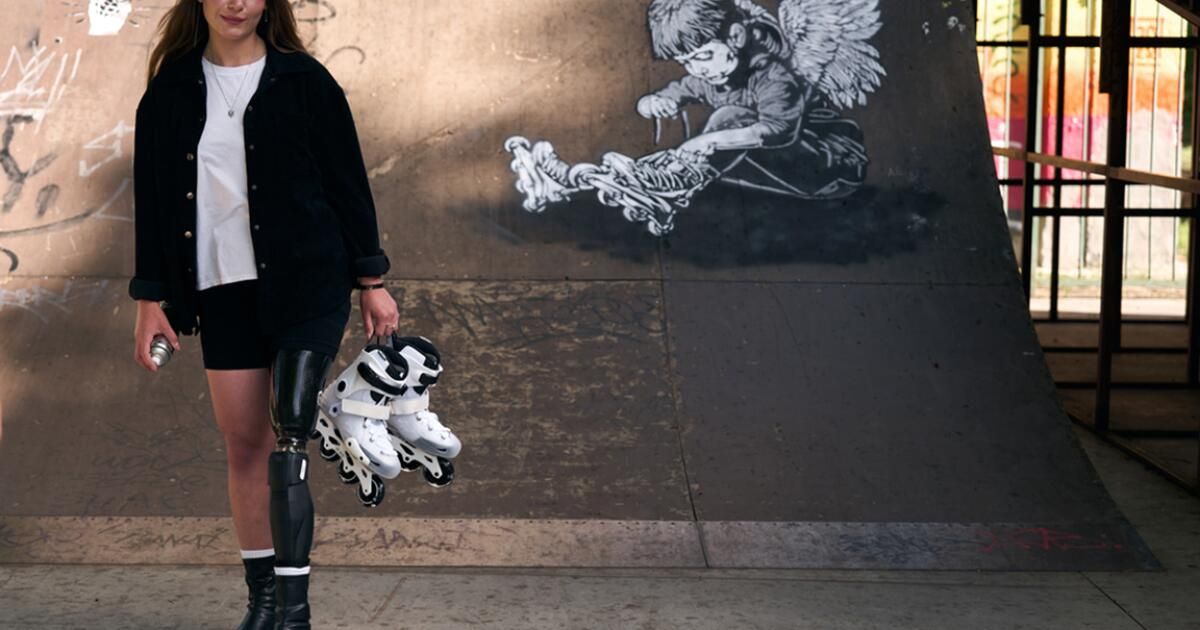
She swims and skates, and competed on a special edition of Ukraine's “Dancing with the Stars” in December, winning the contest with an emotional rumba that received a perfect score from the judges.
“When I first got into Superhumans, I met people with two and even three prosthetics,” said Danilkina, now 23. “I immediately felt something there. It felt like home. That's when I realized this is where I want to start my new life.”
Rudneva grew up with her grandmother's gruesome stories of the grim aftermath of World War II: the poverty, the hunger, the broken amputees. At the end of this war, Rudneva said, Ukrainians are determined that things will be different.
“We will be the same people, not with wounds but with scars,” Rudneva said. “The same people, not silent but speaking. If our children grow up surrounded by superhumans, the trajectory will be different for us.”
Blue sky: @rabcarian
Rags: @rabcarian