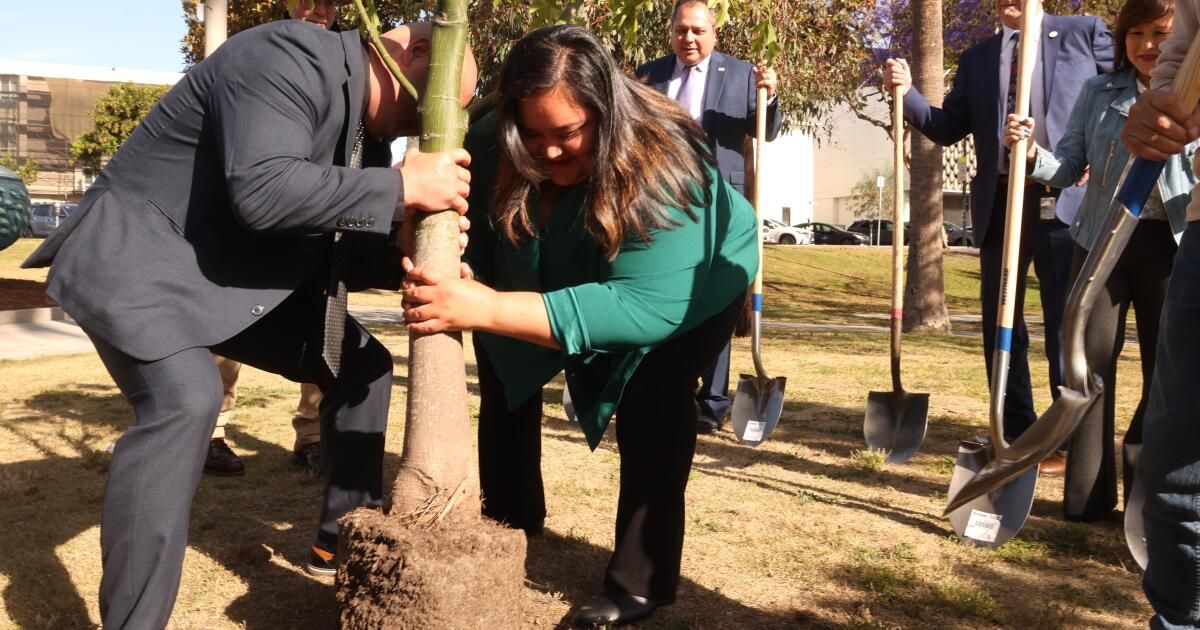
MacArthur Park was designed as a bucolic respite from urban life, but in recent years it has become better known as a gathering place for the homeless, an open-air illicit drug market and a magnet for gang violence and crime.
Los Angeles officials this week announced a $40 million project at the park aimed at turning storm runoff into drinking water, and perhaps also improving the park's tarnished reputation. The project will also include new landscaping, walking paths and other features to enhance the site's appeal as a park.
“We know that MacArthur Park has faced real challenges, and those challenges are the result of insufficient investment in infrastructure, public health and basic services,” said Councilman Eunisses Hernández, who represents the area, during the presentation of the park plans on Wednesday. “But what we're doing now is different.”
The Lake MacArthur Park Stormwater Capture Project calls for the construction of a water treatment system that will be able to convert rainwater into drinking water — about 9 million gallons a year, or enough to fill an Olympic-sized swimming pool 14 times, Los Angeles Department of Sanitation Acting CEO and CEO Traci Minamide said at Wednesday's news conference.
The project will add a pedestrian bridge, updated walking trails, native trees and landscaping for shade, seating and a decorative water feature. The stormwater system will clean 244 acre-feet of stormwater annually, cleaning 10 tons of sediment before it hits Lake MacArthur or Ballona Creek downstream, Board of Public Works Commissioner John Grant said at the news conference.
A rendering of the MacArthur Park Lake Stormwater Capture Project, which will add trees, walking trails and a water feature to the park. Construction is scheduled to be completed by the end of 2028.
(Council District 1 Eunisses Hernandez Office)
“This lake has seen it all. It's also absorbed it all: the runoff, the pollution and the years when this neighborhood wasn't at the top of anyone's list,” Grant said.
The project is scheduled to finish in late 2028 or early 2029, Hernandez said, a decade after Measure W established funding for projects like it in 2018.
Measure W imposed a parcel tax of 2.5 cents per square foot of “impervious space” in Los Angeles County to build critical water infrastructure. The measure raises about $285 million annually for stormwater projects like these, according to its website.
Maria Lou Calanche, one of the candidates challenging Hernandez in the June 2 primary for the 1st Ward council seat, said improving the aesthetics of the park is fine, but the city must first make it safe for people to go there.
“The city has its priorities backwards,” Calanche said. While he supports the project, Calanche said it should have been preceded by serious efforts to clean up the park and treat people with mental health and drug problems who congregate there.
Hernandez said the city has taken steps to improve conditions at MacArthur Park, including deploying street medicine and overdose response teams and removing more than 24,000 bags of trash within a half-mile radius of the park by 2025.
Last year, the Los Angeles Board of Recreation and Park Commissioners voted to approve, in concept, construction of a $2.3 million iron fence surrounding the property to address public safety issues.
Some people have opposed the fence, saying it would close the park and make it harder for residents to visit and provide outreach services to reach homeless people in need.
When asked about the status of the project, Parks and Recreation General Manager Jimmy Kim wrote in an email that “we are still working through our process.”

The first phase of the “Reconnect MacArthur Park” project was announced at the park on July 9, 2024. This first phase will study the feasibility of permanently closing Wilshire Boulevard (pictured), which bisects the park, to vehicular traffic in favor of an “open streets” concept.
(Myung J. Chun / Los Angeles Times)