For most of Hollywood history, the word “actor” has required little explanation. Actors search for emotional truth in imaginary lives. They collaborate with directors and scene partners, endure 4 a.m. calls, and, if all goes well, thank their agents while collecting awards.
Tilly Norwood has done none of those things. This is because Tilly exists only as code and pixels.
Last week's announcement that Tilly — the AI-generated character who debuted last year amid fierce backlash from actors and unions — would star in an upcoming movie called “Misaligned” sparked a debate not only about the impact of AI on Hollywood jobs but about something even more basic: What exactly is Tilly? Some objected to referring to the digital character as “she” or “her.” Others rejected the idea that Tilly could be described as an actor.
The debate quickly spilled over into reader comments on the Times' coverage of the project. One commentator urged journalists to “stop writing about this like it's a person.” Another asked: “How is this not just an animated movie?” A third objected: “She is NOT an AI actress, she is an AI software program.” But not everyone backed down. “I'll buy a ticket,” wrote one reader. “She is very pretty.”
Taken together, the reactions exposed how unstable the language around AI has become. No one has ever confused Woody from “Toy Story” with Tom Hanks or Elsa from “Frozen” with Idina Menzel, or suggested that the characters themselves deserved acting awards. Tilly's concept is testing whether those assumptions are still valid. If audiences laugh and cry at what they see on screen, who deserves the credit: the AI, the filmmakers behind it, or both? And where exactly does the performance come from?
Speaking by video call Thursday from the London headquarters of Particle6, the AI entertainment startup that invented Tilly, Eline van der Velden, who started out as an actress before turning to film and artificial intelligence, says she understands why many actors reacted so strongly.
“I totally understand the fear,” he says. “I had the same fear when AI first came out. I didn't invent the technology. I didn't want it to be here. But it is. My way of dealing with it is to join in.”
Set in a surreal digital world its creators call the “Tillyverse” and described as a coming-of-age comedy-drama, the planned film follows Tilly, an artificial intelligence entity with no experience of her own who gradually develops desires, ambitions and even shame as she becomes increasingly human.
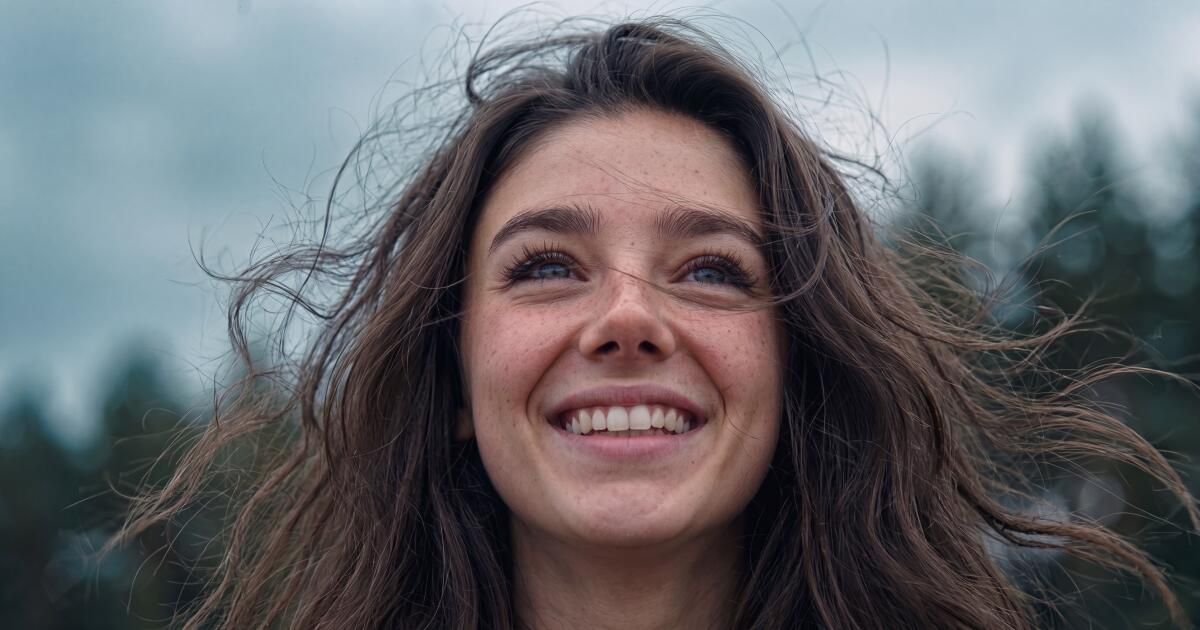
AI-generated Tilly Norwood was created with a wide variety of scenarios in mind: romantic comedies, dramas and indies. This image is generated by AI.
(Particle6)
Van der Velden compares Tilly to a character like Cinderella. Just as audiences naturally refer to the Disney princess as “she,” she maintains that it seems natural to think of Tilly in the same way. She doesn't consider pronouns important.
“People can call it whatever they want,” he says with a shrug. “I'm not offended by being called 'it.'”
The label that matters most to him is that of actor. Van der Velden imagines Tilly not as a single fictional character, but as a performer who could appear in anything from a period drama to a monster movie to a music video.
“The reason I called her an actress was because I don't want to limit myself to one character,” he says. “I just created my own Barbie doll and I want to play with her.”
Van der Velden says creating a Tilly performance is a collaborative process that combines acting, AI prompts and traditional filmmaking. Van der Velden and other actors help develop the character's backstory, voice, and emotional life and, in some cases, contribute performance and motion capture work. The creative team then reviews and refines multiple AI-generated versions of a scene before deciding which expressions and line readings best fit the story.
“That's where the critical human eye comes into play,” says Van der Velden. “Decision making is important. Creativity is there.”

Eline van der Velden, creator of AI Tilly Norwood, is a former actress turned filmmaker and technology strategist.
(Particle6)
Even her creators don't always know what Tilly will do next. Van der Velden says that reviewing different AI-generated versions of a scene can sometimes feel like discovering an unexpectedly inspired take on a human actor. “Someday I'll tell you about a blunder,” he says, laughing. “Honestly, she does the craziest things.”
Van der Velden disputes the idea that Tilly should replace the actors. “I'm not interested in Tilly taking on a role that could be played by a real actor in a real movie,” she says. Rather, the project has created new jobs, also for the actors.
“We have sixfolded our workforce,” he says of Particle6, which now has more than 30 employees. Van der Velden says the company is also collaborating with Hollywood directors and producers who asked not to be publicly identified for fear of backlash. “We've created jobs for filmmakers, including actors who are incredible at developing characters and backstories: how this person would think, how they'd say a line,” he says. “Those skills still come into play. That's the biggest mistake.”
Critics, including SAG-AFTRA leadership, respond that displacement is already present in more subtle ways, with background and commercial roles increasingly filled by digital doubles rather than human actors. For the actors union, the objection runs deeper than any individual role or AI-generated advertising. It's about what counts as a performance.
“Let's be clear: Tilly Norwood is not a person,” SAG-AFTRA president Sean Astin and national executive director Duncan Crabtree-Ireland jointly wrote in a message to members in October. “It's a software-generated synthetic construct.” They argued that such systems rely on the work of countless professional artists without their permission, credit or compensation, and that audiences ultimately connect not with algorithms but with artists because “performance has always been a mirror of our shared humanity.”
Actress Justine Bateman takes an even tougher stance. Best known for playing Mallory Keaton in “Family Ties,” Bateman later became a filmmaker, earning a bachelor's degree in computer science from UCLA and founding CREDO 23, a film festival dedicated to showcasing and certifying films made without AI.
For Bateman, no convincing imitation changes the fact that an AI figure has never experienced the emotions it portrays.

Actress and filmmaker Justine Bateman, a staunch opponent of the adoption of AI in Hollywood, believes that any human role should be played by a human actor.
(Jay L. Clendenin / Los Angeles Times)
“It should be absolutely non-negotiable: If you have a character in your movie that is human, it should be played by a human actor,” Bateman, a former SAG-AFTRA board member, told The Times last year.
Stephen Galloway, dean of Chapman University's Dodge College of Film and Media Arts and former executive editor of the Hollywood Reporter, sees Tilly occupying an uncomfortable middle ground. He compares Tilly to Pixar's computer-animated characters, another technological leap that initially met with resistance before being accepted as a legitimate form of on-screen acting.
“Yeah, it's kind of an act,” Galloway says. “Tilly is not an actor and yet it is a performance. It is a strange paradox.”
Still, he sees a crucial distinction.
“We enter a film wanting to believe,” he says. “We go in ready to see the same person in different settings (Brad Pitt or any movie star) because they allow us to pretend that they are someone else and identify with them. When it's an entirely computerized creation, you come in with the odds completely against you. You're never going to believe that Tilly Norwood is a real person in a real situation that we can identify with and care about. The reality is still too fake to accept.”
Galloway says he glimpsed that resistance this spring when Chapman University hosted a symposium examining the impact of AI on entertainment. After promotional materials announced that Tilly would appear, he says, the school was inundated with emails from people who wrongly assumed that the AI character was being presented as the equivalent of a celebrity master class.
“We had had master classes with Rock and Ariana Grande,” he remembers. “Suddenly there was a bushfire: 'How dare you do a masterclass with Tilly Norwood?' “People were more upset about Tilly than they were about all kinds of things that were happening in Washington.”
Whatever happens to Tilly, it's unlikely she'll be the last AI-generated character audiences encounter. AI-generated influencers, virtual personalities, and digital artists are already proliferating online, while entertainment companies continue to experiment with AI-created characters.
Bateman worries that audiences will eventually stop caring whether a performance comes from a human or an AI. “If you've only given them junk food and then you put a beautiful Michelin-starred meal in front of them, it will seem foreign to them,” he says.
For Bateman, the difference is not merely aesthetic; It's human.
“AI has gotten better at all the peculiar human behavior: the little head tilts, the hesitations, and the body language,” he says. “But when you hear someone sing live who has that gift, who has that instrument in their throat, it's extraordinary. It reaches the human soul.”