PITTSBURGH— Daniel Jeremiah attributes his rise as an NFL draft analyst to two seemingly unrelated events: a prominent football reporter showing up in his living room to visit a televangelist and randomly running into his brother's college roommate in a press box.
First, understand that Jeremiah is not just one in a sea of people evaluating career prospects. He is highly respected in the industry and, in addition to his radio work as a color analyst for Chargers games, has been the NFL Network's go-to expert when it comes to analyzing players' strengths and weaknesses and how they fit into a given franchise.
The former college quarterback is glib, quick and meticulously organized. Reporters turn to him (his pre-draft conference calls with NFL writers from coast to coast have sometimes lasted more than two hours) and the team's super-secretive scouts rely on “DJ” as a peer, an extra pair of eyes.
“I like to joke that I can be kind of a checker for these teams,” said Jeremiah, 48, who lives in El Cajon, where he once set San Diego records for passing yards and touchdowns at Christian High. “Then they'll call and say, 'Hey, where do you have this guy? What do you think of this player?'”
Jeremiah was once part of that world. He was a college scout with the Baltimore Ravens, Cleveland Browns and Philadelphia Eagles. But his path from being a quarterback at Northeast Louisiana and Appalachian State to where he is now was anything but a straight line. It was a more unpredictable and devious route than any offensive coordinator would dare to chart.
Let's go back in time 40 years, when his father, David Jeremiah, was the senior pastor of a Baptist church in El Cajon. Every Sunday, he went from pew to pew greeting parishioners. Young Daniel stood next to him and did the same, perfecting a firm handshake, practicing looking people in the eye.
The elder Jeremiah would go on to launch an international radio and television ministry. His son, who remains devout, would eventually carve out a career preaching the gospel of the NFL to an audience of millions. Daniel's description of players' traits is digestible and entertaining, whether it's his own phraseology or the language he's learned after more than two decades in the business.
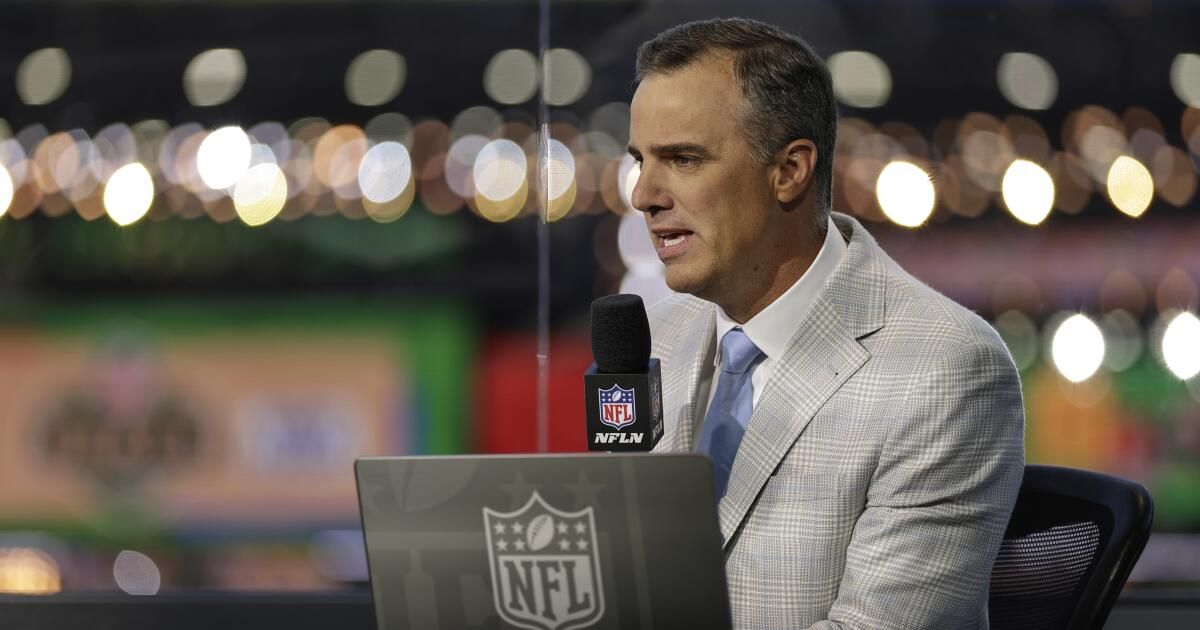
Daniel Jeremiah speaks with a reporter before the NFL draft in Pittsburgh on Wednesday.
(Ed Rieker/Associated Press)
A stalwart running back might “choose violence,” a team that builds the line before adding talent at skill positions is “putting the hardware store before the toy store,” and a running back who passes the “wet paint” test can get around the corner with such agility that “if he played on a wet paint field, he didn't have a drop of paint at the end of the game.”
Said Charlie Yook, executive content producer for NFL Network: “Daniel is hilarious, a fun guy. He's a different kind of humor. He doesn't swear. He has that kind of schoolboy, juvenile, sarcastic humor, but it's still something that everyone can relate to.”
Now, for that renowned football reporter who showed up in your living room. It was the late Chris Mortensen, who covered the NFL for ESPN and regularly listened to Dr. David Jeremiah's preaching on Sunday mornings. In 1998, when San Diego hosted the Super Bowl between Denver and Green Bay, Mortensen took the opportunity to meet with his favorite radio minister. The eldest of the Jeremías invited him to lunch at the house. Daniel was a college freshman who was home for winter break. He and Mortensen instantly bonded, and the reporter asked him if he'd like to attend the Super Bowl media day. Later, he invited the young man to join him at the draft in New York and assigned him the task of working the phones.
Mortensen would give his landline number at the draft to all team general managers, journalists and other league contacts. Jeremiah answered the phone “like a secretary,” taking notes and relaying them during commercial breaks. Jeremiah, already showing a knack for organization, kept the cards organized by division and by tracking the needs of receivers and cornerbacks, controlling which of those players went there.
“That draft was bigger than this one for me personally,” Jeremiah said, sitting in the stands at an NFL event in Pittsburgh before a group of reporters surrounded him for closing remarks on how the first round would play out.
So a straight line from there to a Mortensen-like role at NFL Network? Hardly. Jeremiah's next job was on ESPN's “Sunday Night Football” and a football-adjacent gig. He traveled with that crew as a production assistant, but his role was to line up the stage footage in each city. Say it was a Rams game in St. Louis, he was the one who set up a photo shoot at a root beer brewery so the chain would have something local to show going in and out of commercials.
He did it for two years, but eventually his knowledge of the game as a former quarterback made him too valuable to waste. The crew put headphones on him and he would be another set of eyes for the camera operators and the people in the production truck. Which cornerback was beaten on that play? He knew it. Who warms up on the sidelines? He was watching. How many times has the defense attacked? He was following the trail. It was a dream job.
“I was a pig in the spleen,” Jeremiah said.
But it was only one dirty water stop in his budding career. While walking through the press box at a game, he ran into his brother's old college roommate, TJ McCreight, who was scouting the Ravens.
“He says, 'Hey, do you think you'd ever have any interest in exploring?'” Jeremiah recalled. “I said, 'I've never… I mean, I love the draft and all that. But I've never even thought about scouting, but yeah, I would absolutely have an interest in that.'”

Daniel Jeremiah speaks during a news conference at the NFL scouting combine in Indianapolis on Feb. 25.
(Gregory Payán / Associated Press)
Soon, he met with Ravens executives who assigned him a volunteer assignment at the combine, something at a very high level.
“I filled the candy jar every day,” she said. “I helped get the players into the interview rooms and all that.”
But he was on track to spend four years with Baltimore, then followed director of player personnel Phil Savage to his general manager job with Cleveland, scouting across the country from Southern California. When the Browns went 4-12 in 2008, Savage and his staff, including Jeremiah, were shown the door.
Jeremiah spent two more years with Philadelphia as a West Coast scout before accepting an analyst job at NFL Network. I could do the same type of player evaluation without the zigzag trips, much better for a father of four.
“I gave up exploring,” he said. “Scouting did not abandon me.”
The draft is his Super Bowl and he is aware that it is often the most important day in the lives of NFL hopefuls. He takes that into account, especially when offering an honest review of a player.
“I'm very aware of that,” he said. “I don't know if there's a right or wrong way to do this job. I just know the way I've approached it, and I feel like it could really gut someone on what is literally the best day of their life. Yeah, I'll never do that.”
However, it's a delicate balance because you want to stay true to your beliefs as an explorer.
“You may not necessarily have a player on a team,” he said. “But I can try to explain to you why I think that team did what they did. That stops me from saying a lot of negative things about a player. I'm not trying to kill the kid, am I?”
Said Yook: “There are about 200 guys being drafted in these three days. It doesn't suck if you get drafted in the NFL. It doesn't matter if you're the No. 1 pick or the No. 1 pick. He understands that there's a very small percentage of people who actually touch the grass in the National Football League.”
What's more, people can follow all kinds of devious paths to success. Jeremiah needs no reminder. Preaching to the choir.