In 1986, when Mexico became the first country to host the FIFA World Cup for the second time, actor and director Diego Luna was only 6 years old. The year before, his hometown, Mexico City, had been devastated by a major earthquake. That the World Cup was being held in a nation recovering from such destruction seemed like a miracle to young Luna.
“It seemed like it wasn't going to happen. It was impossible given the magnitude of the disaster,” Luna, now 46, recalled in Spanish during a recent video interview. “And then when it happened, you could witness what a blessing it was for the people of Mexico City to host the opening ceremony, to welcome so many people from all over the world and to receive such an outpouring of affection.”
“Mexico even had a song that said, 'For now, at least, we have the Friendship Trophy.' Unfortunately, that was the only trophy we got. And the only trophy we've ever won in soccer,” Luna adds with a smile.
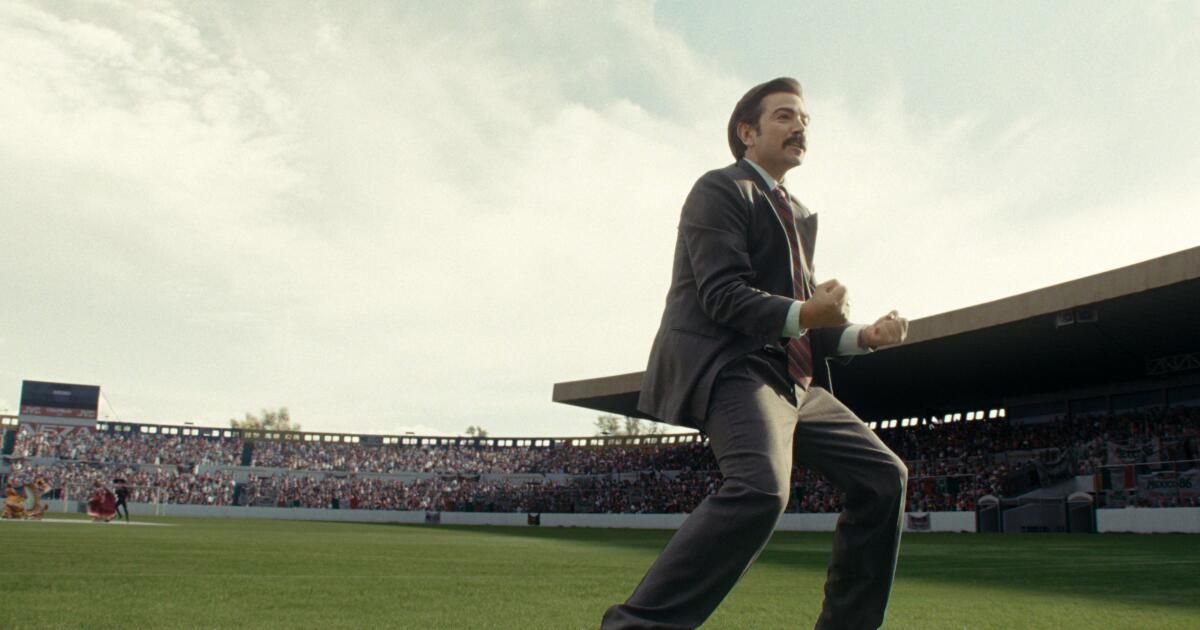
Now, in the acid humor film “Mexico 86” by Gabriel Ripstein, which premieres on Netflix starting Friday, Luna plays a fictional man in a partially true story about the ins and outs of how the country defeated more powerful adversaries and overcame the chaos of the time to successfully organize the event.
Luna's passion for football, he says, was born during that fateful World Cup at home, where Argentina won its second title from the “hand” of Diego Maradona.
“My uncle took me to see a game. He had won two tickets in a raffle at his work,” Luna says. “Back then, the people who attended the World Cup were the same people who regularly went to soccer matches.”
Luna worries that exorbitant ticket prices for the upcoming World Cup (held in Mexico, the United States and Canada) will prevent soccer fans from attending every day. “I don't know who will be able to pay for these tickets, but it is obvious that the people who go to watch soccer every weekend in Mexico are no longer invited to the World Cup,” he says. “They will have to see it on screens in public squares.”
Luna believes that the claim that this year's World Cup (starting on June 11) will be organized between three countries is nothing more than a smokescreen.
“In reality, the United States organizes it, while Mexico and Canada have only been assigned 13 games each,” he explains. “Yet the United States, a country currently fighting with the rest of the world, hosts more than 70. It is difficult to understand how they can hope to host a tournament that is fundamentally about justice, equity and communion of diverse cultures.”
Unfortunately, politics and football have often been intertwined. Luna's character in the satirical “México 86,” Martín de la Torre, is a humble government worker who manages to rise to a position of influence to have the attention of more powerful men like Televisa's Emilio Azcárraga (played by Daniel Giménez Cacho). To emerge victorious in his quest to bring the World Cup to Mexico, De la Torre shamelessly degrades and stabs himself in the back.
“My character is fictional precisely because it seeks to summarize the actions of the many bureaucrats who served this vast structure known as the State or PRI. [party]”says Luna. “And how, in their desire to please the State, to appease this machinery, they are willing to sacrifice everything, including their own morals and professional ethics. “These acts of betrayal ultimately set the course for the system’s own downfall.”
Luna's love for the sport also comes from her late father and her lifelong predilection for the Liga MX team Pumas. “My father worked at UNAM, and the university and its team, Pumas, have a very close relationship,” he says. “The stadium is there, very close to the cultural zone. It is a beautiful architectural project and is part of the campus.”
Passionately cheering for Pumas has also been part of his friendship with actor Gael García Bernal since he was little. “I went with Gael to see the last game of the 1990-91 season, where Pumas became champions,” he remembers. “There we were both, 11 and 12 years old, watching our team triumph and win the final against the hated America.”
The Charolastras, their characters in Alfonso Cuarón's “Y Tu Mamá Ahora,” were also Pumas fans. In the 2008 film “Rudo y Cursi,” the actors played feuding brothers who dream of playing soccer professionally.
“'Rudo y Cursi' brought us closer to the experience of being a Mexican player in a deeply endearing way,” he explains. “We had the opportunity to be close to many players to understand what their journey had been like.”
As a football fan, Luna has played many positions, all of them quite poorly, he confesses. However, he has always appreciated the joy of playing for the sake of playing.
“Soccer has always been a part of my life and I played it until recently,” says Luna. “I don't play anymore because my knees and ankles just can't handle it. My age doesn't allow it anymore, but I still watch it a lot.”
What Luna finds most beautiful about this sport is the inherent hope that no matter how imposing your opponent is, if luck is on your side, winning is possible. And maybe it's just wishful thinking, but it's enough to inspire professionals and amateurs alike.
“When you're on the field, no matter how great your instinct is, or how bad of a hangover you have from the night before, when the ball comes at you, just for a split second you say to yourself, 'I think this time I'm really going to hit it really well. I'm going to put it right in there and score.' But then reality sets in and the ball ends up hitting you harder than you hit the ball,” he says, laughing.
That football thrives on the genius and physical prowess of human beings, which also means that the possibility of failure makes it deeply dramatic, fascinates Luna.
“In 86 Hugo Sánchez missed a penalty,” remembers Luna. “He was the best striker in the world at the time. There was no man more closely associated with scoring a goal than him. And yet, in his own country, he missed a decisive penalty. That sense of drama caused by human error in football is absolutely thrilling.”
Luna believes that while the stories surrounding the sport are compelling, there are no good films that focus on the action on the field. “What happens there is already a perfect spectacle,” he says. “It consists of 90 minutes, divided by a break at 45 minutes that allows for speculation. It has two acts, and the second is always better than the first because it is definitive. There is no turning back. The end is inevitable.”
Football also has an egalitarian quality that other sports lack. You can play without equipment and with an improvised ball, as long as you have others to play with.
“I played even without a ball, using a Frutsi bottle, we filled it with sand to give it a little weight and that served as a ball,” says Luna. “Or there are moments when you find yourself playing even without the ball, juggling an imaginary one like Maradona used to do.”
Luna believes that football represents an affront to the individualistic mentality that plagues the world today because, by nature, it must be done in community.
“At least two people are needed, and the more players on each side, the more exciting and fun it will be,” he says. “As long as we defend the ability to act collectively, to exist in community, I believe that football will endure.”
That thought reminds Luna of one of the other loves of her life.
“If you think about it, football is like cinema,” he adds. “To play it you have to do it as a team, and cinema is not cinema unless it is seen in a community, unless it is shared.”