A Bay Area startup is trying to reinvent semi-trucks by making the giant gas guzzlers electric, autonomous and designed for efficiency.
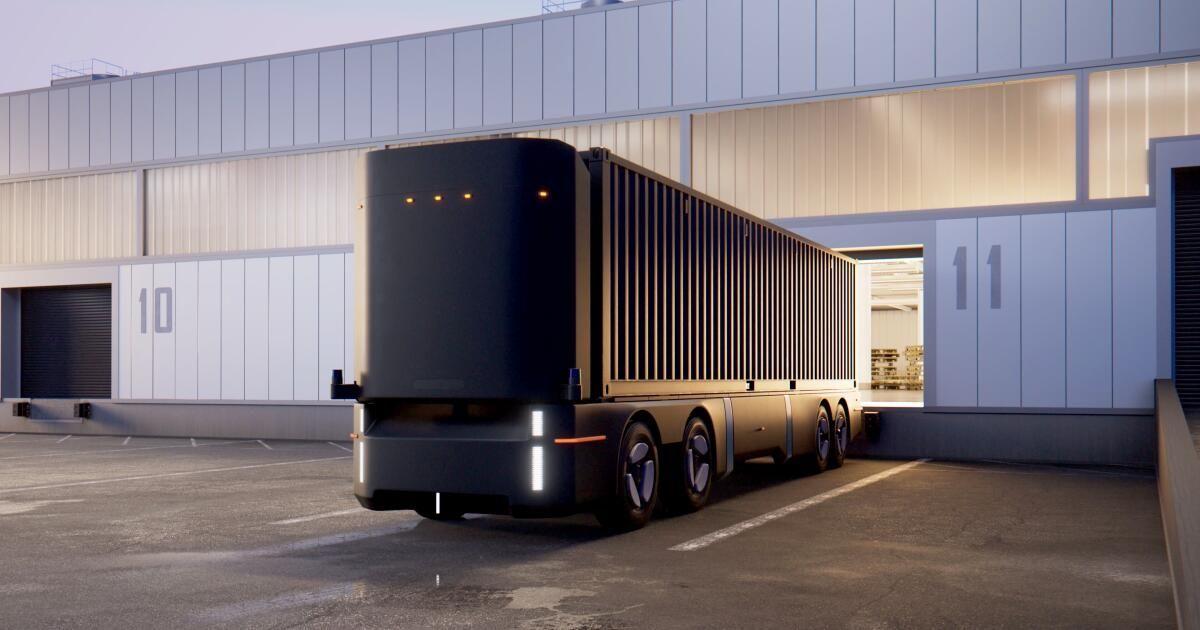
Humble Robotics, founded last year in San Francisco, has raised $24 million to develop a wireless cargo truck that lacks a steering wheel, accelerator and driver's seat.
The company says its reinvented truck could transport cargo across California and other states while saving money and reducing carbon dioxide emissions.
Humble Robotics emerged from stealth in April with seed funding led by Eclipse Capital, a Palo Alto-based venture capital firm, and Energy Impact Partners.
A rendering of the Humble Hauler, an autonomous electric cargo truck developed by San Francisco startup Humble Robotics.
(Eyal Cohen)
The company is looking to capitalize on new regulations in California that could pave the way for autonomous trucks to hit public roads in the near future.
But the technology still faces obstacles, experts said, and labor groups, including the Teamsters, are sounding the alarm about job security and availability.
“We are building an autonomous electric platform to move cargo, and when we conceived the company, the goal was to move cargo at the lowest possible cost,” said Eyal Cohen, founder and CEO of Humble Robotics. “We just want everyone to participate in modernizing this technology.”
Cohen, who has spent nearly two decades working on electric and autonomous vehicles at companies including Uber, Apple and Waabi, said Humble's self-driving truck, dubbed Humble Hauler, could begin pilot testing for customers within a year.
In April, the California Department of Motor Vehicles revised its regulations for autonomous vehicles and lifted a ban on self-driving trucks weighing 10,001 pounds or more. However, heavy-duty autonomous vehicles must begin testing with a human safety driver and must complete 500,000 miles of testing at each certification stage.
Humble Robotics has not yet applied for an autonomous vehicle permit from the California DMV and was originally planning test operations in Texas. Cohen said the company will adapt to new California regulations.
“Our focus is now returning to our home state of California, given these recent changes,” Cohen said. “We look forward to working with the DMV to understand the requirements of these changes and plan our operations in this state.”
Humble Robotics faces competition from other autonomous transportation companies, including Pittsburgh-based Aurora and Bay Area-based Kodiak.
Both Kodiak and Aurora are developing autonomous trucks with traditional driver components, such as a steering wheel. By giving up the front cabin, Humble Robotics could face additional regulatory hurdles, said Dan Sperling, founding director emeritus of the Institute for Transportation Studies at UC Davis.
“By the time they would approve a truck without a steering wheel or pedals and without a cab in the vehicle, it will probably be a little bit longer,” Sperling said. “Without a taxi, that means when something goes wrong, you can't get someone to drive it.”
Cabinless heavy vehicles known as automated guided vehicles already exist in controlled environments such as seaports. These vehicles are not fully autonomous, but rather independently follow a predetermined route.
Cohen said Humble Robotics is working to make cordless vehicles applicable to public roads, particularly those surrounding the busy ports of Los Angeles and Long Beach.
“Humble intends to partner with ports, terminal operators and intermodal shipping companies for initial deployments,” Cohen said. “We are impressed by the Long Beach Container Terminal's adoption of cutting-edge technology.”
The company employs fewer than 50 people and relies on technology similar to that used in autonomous vehicles, including radar, lidar and cameras that provide a 360-degree view around the vehicle. The truck will also use artificial intelligence to make driving decisions with “intelligent reasoning that adapts to any scenario,” the company's website says.
“What's unique about Humble compared to previous efforts is that the cameras are the primary mechanism we use to get the job done, while the lidar and radar are more of a backup,” Cohen said.
The company declined to share the production or sales price of the vehicle and did not disclose its finances.
The Humble Hauler is a Class 8 vehicle, the same group as semi-trailers, and has a universal transport platform that can accommodate typical cargo containers or other loads such as a concrete mixer. The truck will have an electric range of 200 miles and a top speed of 55 miles per hour.
Although the Hauler is in the same class as long-haul trucks, Cohen said its primary use case will be for shorter round trips. Long-haul electric trucks are harder to scale because they require a large, expensive battery.
As of last year in California, nearly one in four new trucks, buses and vans were zero-emission. Zero-emission vehicles accounted for about 23% of new medium- and heavy-duty truck sales in the state in 2024, according to a statement from Gov. Gavin Newsom's office.
Earlier this year, California's clean truck voucher program set aside $165 million to subsidize Tesla's planned electric semi-truck.

A rendering of the Humble Hauler, an autonomous electric cargo truck developed by San Francisco startup Humble Robotics.
(Eyal Cohen)
“For a lot of the moves we make in freight transportation, like getting back and forth from two points that are just a few miles apart, electricity is a really great technology,” Cohen said.
California is among the largest markets for freight transportation and employs more than 130,000 drivers. Eight out of every 1,000 jobs in California belong to a truck driver, according to Fremont Contract Carriers.
That means eliminating human driver jobs could be particularly damaging in the state. Teamsters California, which represents 250,000 workers in dozens of industries, strongly opposed the DMV's decision to lift the ban on autonomous trucks.
“The DMV's decision to rush in with driverless heavy trucks is reckless and we will use every tool necessary to stop it,” Teamsters California said in a statement. “These rules endanger our streets, our highways and our jobs.”
Cohen said he doesn't think automated transportation will completely replace human jobs anytime soon.
“Obviously people are concerned about autonomous transportation and what it means,” he said. “There are millions of Class 8 trucks and it will be a long time before all of them are automated. A truck driver today will have a job for the rest of their career.”
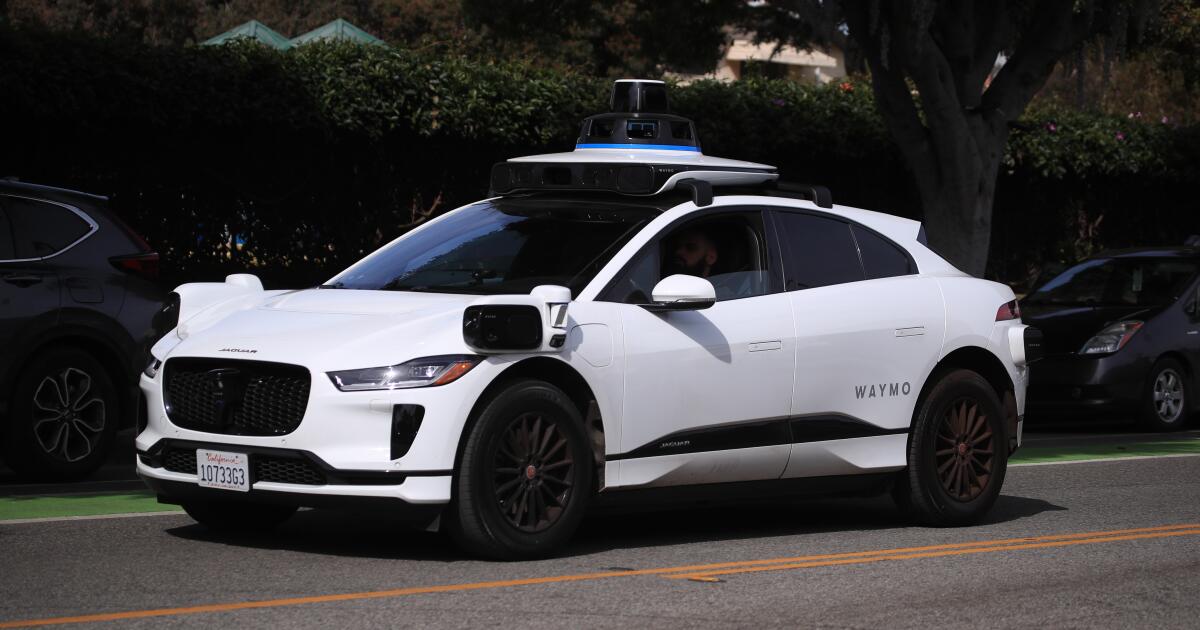
Communities in California and beyond are gradually adapting to autonomous vehicles with the arrival of Waymo and Zoox robotaxis. But autonomous trucks are likely to face greater scrutiny, said UC Davis' Sperling.
“There's an optical problem, which is that if you're driving down the road and you see this huge truck next to you with no driver, you're going to freak out,” Sperling said. “If something goes wrong, the repercussions are enormous.”