For the past two decades, major exporters and traders of liquefied natural gas have presented the fuel as a panacea for the world's energy-hungry emerging economies.
Supercooled in liquid form for shipping by sea, tens of billions of dollars of gas produced in the United States and Qatar each year could supply every corner of the world. With both nations rapidly expanding their export capacity, energy experts anticipated that the global market would be flooded with cheap LNG by 2030.
Governments in developing Asia, expected to be the center of global energy demand growth over the next half century, have based their long-term national energy strategies on this promise of abundant, free-flowing gas. They believed LNG presented the key to driving expansion while also moving away from more polluting coal.
But five months of war in the Middle East have shaken that belief.
The inability of ships to cross the Strait of Hormuz has abruptly separated Asian buyers from Qatar, their main LNG supplier. Faced with a sudden supply shock, energy executives and policymakers across Asia are looking to turn inward. They are turning to whatever domestic resources they can – from coal and gas to wind and solar – to help protect themselves from future volatility. That need is only aggravated by the expansion of the conflict to the Red Sea, another critical energy transit route.
The Middle East crisis “accelerated interest in exploiting resources in the Philippines,” said Guillaume Lucci, chief executive of Prime Infra, a Manila-based energy infrastructure conglomerate. “The moment you rely on imports, by definition, you expose yourself to market forces that are outside the control of the importing nation.”
This “means trying to free ourselves from markets that we do not control,” he said.
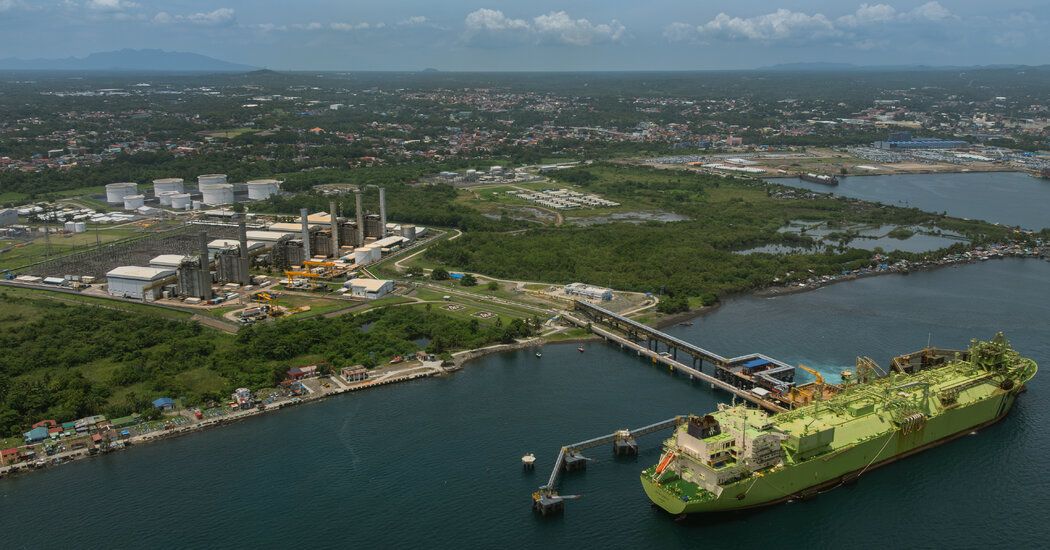
Prime Infra operates a complex of natural gas-fired power plants in Batangas, a city about a two-hour drive south of Manila. Plants at the site have operated for more than two decades, extracting gas from the Malampaya offshore field, about 400 miles to the southwest.
The Batangas site is carved into a coastline of mangroves and dark sand beaches fringed with tropical almond trees and sunbathing monitor lizards. Transmission lines leave the facility and extend inland toward Mount Makiling, a misty green saddle-shaped peak in the distance.
In 2023, when executives believed the Malampaya field was on the verge of exhaustion, they built an offshore LNG terminal. Now, however, Prime Infra's leadership is looking closer to home.
A subsidiary of the company began drilling more natural gas wells in the Malampaya field, extending its useful life by at least six years, Lucci said. “Unfortunately, very few wells have been drilled in the Philippines in the last decade and a half,” he added. “Hopefully that starts to accelerate.”
Meanwhile, about 120 miles north of Batangas, the country's largest solar project began delivering its first megawatts of power in March. This came two weeks after the outbreak of the Iran war, which raised energy prices and wiped out 20 percent of the world's LNG supply.
“That was a lucky moment. It was like fate,” said Emmanuel Rubio, CEO of Meralco PowerGen, the utility-backed power generation company that operates and invests in Terra Solar and gas- and coal-fired power plants in the Philippines.
For a country that imports almost all of its fossil fuels, the solar project has shown that “we can be, to some extent, self-sufficient,” he added.
The crisis in the Middle East has highlighted the risks of import dependence, Rubio said. LNG was championed as a stable option for electricity production, unaffected by fluctuations in sunlight or wind. “But with the volatility of LNG, we are rethinking that,” he said.
In March, a month after the start of the war, Philippine LNG imports fell by a quarter compared to a year earlier, according to Kpler, a maritime data company. Since then, shipments have recovered slightly, but Asian countries are still paying about double what they did before the war.
In 2020, the Philippines declared a moratorium on new coal plants to accelerate its shift to cleaner energy. But the goal is to ensure “a stable, reliable and profitable source of energy for Filipinos,” Rubio said, even if that means extending the life of coal.
A similar recalculation is being carried out in the rest of developing Asia.
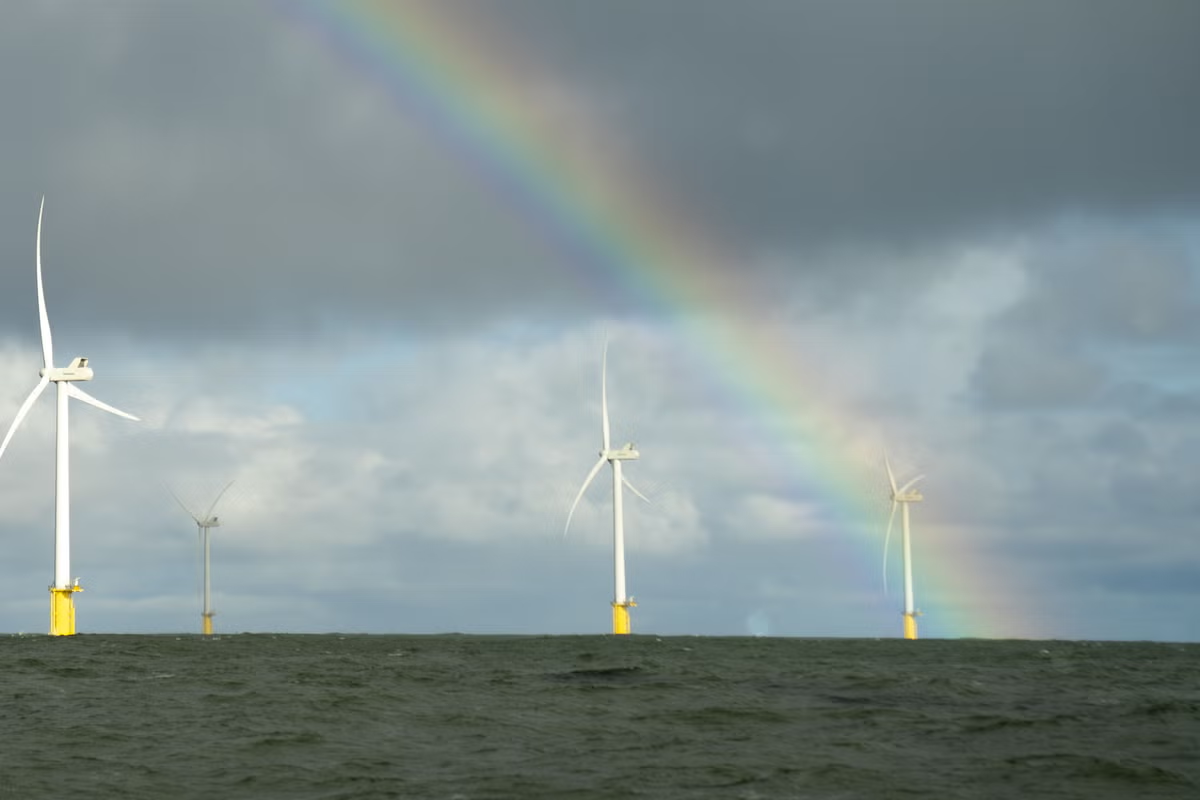
In recent months, countries in the region have increased generation at coal-fired power plants. Governments have accelerated renewable energy projects and are reporting an increase in sales of home solar energy systems and electric vehicles. Countries such as Indonesia, the Philippines and Vietnam are also exploring or beginning work on their first commercial nuclear power plants.
Vietnamese conglomerate Vingroup shelved its plans for a multibillion-dollar LNG import terminal in March. The company has since said it would use the site for a manufacturing center powered by renewable energy.
Before the war, global markets had been anticipating an “unprecedented” wave of LNG supplies, said Keisuke Sadamori, former head of the International Energy Agency.
LNG supplies were already choked once following Russia's invasion of Ukraine in 2022 and demand for natural gas soared as Europe turned to other sources. With this latest supply disruption, there are more questions “about whether Southeast Asian countries will actually decide to invest additional money in LNG import infrastructure,” he said.
Many developing Asian nations are taking note of China, which has sought to insulate itself from dependence on energy imports. It has relied heavily on its coal reserves, while expanding domestic production of renewable energy, electrification and nuclear power. It also supplies much of the renewable energy infrastructure to the rest of Asia.
“We are seeing the bifurcation of global energy systems. On the one hand, the United States and Japan are clinging to the legacy of fossil fuels, and the renewables case led by China, which is growing at a rapid pace,” said Sam Reynolds, research leader for LNG and gas in Asia at the Institute for Energy Economics and Financial Analysis.
“New supply is based on the existence of markets such as China, India and emerging Asia,” he said. A drop in Asian demand could leave suppliers building capacity in the United States and elsewhere with fewer buyers than they expected, he said.
Still, some energy experts and industry officials believe the appetite for LNG infrastructure investments will return to pre-war forecasts once global supply recovers.
Energy giant Shell projected in June that global LNG demand would rise 65 percent by 2050, with South and Southeast Asia the main drivers of growth.
Edward McCartin, chief executive of Energy World Corporation, which develops power generation and LNG projects in Asia, is optimistic about the long-term prospects. LNG can balance intermittent renewable sources like solar and help the region transition away from coal, he said.
“Solar, hydro, geothermal, natural gas and coal – we need it all,” he said.
For now, Philippine Department of Energy officials are closely monitoring the conflict in the Persian Gulf. Michael Sinocruz, director of the Office of Energy Planning and Policy, said the government was considering revising its national energy plan to potentially reflect a different mix of energy sources for the coming decades.
“What we're looking at is how much gas we need,” he said. “We cannot rely solely on renewable energy.” But the energy crisis “has awakened developing Asia to the importance of energy independence.”