Over the past year, Jerome H. Powell has frequently said that the Federal Reserve faced “no risk-free path” as it faced a series of economic shocks that simultaneously raised inflation and hurt growth.
The same could be said for his momentous decision to remain at the Federal Reserve as governor after his term as Fed chair ends on May 15.
In deciding to stay, Powell used the only leverage tool he had left to confront an administration that has aggressively attacked the central bank for its refusal to bow to the president's demands for lower interest rates. Unless another Fed governor leaves, President Trump will not have another vacancy to fill until Powell's term ends in January 2028, hampering the president's plans to get more of his supporters on the powerful board of governors.
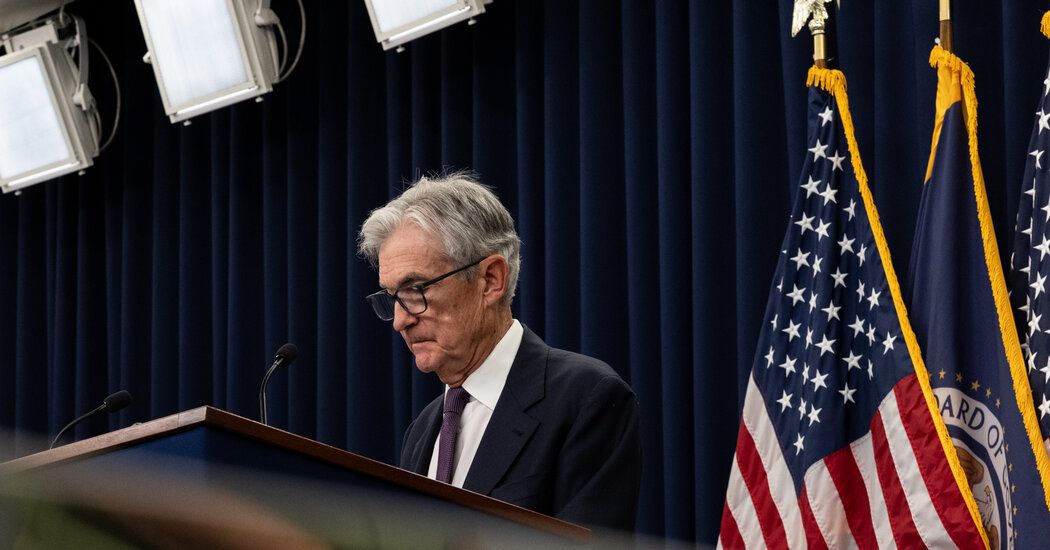
The move, which Powell announced Wednesday at his final news conference after eight years as chairman, drew an immediate rebuke from the administration. Trump joked that Powell would stay because “he can't get a job anywhere else; no one wants him.” Scott Bessent, the Treasury secretary, called Powell's decision a “violation of all Federal Reserve rules.”
On Thursday, Trump appeared to soften his approach, saying during remarks at the White House that he didn't care if Powell stayed and was only concerned about Warsh taking the top job.
The question now is whether Powell's continued presence will further inflame tensions between the administration and the central bank, leading to even more intense attacks that will keep the institution on the defensive. Weeks before Powell announced his decision, Trump threatened to fire him if he did not resign once his term as president ended.
“This could still go wrong, and if it does, some people will point to Powell staying on as a provocation,” said Claudia Sahm, a former Federal Reserve forecaster and now chief economist at New Century Advisors. “Stay or go, there are risks on both sides of this.”
Powell made it clear on Wednesday that all he wanted was to leave the Federal Reserve. However, he said he had “no choice” but to stay and protect himself against further encroachments on the institution where he has served for nearly 14 years, first as governor and then as president. The last time a president whose term had expired remained as governor was 1948.
“I will literally stay because of the actions that have been taken,” Powell said when asked if his decision would be seen as a political act. “I've been planning to retire for a long time.”
The decision had nothing to do with Kevin M. Warsh, Trump's pick to replace him as president, Powell emphasized Wednesday.
He said he took Warsh at his word that he would resist political pressure from the president. Powell also promised to keep a “low profile as governor,” despite continuing to vote on rate and other policy decisions.
William Dudley, who was previously president of the Federal Reserve Bank of New York, said he expected Powell to remain relatively calm and take a “one man, one vote” approach.
Powell spent much of his news conference explaining that his decision to stay was based on the belief that the central bank's independence was fundamentally “at risk” amid a litany of legal threats that were far from over.
“These legal actions by the administration are unprecedented in our 113-year history, and there are ongoing threats of additional similar actions,” he said. “I am concerned that these attacks are hitting the institution and putting at risk what really matters to the public, which is the ability to conduct monetary policy without taking political factors into consideration.”
Most important for Powell is a criminal investigation the Justice Department launched against the Federal Reserve regarding renovations to its Washington headquarters and whether it lied to Congress about the plans. Federal prosecutors dropped the investigation Friday but maintained they could reopen it at any time. Jeanine Pirro, U.S. attorney for the District of Columbia, said Thursday that there was “no question” that the Justice Department would appeal a federal judge's recent ruling that quashed subpoenas issued to the central bank. For now, the Federal Reserve's inspector general is investigating the renewal, an investigation Powell requested in July.
“There are billions of dollars in cost overruns on a very small project,” he said, adding that prosecutors would wait for the “decision” of the Federal Reserve's internal watchdog and “based on that decision we will decide what we are going to do.”
Powell has long stipulated that he would not leave the Federal Reserve until the Justice Department's investigation was “completely completed, final and transparent.” But a growing concern is whether Trump will now use the allegations made in the investigation to try to fire Powell, after having accused him of “incompetence” and questioned whether he committed fraud.
“There's definitely a cost-benefit analysis that you would think Powell did, and the cost of staying is that it greatly increases the likelihood that there will be a for-cause deportation case against him related to the renovations, which would be novel litigation,” said Lev Menand, an associate professor at Columbia Law School.
A president can remove a Federal Reserve official only for cause, which legal experts interpret as serious misconduct or dereliction of duty. The issue is being debated by the Supreme Court after the president's attempt to fire Lisa D. Cook, the governor, in August.
Joseph Gagnon, a former senior Federal Reserve staff member who now works at the Peterson Institute for International Economics, said it was crucial for Cook to win that case. “If they let Trump fire governors at will, then there will be no more independent monetary policy,” he said.
If Trump or the Justice Department take additional legal action, “being in is always better than being out,” Scott Alvarez, who previously served as general counsel of the Federal Reserve, said of Powell's decision to stay.
Graham Steele, a longtime financial regulation lawyer and former Treasury Department official, said doing so would have “strategic” advantages, such as “physical proximity, access to information and the institutional halo effect that comes from being a sitting governor.”
For the moment, Powell's continued presence at an institution that has been through so much tumult in the last year and is now on the cusp of a major leadership transition is “symbolically really important,” said Jon Faust, a fellow at the Center for Financial Economics at Johns Hopkins University and a former senior adviser to the outgoing president.
What perhaps matters even more is when Powell decides to leave, Sahm said.
“It will mean a lot when he says, 'I'm ready to retire,' because it will be a signal from someone who cares deeply about the institution that everything will be okay.”
— Tony Romm contributed reporting.