During China's slow-moving housing crisis, there have been brief periods when prices stabilized, raising hopes that the multi-year slump was finally over. Each time, those respites have proven short-lived: pauses before the market resumed its decline.
After housing prices in several of China's largest cities stabilized in the first months of the year, the market is once again at a crossroads. Analysts and economists are divided over whether this constitutes the nadir of a crisis that has eroded much of the savings of the country's middle class or just another pause before the next downward stretch.
Average prices of existing homes in China's so-called Tier 1 cities (Beijing, Shanghai, Shenzhen and Guangzhou) rose 2 percent from February to April, according to data compiled by UBS, the Swiss financial institution, and Centaline, one of China's largest real estate brokerage firms. The rebound followed a 38 percent drop from 2021 that has spread to the Chinese and global economies.
The cost of the accident has been high in the country and with consequences abroad. Many Chinese families had invested most of their savings in apartments, treating the property as a safe bet for generating wealth, only to discover, to their anger and dismay, that the opposite was true.
Timothy Liu, an office worker from Henan province in north-central China, is one of those buyers. He spent around $76,000 on a small apartment in his hometown in 2021, only to see its value drop by almost a third. Like many in China, he lost his job two years ago and has struggled to find another as the economy has slowed, in part because of the housing crisis.
His only consolation is that he paid cash for a modest house in a low-cost neighborhood instead of borrowing money to buy it in a big city. “Although I managed to avoid a huge mortgage in a first-tier city, the value of my apartment has dropped almost 30 percent. I'm really upset about that,” he said.
Mr. Liu's situation is far from unusual. As home values have fallen, consumers have cut back on spending on cars, cosmetics and other non-essential items. As factories could not sell enough products at home, China unleashed an avalanche of exports, resulting in trillion-dollar trade surpluses.
Optimistic analysts now see a turning point, especially in Shanghai and Shenzhen. Landlords still can't collect enough rent to cover mortgage payments, but the gap has narrowed dramatically. Shanghai has also made it much easier for buyers to borrow money through a municipal housing fund that offers dirt-cheap mortgages.
“Effectively, we are seeing a cut in interest rates,” said Karl Choi, head of Greater China real estate research at Bank of America Global Research.
Choi predicted that prices in major Chinese cities would stabilize in the second half of this year and that the recovery would spread to smaller cities in 2027.
In percentage terms, China's housing market has fallen almost twice as much as that of the United States two decades ago, when the American housing collapse caused banks to fail and triggered a global financial crisis.
Many Americans had taken out large mortgages with little or no down payment and were unable to make the payments once prices stopped rising and started falling.
Chinese banks, by contrast, have consistently required large down payments, which urban households can afford because they typically save up to two-fifths of their income.
Those large down payments have cushioned China's banking system. Prices have to fall a lot before a mortgage is worth more than the house behind it.
However, limiting mortgage losses is not the same as reviving the real estate market.
Other analysts question whether there are true green shoots, pointing to the estimated 90 million empty or unfinished apartments and the long delays sellers face in finding buyers.
Prices also briefly stabilized a year ago, before falling again.
Furthermore, the four Tier 1 cities represent only 6 percent of China's population, and prices have fallen even more sharply elsewhere.
In recent years, large Chinese cities have allowed more apartments to be sold to residents of smaller cities. “That attracted more people from other parts of the country,” said John Lam, head of Asia property research at UBS.
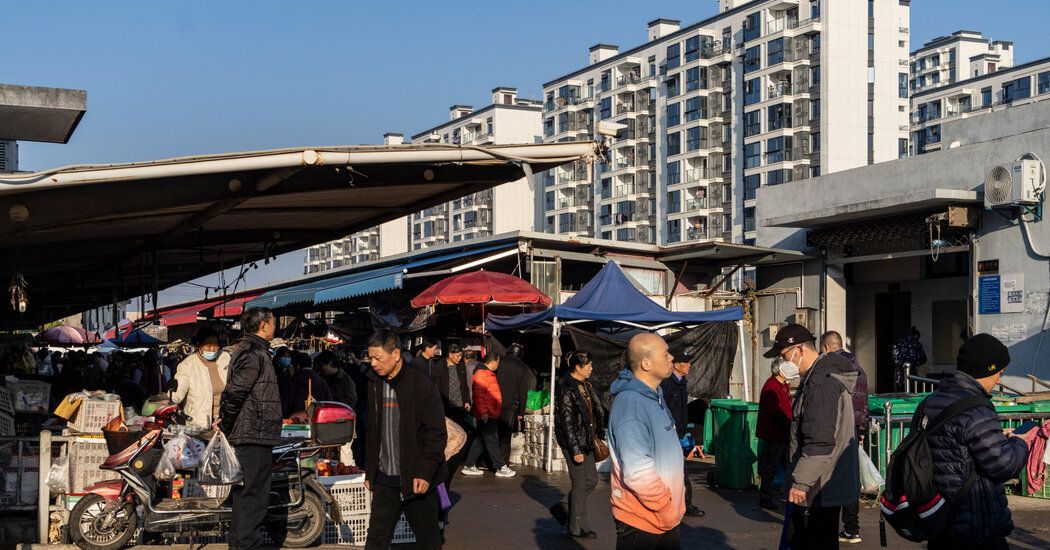
That migration has emptied smaller cities. In Yancheng, a city about 200 miles north of Shanghai, a resident who gave only his last name, Shao, said real estate prices had halved in recent years as people moved to larger cities.
“Locals are no longer interested in buying houses here; many have moved to cities further south, such as Suzhou or Shanghai, to buy property and not return,” he said.
As prices have plummeted in China since 2021, the toll has fallen not on banks but on homeowners, who have seen much of their capital disappear.
China's National Household Finance Survey, conducted every two years by the Southwest University of Finance and Economics in Chengdu, China, found that the average net worth of urban households had fallen to $130,000 in the summer of last year, down from $163,000 two years earlier.
Even these figures may underestimate the damage. The survey found that homeowners typically assumed their homes had lost only a fifth of their value since the peak.
Surveys consistently find that Chinese households keep three-quarters of their savings in real estate, and often buy an extra apartment as an investment instead of buying stocks, bonds or mutual funds.
A quarter of urban Chinese households own two or more homes, compared with about 4 percent of Americans, said Sam Radwan, chief executive of Enhance International, a global real estate consulting firm based in Chicago. Many Chinese families cannot find tenants for these investment apartments due to too many vacant units. Even when they do, the rent is usually much less than the monthly mortgage payment.
For Mr. Liu, who is in his early 30s, the drop in the value of his apartment has wiped out all the savings he had accumulated since college.
“I feel like I've worked for nothing for a decade,” he said. “I can only try to console myself by thinking that if I had bought a house and settled in a first-tier city back then, the losses I am facing now could be equivalent to working for free for 30 to 50 years.”
Ruoxin Zhang contributed to the research.