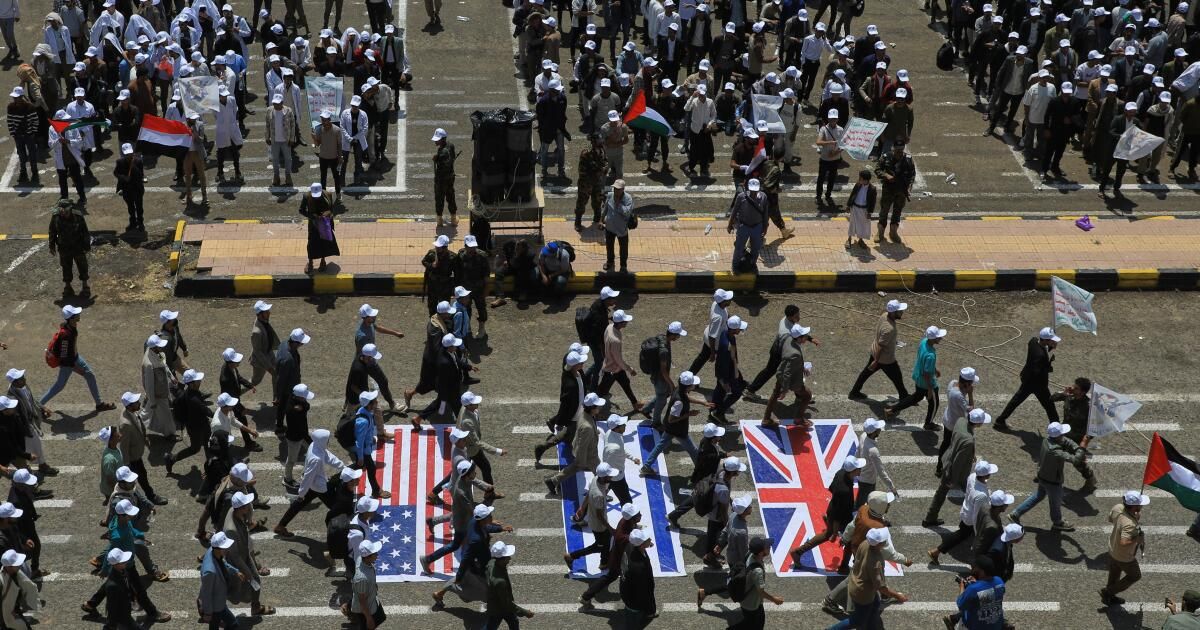
The US war with Iran escalated again on Thursday when Iran-backed Houthis in Yemen attacked two Saudi Arabian oil tankers in the Red Sea, sending global oil prices surging amid fears the conflict would choke off another vital energy corridor.
The attacks came after the Trump administration threatened additional attacks on Iran's nuclear infrastructure while pushing for a new deal to help Saudi Arabia develop its own nuclear energy program. Also on Thursday, four Republicans in the US House of Representatives joined Democrats in a vote to halt the US military campaign without congressional approval. Senate Republicans blocked a similar measure.
The price of oil hit $100 a barrel for the first time since May, increasing financial pressure on Americans at the gas pump and political pressure on President Trump to end a war that he promised would last weeks but has persisted for months. At least 18 American service members have died in the war.
The Houthis, who control Yemen's populous northwest, receive weapons and training from Tehran but have remained on the sidelines since the United States and Israel launched the war. Their latest attacks complicate already tense negotiations between the United States and Iran after the collapse of a ceasefire this month amid renewed hostilities in the Strait of Hormuz, the other major energy corridor choked by the conflict.
The Houthis had announced this week a naval blockade of Saudi ships in the Red Sea, which runs along Saudi Arabia's western flank. That blockade focused on the Bab al Mandeb Strait, the only route south for Saudi oil tankers heading to Asian markets.
Tanker traffic has already slowed sharply in the Persian Gulf along Saudi Arabia's northeastern flank and between Saudi Arabia and Iran, due to Iran's threats to ships traveling through the Strait of Hormuz. Saudi Arabia had diverted its oil exports to its Red Sea ports and away from Bab al Mandeb, shipping about 4.5 million barrels that route per day.
In a social media post on Thursday, Trump said that if the Houthis continue to attack ships in the Red Sea, the United States will “hold Iran responsible” because the Houthis are proxies of Iran and will inflict “major military punishment” on the Houthis and Iran.
He said he was “very disappointed” in the Houthis “because, so far, they have acted very professionally and intelligently” amid the Iran war.
At a later event on Thursday, Trump said the United States is “very good” against Iran, which he accused of having “bad intentions.”
Democrats in the House and Senate cited the war's extension to the Red Sea as yet another reason Congress should act to pass a war powers measure to stop the president's military campaign. Sen. Chris Van Hollen (D-Md.), who led the failed effort in the Senate, cited the expansion and recalled how Trump had claimed victory in Iran as early as March.
“If we won in March, why are more Americans dying in July? If we won in March, why is the Strait of Hormuz closed? If we won in March, why is the war expanding as the Houthis attack ships transiting the Bab al Mandeb Strait in the Red Sea? If we win in March, why are oil, gas and diesel prices skyrocketing again, imposing costs on all American families?” Van Hollen said. “Is that your definition of winning?”
Houthi military spokesman Yahya al-Sarea said the group's forces carried out “a qualitative military operation” against two Saudi oil tankers with missiles and drones for what he said were violations of the Houthi blockade in the Red Sea.
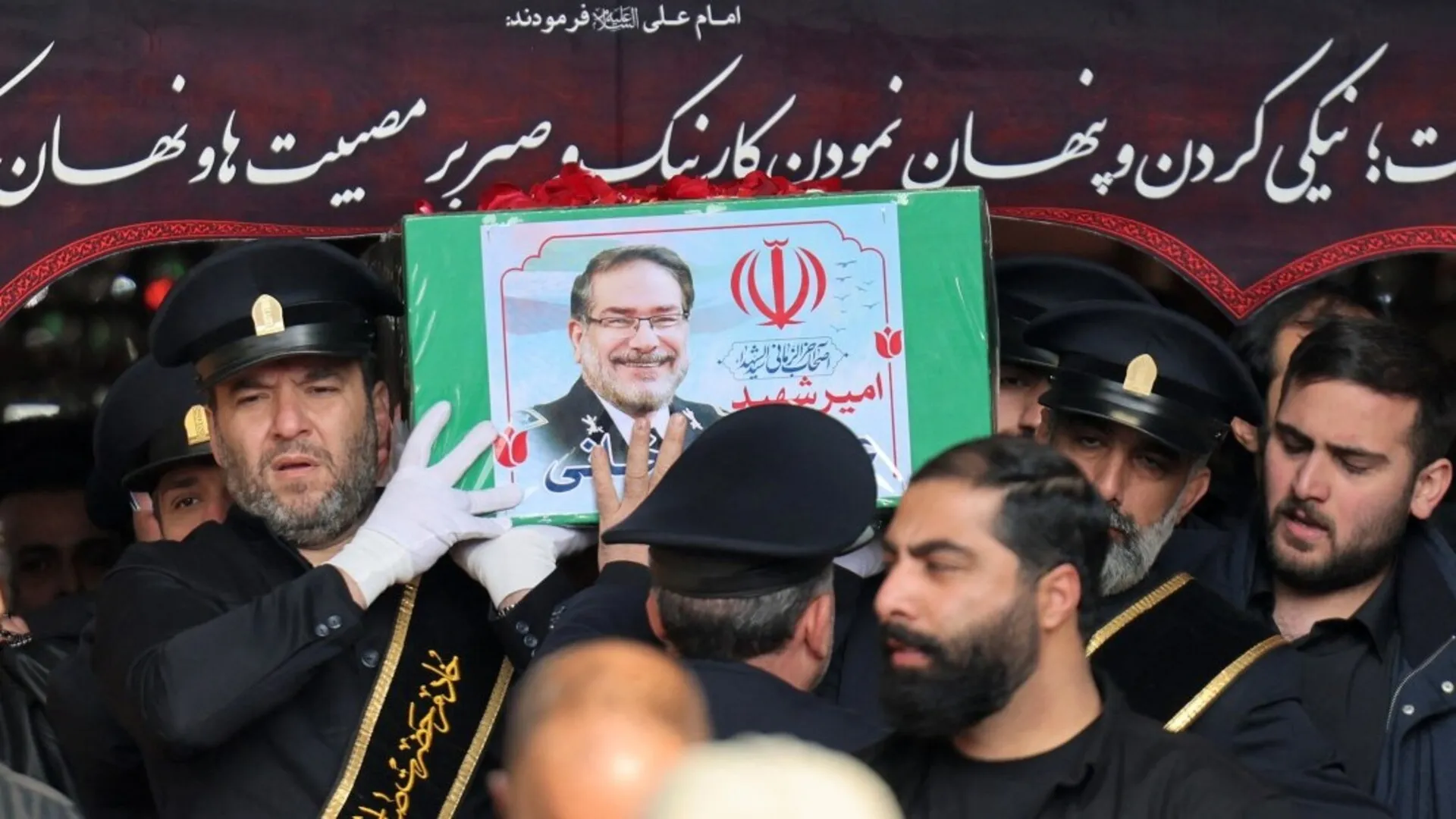
The Houthis have accused Saudi Arabia of imposing a blockade on airports and seaports in northwestern Yemen, where most of the country's population lives and which the Houthis control. They also blamed Saudi Arabia for an attack this month on Sana'a airport to prevent the landing of a plane carrying a Houthi delegation returning from the funeral of Iranian supreme leader Ali Khamenei, who was killed at the start of the war.
Al-Sarea said that in addition to attacking the two oil tankers, the Houthis forced 10 other ships to reverse their passage, “will continue their naval operations against the Saudi enemy” and “will continue to impose the equation of blockade against blockade.”
The escalation of the war — and the shockwave it sent through global energy markets — added to regional uncertainty already stoked by the Trump administration's Wednesday announcement that it had agreed to work with Saudi Arabia to develop a civilian nuclear program.
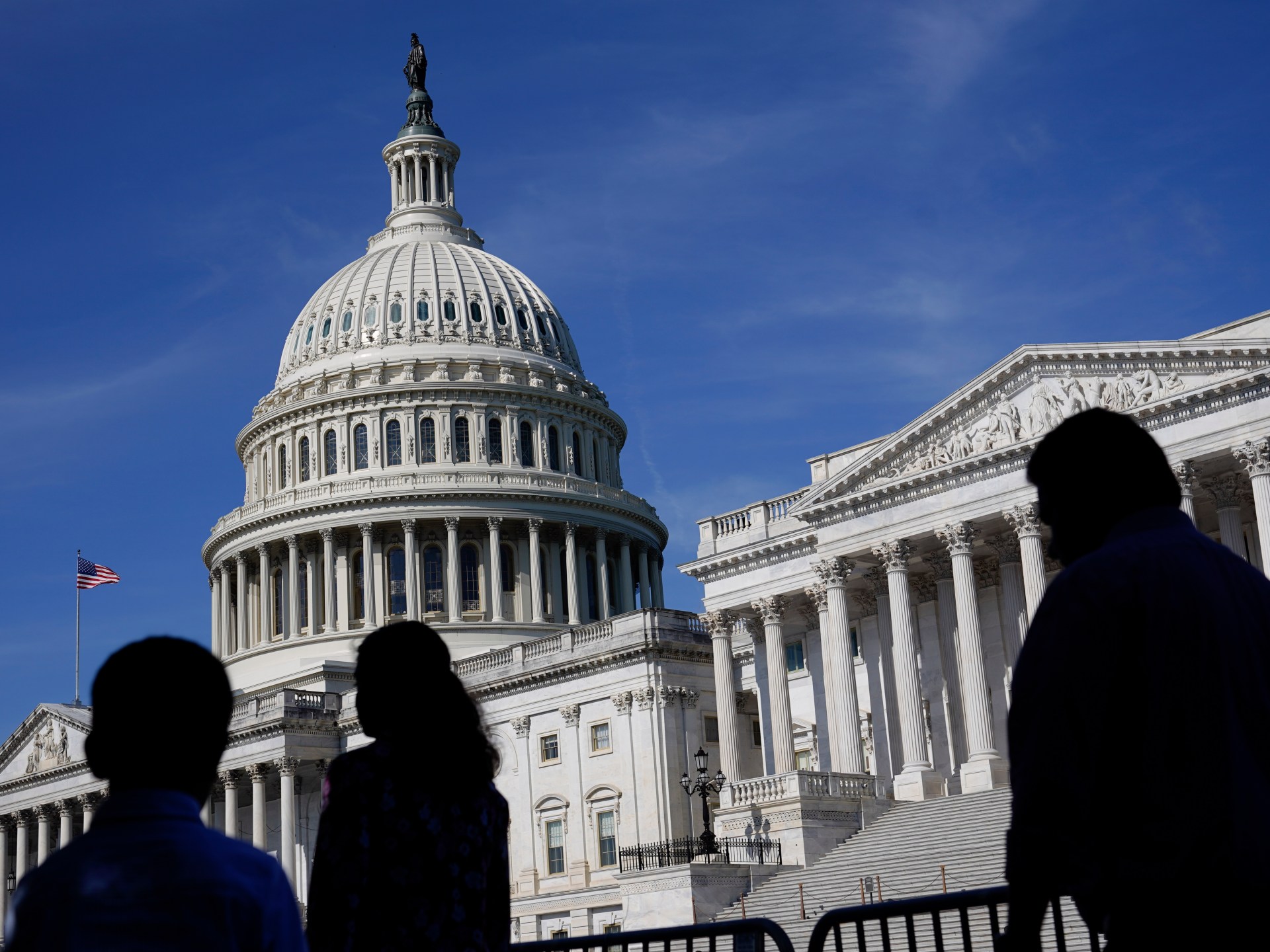
That announcement, after years of U.S. attempts to block nuclear proliferation in the Middle East, sparked widespread concern in Washington, where lawmakers will vote on the deal, and in Israel, which has long feared a nuclear arms race in the region.
Trump administration officials said the deal would “maintain the highest standards of nuclear security and nonproliferation,” and the program would be developed by American companies. But they provided few details, and questions immediately arose about the absence of clear inspection protocols or any requirement that Saudi Arabia first normalize diplomatic relations with Israel.
On Thursday, Trump said the deal would be conditional on Saudi Arabia joining the Abraham Accords and establishing diplomatic relations with Israel. White House press secretary Karoline Leavitt later said that Trump had not spoken to Saudi leaders since making that condition public, but that they would have to accept it or “the deal would be canceled.”
Leavitt said Trump had raised the issue with Saudi leaders in the past, and that it's something Trump “feels very strongly about.”
Asked if Israel pressured the president to impose the condition, Leavitt said: “Not that I know of.”
Earlier this week, Defense Secretary Pete Hegseth told Congress that the war against Iran has already cost the United States $37.5 billion. House Republicans on Wednesday pushed a $1.15 trillion defense policy bill to fund future war. Most Democrats voted against the measure in protest of the war and it faces stiff opposition in the Senate.
In recent days, Trump has sought to deny polls showing plummeting support for the war among Americans. On Wednesday, before attending the dignified transfer of the bodies of American military dead in the war to Dover Air Force Base in Delaware, Trump said that Americans do not want high gas prices but that they “are not against war.”
On Tuesday, Trump released statistics showing that more U.S. service members died in past wars, which Democrats denounced as a lack of respect for those killed in the current conflict.
The Houthis took control of the Yemeni capital in 2014, along with much of Yemen's northwestern town. Their advance triggered a devastating campaign led by Saudi Arabia to dislodge them. Since 2022, both sides have been at a stalemate, although tensions have risen again in recent months.
Mohammed al-Basha, founder of Basha Report, an American risk advisory firm focused on the Middle East and Africa, said the latest escalation by the Houthis comes as their influence is growing due to the growing importance of Bab al Mandeb while the Strait of Hormuz is blocked by Iran.
“This is their moment, because with everything happening in the Strait of Hormuz, Bab al Mandeb quadrupled in importance. By exerting maximum pressure in this period, they can maximize the effect of any kinetic action they are trying to perform,” Al-Basha said.
“Their narrative is very aggressive. They want war. And they feel that because they want war and they feel the United States and Saudi Arabia don't want it, they will submit to their demands.”