- Court orders that protesters' digital personal data not be made public.
- The states ordered the release of those arrested under 18 years of age.
- The court asks authorities to preserve all surveillance images.
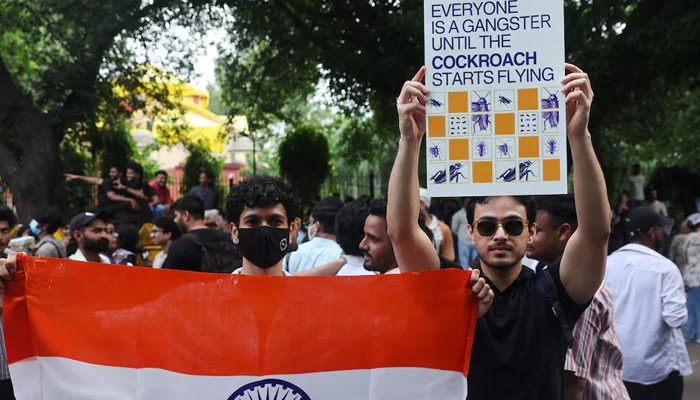
NEW DELHI: India's Supreme Court on Tuesday ordered the release of minors under 18 arrested during youth protests over exam leaks and said authorities must ensure surveillance footage is preserved after petitioners alleged police brutality against protesters.
Indian media reports said Chief Justice Surya Kant also ordered authorities to preserve the digital and personal data of people who participated in the protests and prohibited any coercive action against them.
Reports said Kant took interim measures in response to petitions filed by students and activists seeking action against police and paramilitary forces for what they said was the excessive use of force and pellet guns during weeks-long protests in the national capital and other cities.
He called for the preservation of all footage, including that from drones, body cameras and CCTV, and ordered authorities to ensure that protesters' data was not made public.
Police officers injured, says attorney general
“Whoever has committed excesses… atrocities against innocent people, the law will take care of them. For that, there needs to be a completely independent and fair investigation,” Kant said, according to the legal website Live Law, one of several outlets that reported on the ruling.
“An investigation has no meaning if no responsibility is determined,” he stated, before ordering provisional measures.
The government has defended police action during the protests as legal crowd control.
The media quoted Solicitor General of India Tushar Mehta as having told the court that while the issue of attacks on students could not be taken lightly, around 250 police officers were also injured, adding that the government had no objection to an investigation into the matter.
The protests, sparked by the leak of question papers for a national medical school entrance exam, ended on Saturday after the education minister resigned and the government acceded to protesters' demands for exam reforms, the withdrawal of police cases and compensation for the families of students who died by suicide after the leaks.
Batons are used against protesters
During the protests, tensions broke out between protesters and security forces in several parts of the country, including New Delhi, where people trying to march towards parliament were met with tear gas and batons.
Indian authorities also suspended a police officer in an eastern state for firing an assault rifle into the air to disperse student protesters over the weekend.
Reuters reported on Monday that Prime Minister Narendra Modi's government was facing a challenge from activists over the use of AI-powered surveillance at protests, after protesters posted photos on social media of a mobile police surveillance van equipped with cameras on a telescopic mast, providing a 360-degree view of the gathering.
The self-styled Cockroach Janta Party, which spearheaded the movement, claimed on Monday that “hundreds” of students had been arrested in several states, in violation of the government's commitment.
Reuters was unable to independently verify the claim.