MEXICO CITY — Residents of Mexico have become accustomed to a regular record of horrors: murders, kidnappings, “disappearances” and the discovery of clandestine graves, among other outrages.
Still, this month's massacre of 10 men in the state of Zacatecas represented a surprising spasm of violence in a region renowned for its mining industry, its pink sandstone colonial churches and its crucial role in the Mexican Revolution.
Last weekend, the bodies of the 10, apparent victims of cartel executions, turned up at three sites across the state in north-central Mexico.
The most dramatic thing was that five of the bodies were hung on a highway bridge, their half-naked corpses showing signs of torture, a macabre display that recalled the worst days of the drug war in Mexico. Four other victims were left near a government clinic; a fifth was dumped on the side of the road.
The targeted killings – and the highly choreographed location of the remains – were clearly a warning of organized crime, which, despite official denials, constitutes a kind of parallel government in many areas of Mexico. The unequivocal message from the gangsters: cooperate with us or pay the maximum price.
The 10 victims were apparently kidnapped in the days before their murders, authorities say, although none of the kidnappings were reported to police until the bodies were discovered.
The victims appear to have been chosen with considerable deliberation. Among them were a former rural mayor, a former police commander, a bar owner, a rancher, a firefighter and several businessmen associated with mining and construction, industries heavily subject to extortion demands.
Authorities say they are considering extortion and possible corruption among public officials as potential factors in the killings.
At least two of the victims were involved in an “extortion ring,” state attorney general Cristian Pablo Camacho Osnaya told reporters Thursday, without specifying their role. Investigators were examining 14 separate bank accounts possibly related to the crime, he said.
Extortion in Mexico is a multimillion-dollar business that affects all economic sectors and is linked to organized crime.
Police arrested five suspects, at least two of whom may have participated in the murders, authorities said. There was no official information on who ordered the attacks or the motive.
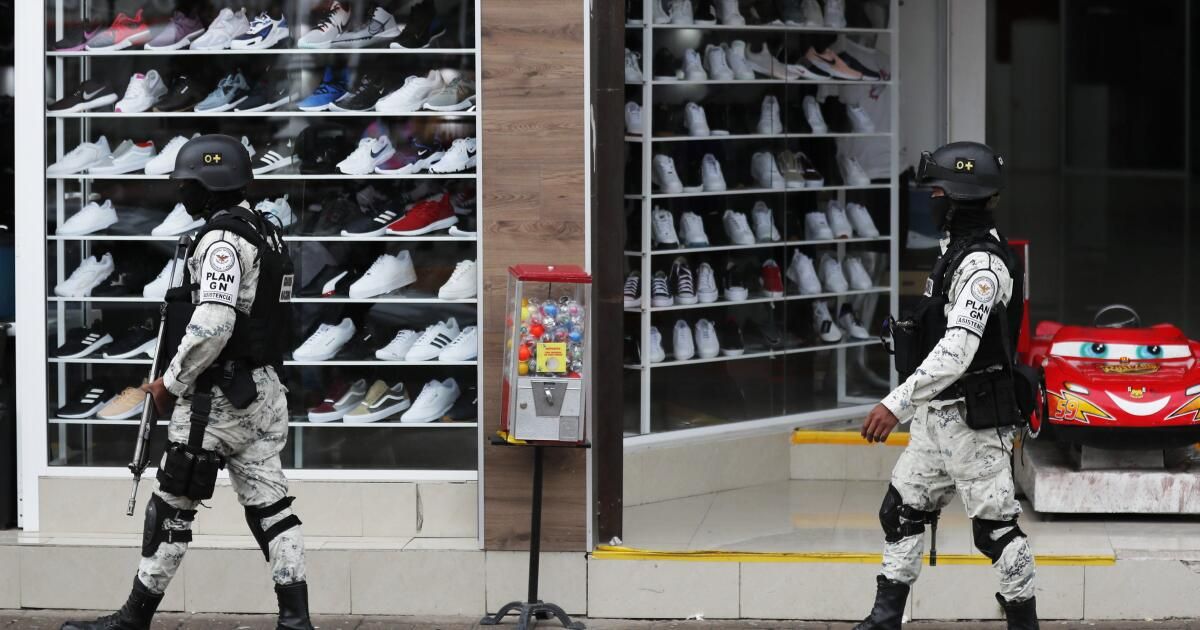
Hundreds of army troops, special forces soldiers and police officers were sent across the state after the killings.
“Whoever ordered and committed this barbarity will pay for it,” promised Zacatecas Governor David Monreal, a member of Mexico's ruling political bloc, Morena. “There will be justice, not impunity.”
For many, official promises of justice ring hollow in a country where few gang murders are solved beyond what critics call symbolic arrests, typically of low-level hitmen rather than the masterminds.
Zacatecas has long been the scene of bloody turf battles between the Mexican cartels of Jalisco Nueva Generación and Sinaloa. But authorities boast that the state has lately become a model for reducing mafia chaos, a claim many consider suspicious.
“We in Zacatecas live terrified because we can be disappeared, murdered, kidnapped and the authorities do nothing,” said Rosa Carmona Rosales, a domestic worker who is part of a search group looking for “missing” victims, including her daughter Adriana, a mother of three who disappeared in 2017. “There is no justice.”
Several business leaders contacted were hesitant to speak on the record, citing vulnerability to retaliation and a general climate of fear and uncertainty.
“Of course we pay extortion, and the demands don't always come from organized crime,” said a construction executive who did not want to give his name. “Many times it comes from local governments… It is an open secret that, in Zacatecas, the government and organized crime are in collusion.”
Two days after the bodies were found, a video began circulating on social media showing a masked figure reading a statement in front of a group of armed men in tactical gear. The murders, he said, were revenge by a faction of the Sinaloa cartel. The man accused state officials of breaking a “pact” with the cartel and warned that similar fates, or worse, awaited others who betrayed the mafia.
“Here betrayals cost lives,” the masked man warned.
Authorities label the video as fake and deny any agreement or cooperation with the cartels.
The massacre comes as the federal government has hailed its national security offensive as a great success. President Claudia Sheinbaum has credited her administration's efforts for reducing homicides by almost 50% in less than two years.
But many Mexicans remain unconvinced, a skepticism that is only reinforced by a steady stream of high-profile murders across the country.
In the days after the Zacatecas killings, a mayor was murdered in his office in the central state of Morelos and a journalist was shot dead in Oaxaca, in the south. Those crimes were not related to the massacre in Zacatecas, authorities said, but they demonstrated again how collective violence continues to wreak havoc throughout Mexico.
“What happened in recent days in Zacatecas is one more indication that… crime is still present, dominating the territory, with links to local governments,” wrote columnist Carlos Puig in Mexico's Medio Milenio.
The 10 bodies were found on the outskirts of the city of Zacatecas, the state capital and a major tourist attraction, with colonial-era churches and other attractions. Visitors are advised not to stray too far from the heavily guarded capital.
In Mexico, Zacatecas is known for its long history of silver mining and for being the site of an iconic 1914 battle during the Mexican Revolution, in which the insurgent forces of General Francisco “Pancho” Villa defeated government troops.
The US State Department gives Zacatecas its highest risk rating: Level 4, which means “Do Not Travel.”
Zacatecas has traditionally been an important source of immigrants to the United States, especially to California. Many American residents with roots in Zacatecas regularly visit family in the state, especially during the holiday seasons.
In 2022, José Gutiérrez, a Mexican-born architect and American citizen living in Ohio, was in Zacatecas while visiting his fiancée during the Christmas holidays. The couple disappeared. Weeks later, Mexican authorities found four bodies in a grave on a ranch in Zacatecas.
The remains were identified as those of the Ohio architect, his fiancée, his sister and a cousin.
McDonnell is a Times staff writer.. Sanchez Vidal is a special correspondent.