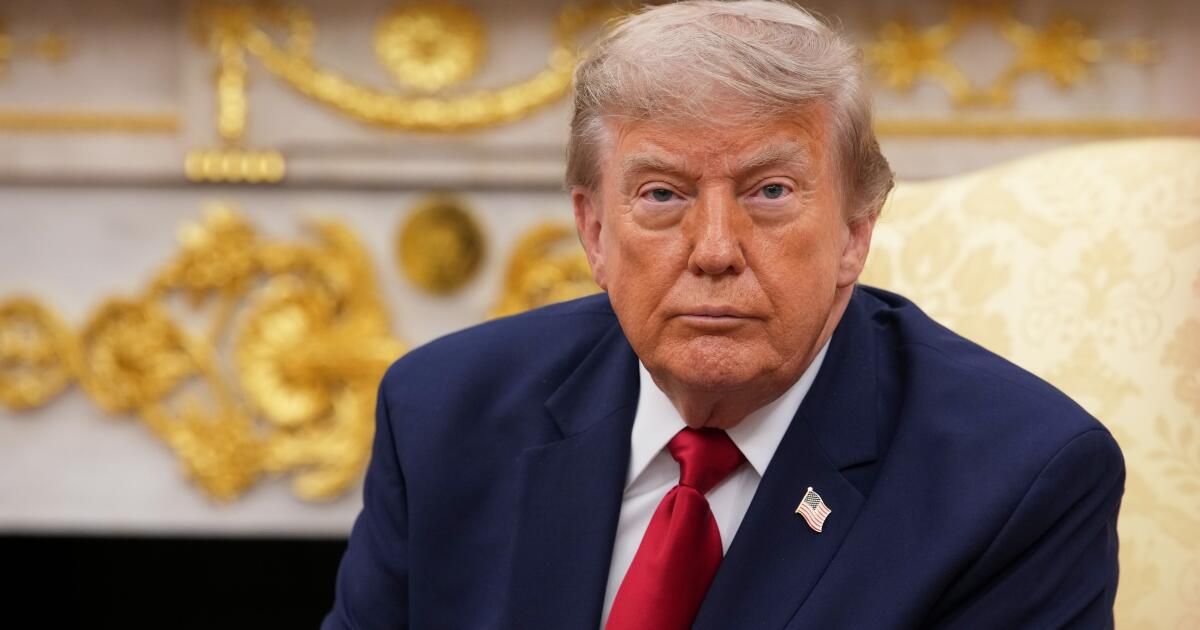
WASHINGTON- President Trump appeared set to question the security of the U.S. election with a planned prime-time speech Thursday night, sparking fears among Democrats and voting rights advocates that he is plotting another play for federal control over voting in November's midterm elections.
The White House has not revealed the exact reason for the speech, and Trump only described it to reporters this week as “really, really important news.” He confirmed that it would have to do with “free and fair elections.”
Washington Post reportedCiting sources, Trump planned to argue that there are vulnerabilities in the country's election infrastructure and claim that China had accessed American voter data. The White House declined to confirm such details Wednesday.
The announcement of the speech raised concerns among the president's political opponents, as well as election experts and voting rights advocates, that Trump could again escalate claims that the country's voting system is vulnerable to domestic fraud and foreign attacks.
He had previously said Republicans should “nationalize” election administration, a task that falls to the states under the Constitution, and has pushed his party to tighten federal voting rules.
“We don't know anything about what he might say … or what he might try to do with his very limited powers, as president, about the election,” said David Becker, executive director of the nonpartisan Center for Election Research and Innovation. “I expect we will hear a lot of repeated and debunked claims.”
The president could potentially use new claims to argue that the nation faces an emergency in the upcoming election that requires greater federal intervention in voting, Rep. Joseph Morelle of New York, the ranking Democrat on the House Administration Committee, which oversees elections, said in an interview with The Times.
“This will be the fundamental reason to declare a national emergency,” Morelle said. “It is transparent that he is creating the emergency and he is creating evidence out of thin air to suggest that there is an emergency.”
Sen. Alex Padilla (D-Calif.), the top Democrat on the Senate Rules Committee, which oversees federal elections, told the Times on Wednesday that Trump was using a well-known playbook to “[sow] doubts about the result before a single vote has been cast.”
“All signs show that tomorrow's speech will be more of the same: debunked conspiracy theories offered not because they are true, but because chaos and doubt are the only cards left to play,” Padilla said.
The speech, which Trump announced on social media on Monday, comes four months before the midterm elections that will determine whether his party retains legislative control in Washington.
White House spokeswoman Karoline Leavitt dismissed news reports about what Trump might say in the 6 p.m. PDT speech as speculation, saying “no one knows yet what President Trump will ultimately say.”
The speech also coincides with Trump's ceasefire with Iran. has fallen apartrenewing expectations of a rise in gas prices, and his approval rating on the economy has been steadily falling. On Tuesday it was also made public that Trump had paid 5.6 million dollars to the writer E. Jean Carroll, as ordered by a jury that in 2023 found Trump responsible for sexually abusing her and defaming her.
“What we're going to talk about on Thursday is that it's not going to get any bigger,” Trump told reporters who asked about the speech Tuesday. “Because without free and fair elections there is no country.”
Trump has spread unfounded claims of widespread voter fraud for years. But his prioritization of his claims about the voting system — even as much of the country's attention is on cost-of-living issues — has been particularly clear in recent days.
He has aggressively pressured reluctant Republican senators to pass his voter ID legislation, refusing to sign a bipartisan housing bill on the matter; he fired all remaining members from the bipartisan United States Election Assistance Commission; and his Justice Department said it would send election observers to six states.
Since the midterm primaries began, Trump has also raised doubts about election security, primarily in California, where he suggested Democrats had cheated or tried to in the gubernatorial and Los Angeles mayoral primaries.
Georgia Democratic Sen. Jon Ossoff, whose state was often at the center of Trump's fraud allegations in 2020, said the president's speech posed a threat to voting rights.
“I hope he uses everything he says on Thursday as a pretext, either for some attempted unconstitutional use of federal power to interfere in the election,” Ossoff said Tuesday on MS Now, “or to give his representatives and loyalists in state and local jurisdictions some cover for any attempt they may attempt, or to lay the groundwork for challenging the result.”
Any effort to federalize or take over elections would face serious legal obstacles, said Nahal Kazemi, a law professor at Chapman University. Although Congress can pass laws regarding election administration, as it did with the Voting Rights Act, the executive branch plays no role in holding elections.
“You basically run into a brick wall that is the Constitution, which makes it very clear that states run elections,” Kazemi said.
When it comes to concerns about foreign interference, experts say there is little evidence that other countries have attempted to hack systems or change votes. Instead, foreign actors have largely operated through disinformation campaigns, as the United States determined had occurred in the 2016 and 2020 elections.
“From the information we now have at our disposal, there is no reason to be alarmed about the possibility of a foreign adversary taking over electoral systems,” said Kazemi, who has studied foreign electoral interference.
One of the things that helps make American elections generally secure, he said, is that they are not centralized but run by thousands of counties. Hacking so many voting systems would be extraordinarily difficult for a foreign adversary, he said.
Jenny Farrell, executive director of the League of Women Voters of California, said California “takes election security extremely seriously” and has one of the most secure systems in the country, subject to strict voter verification measures and an intense chain of custody and audit procedures.
Democrats have worked with election experts in recent months in attempts to assure the public make the US elections safe and secure. They have also tried to counter Trump's claims that mail-in ballots and voting machines are unreliable.
A series of 2020 election reviews, including those conducted by the first Trump administration, concluded that Trump lost and Biden won. Election experts say there is no evidence that widespread fraud determined the outcome of the election.
A judge also determined that claims made by Trump and his lawyers that the company Dominion Voting Systems manipulated votes cast through its machines in favor of Biden were false.