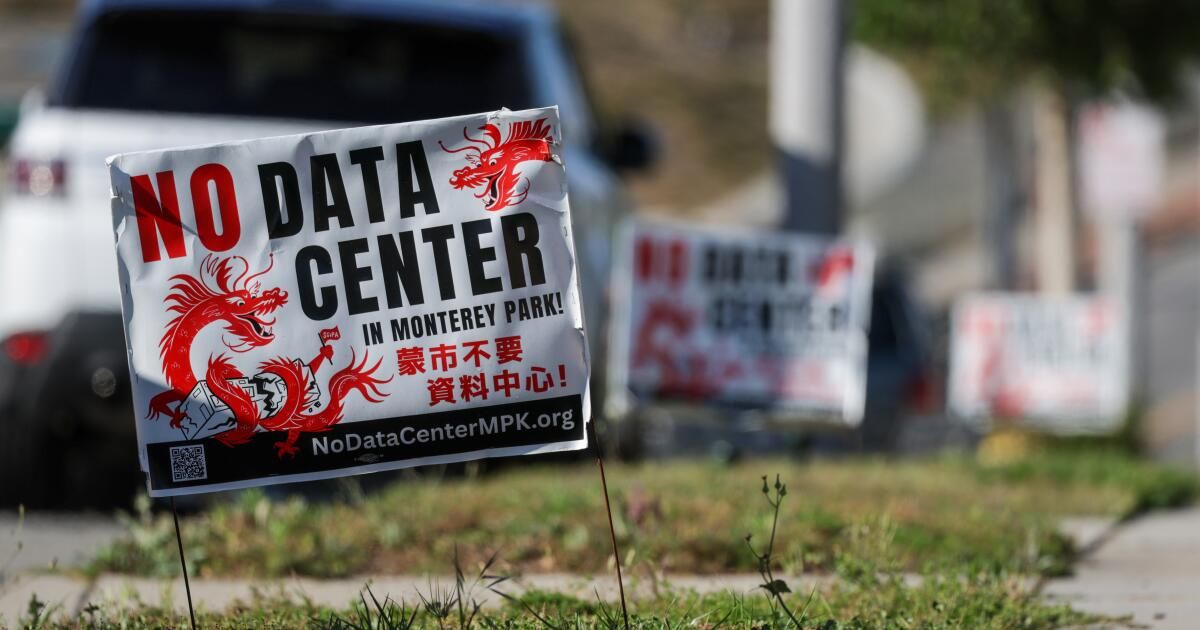
City of Monterey Park residents will be the first in the country to vote Tuesday on a permanent ban on data centers.
If passed, Measure NDC would prohibit data centers within city limits and could only be repealed by another vote.
Lawn signs reading “No Data Center” in English and Chinese with images of dragons line the sidewalks of the San Gabriel Valley city.
As a wave of opposition to data centers sweeps the country, numerous cities and counties across the United States have instituted temporary moratoriums and other restrictions on facilities. But only a handful have instituted indefinite bans, and only four other cities have put related issues to a vote.
Supporters hope the vote sets a precedent for the rest of the region, where residents are fighting proposals in Vernon and City of Industry.
“This is the most permanent ban we can get,” said Steven Kung, co-founder of the group No Data Center Monterey Park. “The winning NDC measure would send a great message to the rest of the San Gabriel Valley about how residents don't want data centers.”
The ballot measure arose from the fight against a 247,000-square-foot center proposed in 2024 by Australian-owned investment firm HMC StratCap for a residential area in Monterey Park.
The facility would have been located less than 500 feet from the nearest home and would have used three times the electricity of the predominantly Asian-American city of 60,000.
While the developer touted the potential for job creation and tax revenue, residents expressed concerns about noise and air pollution, rising electric rates and the potential for reduced property values.
The company canceled its plans in late March following public outcry and a March 4 city council vote to extend a temporary data center moratorium and ban Tuesday's vote.
In a letter to the city council, HMC StratCap said it would seek a different use for the land and would not engage in a fight over ballot measures.
The city council subsequently banned data centers indefinitely, the first in California to do so, Mayor Elizabeth Yang said. But she has still been campaigning for the measure with the other four council members.
“If a council enacts an ordinance, a future council can also reverse it,” Yang said. “With the ballot measure, unbanning it is much more difficult because the entire city needs to vote on it.”
The measure proposes the ban “to protect air quality, drinking water resources and public health” and “prevent impacts on electricity and water rates.”
While California ranks third in the country for existing data centers with around 300 facilities, it has not been a hot spot in the recent AI-powered data center boom. High electricity rates, expensive land and regulatory hurdles mean that fewer and smaller facilities are currently planned than in Virginia, Texas, Georgia, Illinois or Arizona.
“Most California data centers are small by today's standards,” said Shaolei Ren, an engineering professor at UC Riverside who studies how to reduce the environmental impacts of data centers. “Ten years ago, they would be medium-sized, but the power demand for new AI data centers has increased a lot.”
The average operational data center demands 45 megawatts, according to the Washington Post, while the planned average would consume 430 MW. The one proposed for Monterey Park would have required about 50 MW at peak demand.
As proposals emerge in Southern California, they are met with fierce opposition. Montebello, El Monte and Baldwin Park have enacted temporary moratoriums, and Alhambra recently banned data centers as part of an update to the zoning code. City of Industry, Vernon, City of Commerce and Santa Fe Springs are moving in the other direction, trying to court developers and streamline data center approvals. Community groups are fighting against it.
Outside the San Gabriel Valley, residents of Coachella and Imperial County are showing up in droves to protest local proposals.
Matthew Shaw, a volunteer with the Coalition for Responsible Data Center Development, which recently published a report on opposition to AI data centers, said a vote to ban them in Monterey Park “would lead to copycats, in part because many groups simply oppose any data center development.”
While there is no formal opposition to Measure NDC, some construction sectors like Ironworker Local 433 supported the Monterey Park data center when it was still active before the city council. Those who work in the data center industry lament the state of public opinion.
“These are multi-billion dollar assets built by multi-billion dollar companies. These things will get done,” said Mehdi Paryavi, president of the International Data Center Authority. “My biggest problem is that our industry doesn't invest enough in community engagement.”
Paryavi said cities looking to limit data centers are missing out on thousands of jobs generated by data center construction, operations and customers, as well as faster AI speeds and better performance.
Kung said local community organizers are “looking at the empirical evidence” and seeing the ban as a victory.
“We've never seen a city embrace a data center and say, 'Look how our quality of life has increased, look how all the revenue has gone toward citywide improvements,'” he said. “That just doesn't exist.”