Measles cases have reached a record high in the United States not seen since 1991, nearly a decade before the viral disease was declared eliminated.
Cases in California have also increased, with double the number so far this year than all of last year. Health officials from Los Angeles to San Francisco have been scrambling to respond to measles cases as they emerge, hoping to control new infections from travelers before they have a chance to spread.
The grim nationwide milestone comes amid a generational setback in control of the highly contagious disease, which before the vaccine era caused millions of infections a year and left between 400 and 500 people dead annually, 1,000 with brain inflammation and 48,000 requiring hospitalization.
Last year, the United States recorded three deaths from measles: two victims were unvaccinated schoolchildren in Texas and one was an unvaccinated adult in New Mexico. They were the first measles deaths in the U.S. since 2015 and the first among children since 2003.
So far this year, 2,318 cases of measles have been reported nationwide, according to the U.S. Centers for Disease Control and Prevention. This number is higher than in any calendar year since a major nationwide measles epidemic between 1989 and 1991 caused 55,365 cases in those three years: 17,914 in 1989; 27,808 in 1990; and 9,643 in 1991.
Friday's milestone was “really disappointing,” said Dr. Yvonne Maldonado, a professor of global health and infectious diseases at Stanford University, who a generation ago served on the committee that issued the report in 2000 on the “elimination” of measles in the United States, which refers to the lack of continued spread of the disease for more than a year.
“Measles is totally preventable… This is one of the few diseases that we could really eradicate from the face of the Earth,” Maldonado said in an interview. “It's not difficult to do, but we just don't seem to have the political or social will to do it.”
Last year, Canada lost the status of having eliminated measles and, according to the World Health Organization, Mexico is among the 10 countries in the world with the largest measles outbreaks.
“As mid-2026, the United States is experiencing the worst year for measles since 1991. We are witnessing a preventable crisis that disproportionately harms children,” Dr. Andrew Racine, president of the American Academy of Pediatrics, said in a statement Friday. “These thousands of cases represent real people in communities across the country, including babies hospitalized with pneumonia.”
California has better measles vaccination rates than other states. Still, experts warn that California could be susceptible to larger outbreaks if the virus reaches a group of unimmunized people.

During the 2024-25 school year, 96.1% of California kindergarten children were vaccinated against measles, above the 95% goal to protect against measles outbreaks. But most states fell below that threshold.
“If you have a community with very undervaccinated populations, then you run the risk of developing an outbreak there because there are so many people who are susceptible,” Maldonado said.
In California, 52 cases of measles have been reported so far this year, more than double the 25 reported in all of last year. There have already been three measles outbreaks this year: in Riverside County, Shasta County and another that affected both Sacramento and neighboring Placer counties. The last measles outbreak in California before this year occurred in early 2020.
The most recent outbreak, in the Sacramento Valley, began after an unvaccinated toddler contracted measles after returning from South Carolina, where an outbreak centered in Spartanburg County has been linked to about 1,000 cases, health officials said. It is considered one of the largest outbreaks in the United States in more than 30 years.
Authorities recommend that babies receive their first measles vaccine at one year of age and a second between 4 and 6 years of age. But earlier vaccination, as early as 6 months of age, is recommended for babies who are about to travel abroad or to domestic areas where there are measles outbreaks, the Los Angeles County Department of Public Health said.
Measles outbreaks can quickly get out of control if the virus reaches a group of unvaccinated people. The measles outbreak at Disneyland that occurred between December 2014 and April 2015 caused 131 cases among Californians and spread to people in six other states, as well as Canada and Mexico. Among measles cases in California, at least 12 of those infected were babies too young to be vaccinated.
Measles is one of the most contagious viruses known to humanity, and 90% of those who are unvaccinated and exposed to it will contract the disease, California health officials say.
Nationally, measles vaccination rates have been declining, falling below the 95% threshold that experts consider necessary to prevent widespread outbreaks. During the 2024-25 school year, only 92.5% of kindergartners nationwide had received the measles vaccine, down from 95.2% during the 2019-20 school year, according to the CDC. More than half of states experienced declines in measles vaccination compared to the previous year, the CDC said.
California measles vaccination rates among kindergartners remain above the 95% threshold. In 2024-25, 96.1% of California kindergarten children were vaccinated against measles. But there are some counties where vaccination rates are below target; In Southern California, there are San Diego and San Bernardino counties, which have measles vaccination rates of 93.7% among kindergarten children.
Other counties with rates below 95% are Calaveras, Del Norte, El Dorado, Glenn, Humboldt, Kern, Nevada, Santa Cruz, Shasta, Sierra, Sutter, Trinity and Tuolumne.
Of the measles cases reported nationally this year, 93% occurred among people who were unvaccinated or whose vaccination status was unknown, the CDC said. Of those infected, 49% were between 5 and 19 years old and 20% were under 5 years old. This year, more than 150 measles patients had to be hospitalized.
The measles surge comes as the nation's top health agency, the Department of Health and Human Services, is led by a vaccine skeptic, Robert F. Kennedy Jr.
Earlier this year, Kennedy defended his record, telling a congressional committee that “there is a global measles epidemic. We have done better to prevent it than any country in the world.” Critics have accused Kennedy of spreading misinformation about the safety of the measles vaccine.
“The anti-vaccine rhetoric you used and the anti-vaccine actions you have taken over the last year clearly correlate with the dramatic increases, again, in preventable diseases,” Rep. Linda T. Sánchez (D-Whittier) told Kennedy at a House committee hearing.
Kennedy has said he is not against vaccines.
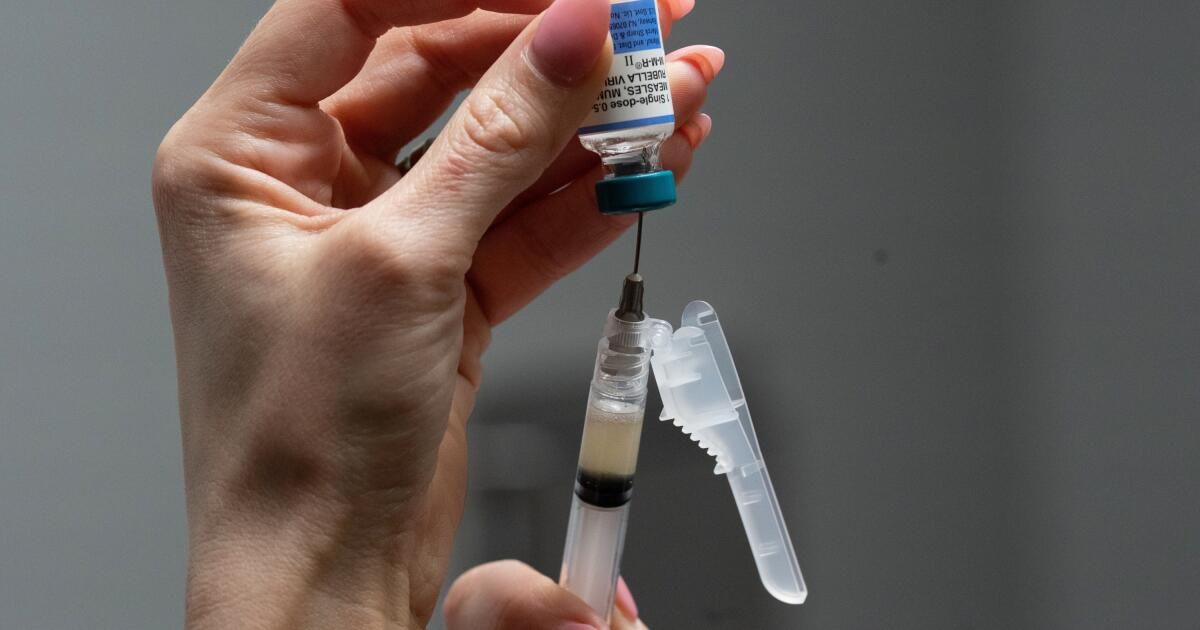
The measles vaccine is very effective and is considered safe by traditional doctors and scientists. “We have been using essentially the same vaccine since the 1960s, literally for 60 years,” Maldonado said. “It still works. It's remarkably safe.”
A study co-authored by Maldonado and published in the Journal of the American Medical Assn. in 2025 said that if there is a 50% decline in childhood vaccinations in the US, there would be 51.2 million cases of measles over a 25-year period, as well as 9.9 million cases of rubella (which can cause serious birth defects in pregnant women), 4.3 million cases of polio, and 10.3 million hospitalizations and nearly 160,000 deaths.
Experts say the rise in measles is because misinformation about the vaccine is rampant and is causing a rise in vaccine refusal rates.
The American Academy of Pediatrics has accused federal leaders of downplaying the risk of measles and providing misinformation about the vaccine that protects against measles, mumps and rubella.
“Since early last year, federal leaders have dismissed measles as benign and inevitable and have spread misleading information about the MMR vaccine,” Racine said. “Today I want to remind parents that measles is not just a rash. The virus can disrupt the immune system's memory, making a previously healthy child much more likely to get sick from any type of infection.”
About 1 in 20 children who get measles will get pneumonia; About 1 in every 1,000 children who get measles will develop inflammation of the brain, which can lead to seizures and deafness or intellectual disability; and between 1 and 3 in every 1,000 children with measles will die, the CDC says.
People might think 2,000 cases of measles aren't a big deal, Maldonado said, but he noted that measles can increase quickly.
“The more cases you have, the more likely you are to have children, immunocompromised people and elderly people in the hospital on ventilators or even dying,” Maldonado said. “I thought we were going to make America healthy again, and one way to do that is to just keep people from getting sick.”