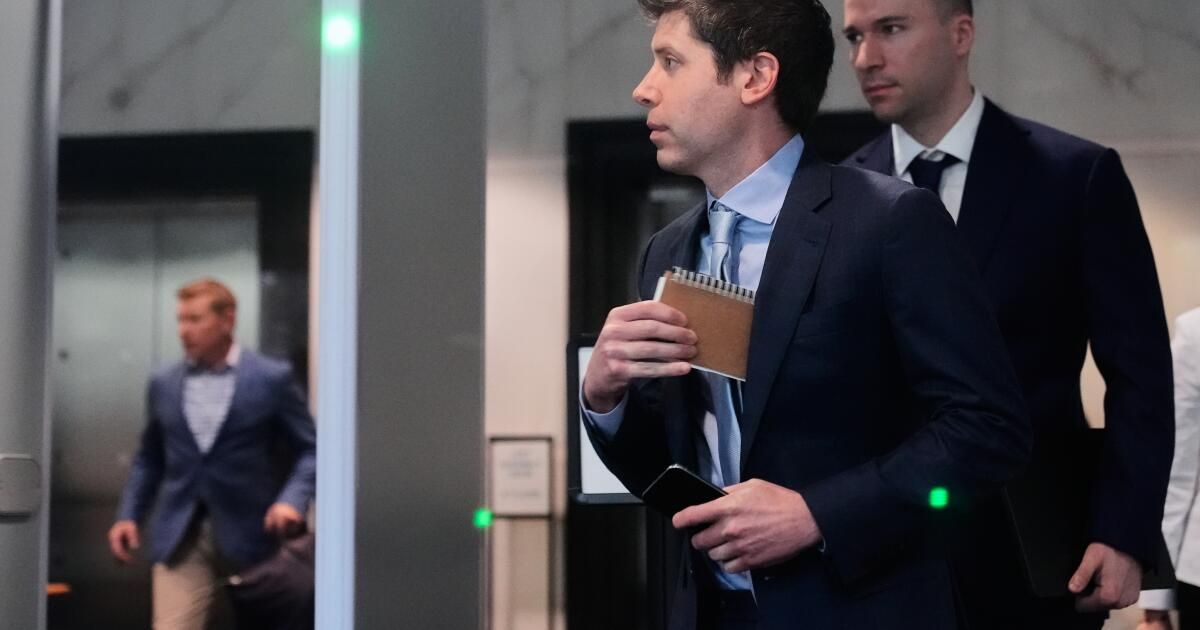
A federal jury sided with OpenAI and its top executives on Monday in a dispute with Elon Musk, who accused them of betraying a shared vision of guiding the development of artificial intelligence as a nonprofit organization.
The nine-person jury unanimously determined that Musk waited too long to file his lawsuit and missed the statute of limitations.
Musk, the world's richest man, co-founded OpenAI, the company that launched in 2015 and later created ChatGPT. After investing $38 million in its first few years, Musk accused OpenAI CEO Sam Altman and his top deputy of turning to money-making behind his back.
The jury played an advisory role, but U.S. District Judge Yvonne Gonzalez Rogers accepted Monday's verdict as the court's own and dismissed Musk's claims.
“I believe there is a substantial amount of evidence supporting the jury's conclusions,” Rogers said as he accepted the jury's conclusion after about two hours of deliberation.
The trial that began April 27 in Oakland shed light on the bitter dispute between the two Silicon Valley titans and on the origins of OpenAI, now a company valued at $852 billion and on track to potentially achieve one of the largest initial public offerings in history.
“The jury wasted no time, taking 90 minutes to determine that Elon Musk's claims against OpenAI for breach of charitable trust and unjust enrichment were brought too late under the respective statute of limitations,” noted Edward Lee, a law professor at Santa Clara University, on his blog.
Microsoft, which is one of OpenAI's largest shareholders and customers, applauded the decision.
“The facts and timeline of this case have long been clear, and we welcome the jury's decision to dismiss these claims as untimely,” the company said in a statement. “We remain committed to our work with OpenAI to advance and scale AI for people and organizations around the world.”
The high-profile, high-stakes showdown between two of the most powerful companies and leaders in technology was billed as a battle that could change the trajectory of AI.
There were weeks of testimonies from grieving entrepreneurs and other key players in OpenAI's story, providing a rare look inside the company, which evolved from a startup to one of the world's most influential firms.
The test revealed more than a decade of corporate documents, private message exchanges, and even private diary entries, providing unprecedented insight into the sometimes chaotic inner workings of OpenAI.
Musk's main claim was that the co-founders had manipulated him into donating millions of dollars and eventually turned OpenAI into a for-profit company.
OpenAI's lawyers argued that Musk was not only aware of the move, but wanted full control of the for-profit company. Lawyers argued that when Musk's wish was denied, he started his own company, xAI, which will soon go public as part of SpaceX.
Musk had fallen out with his fellow co-founders and then, after OpenAI became arguably the biggest company in AI, decided he wasn't happy with the way the pioneer was being managed after his departure.
Musk claimed that Altman, the startup's CEO, and OpenAI president Greg Brockman “robbed a charity” by exploiting their initial support for an altruistic research project and then enriching themselves by becoming a regular for-profit company.
OpenAI and its leaders said Musk was suing them to gain a competitive advantage for his own startup, xAI.
“This is a big win for Altman and OpenAI despite the scratches and bruises on Altman's personality and leadership, as it eliminates significant excess in the company's operations and this is now considered a 'zero impact' for OpenAI,” Wedbush technology analyst Dan Ives wrote in an analyst note.
Musk was seeking more than $100 billion in damages (to be awarded to the nonprofit arm of OpenAI rather than himself), as well as the removal of Altman and Brockman.
The case was seen as an existential threat to OpenAI. If the decision had been reversed, it would have triggered a restructuring that would have destabilized the company just as it is working to ensure that the United States takes the lead in AI and prepares for a public offering with a valuation close to $1 trillion.
Bloomberg contributed to this article.