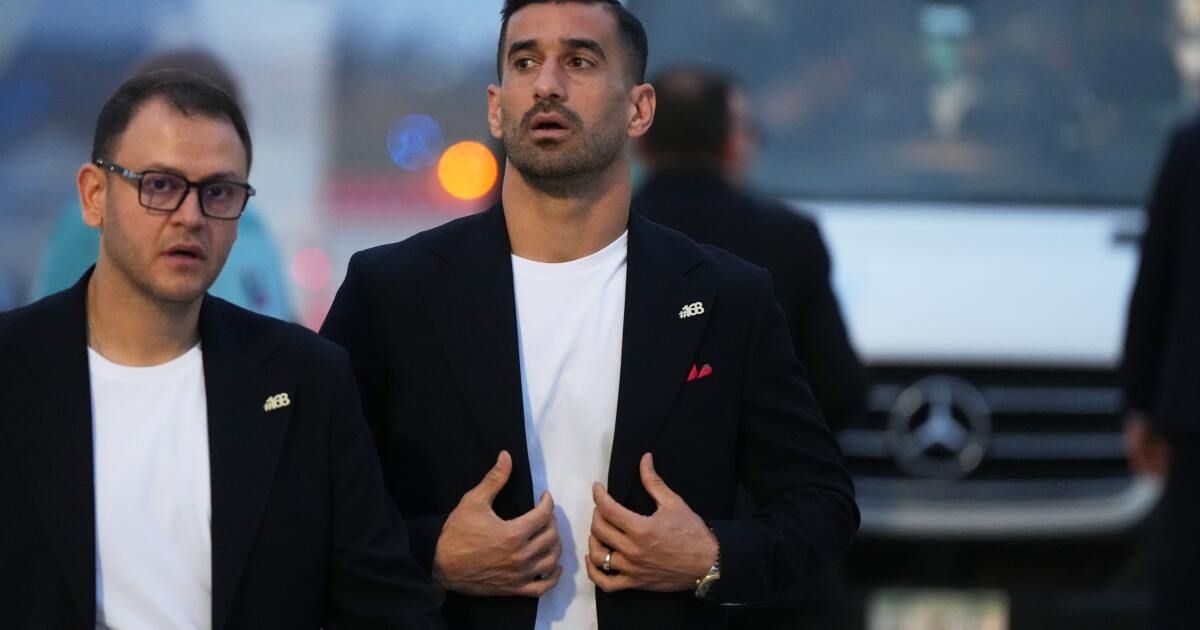
The Iran World Cup team's ferry between Mexico and the United States docked in Tijuana on Sunday with an accessory.
The players arrived in Tijuana wearing gold pins on the lapels of their jackets recognizing the victims of the missile attack on an elementary school that occurred on February 28 at the beginning of the war in their country.
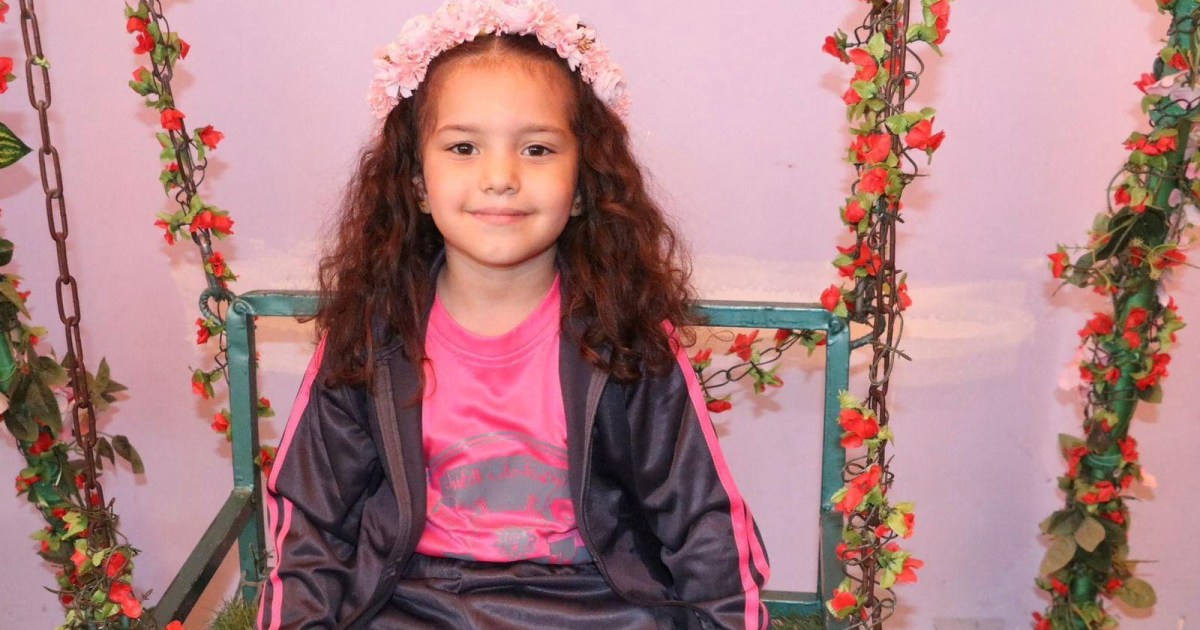
The pins simply say “#168,” replicating the hashtag for the number of people killed in the daytime attack in Minab, southern Iran. Most of the victims were girls who attended Shajareh Tayyebeh Primary School.
The Iranian delegation flew on a private jet from Türkiye to Tijuana. Mehdi Taj, president of the Iranian Football Federation, said two weeks ago that the training base would be in Mexico instead of Tucson.
FIFA has not given a reason for the change, although there have been delays in processing US visas for some Iranian players and other members of the delegation who reportedly have ties to the Revolutionary Guard.
Iran is preparing to play its three group stage matches in the United States, with the first scheduled for June 15 against New Zealand at SoFi Stadium (called Los Angeles Stadium during the World Cup). Their second match, on June 21 against Belgium, is also scheduled in Los Angeles and the third match will take place on June 26 in Seattle against Egypt.
It is unclear whether FIFA, the World Cup governing body, would allow anyone on the bench to wear the pins during matches. That would include coaches and other team personnel in addition to the players.
FIFA took no action in response to previous displays of memorabilia by Iranian players and has not commented on the legality of wearing the badges. FIFA rules state that “equipment must not have political, religious or personal slogans, statements or images.” The rule applies to players, coaches and officials who are on the sidelines during games.
Iran's team twice acknowledged the victims of the airstrike during Iran's national anthem before warm-up matches in March. In the first, players held purple school backpacks decorated with bows. In the second, the players held images of the deceased.
Before the most recent warm-up matches, the Iranian team stood with its right hand on its chest during the anthem. And in early March, some members of Iran's women's soccer team remained silent during the national anthem at an Asian Cup match, prompting Iranian state television to call them “wartime traitors.”
Video footage analyzed by research group Bellingcat appears to show a US Tomahawk missile hitting the school, which was adjacent to a compound associated with the Iranian Revolutionary Guard and its naval brigade barracks. The United States has not accepted responsibility for the attack, although the military is investigating.
Upon arriving in Tijuana, the captain of the Iranian team, Ehsan Hajsafi, criticized FIFA for the delay in obtaining visas.
“First of all, we are very happy that the team has finally arrived and we are delighted about it,” Hajsafi told reporters. “Thank God the condition of the team is very good.
“With everything that happened, in the end the visas were granted. But I personally have a complaint about FIFA. Why did it take so long? As I understand it, the visas were granted only to the players and some members of the coaching staff.”
Ahead of the 2022 World Cup in Qatar, Hajsafi spoke boldly about the government's crackdown on mass protests in Iran.
“First of all, I would like to express my deepest condolences to all the bereaved families in Iran,” Hajsafi said. “They must know that we are with them, we support them and we sympathize with them. We cannot deny the conditions; the conditions in my country are not good and the players know it too.”
The Associated Press contributed to this story.