Mukalla, Yemen – Weeks before this year's World Cup began, Adel Mohsen's backup battery broke and he couldn't afford to replace it, meaning he would have no power at home when the electricity regularly goes out.
Fuel shortages also affected his hometown of Mukalla in eastern Yemen, forcing him to struggle to get enough for his motorcycle and restricting his ability to get around and watch matches outdoors.
Recommended stories
list of 3 itemsend of list
Adel is frustrated. The 56-year-old football enthusiast has watched every World Cup since 1982, braving wars, economic collapse and political turmoil. But this year, he can't escape the reality that more than a decade of war and economic hardship has brought to Yemen.
“I think this is the worst World Cup,” Adel told Al Jazeera, sitting on a wooden bench as his eyes focused on a giant public screen in a local stadium. “I could miss a lot of games due to power outages.”
Despite paying for a subscription to a local television service that broadcasts the games, Adel couldn't come up with the $200 needed for a backup battery at home, nor could he afford the internet vouchers needed to stream the games on his cell phone.
The local stadium was, therefore, the best option for the 2026 World Cup.
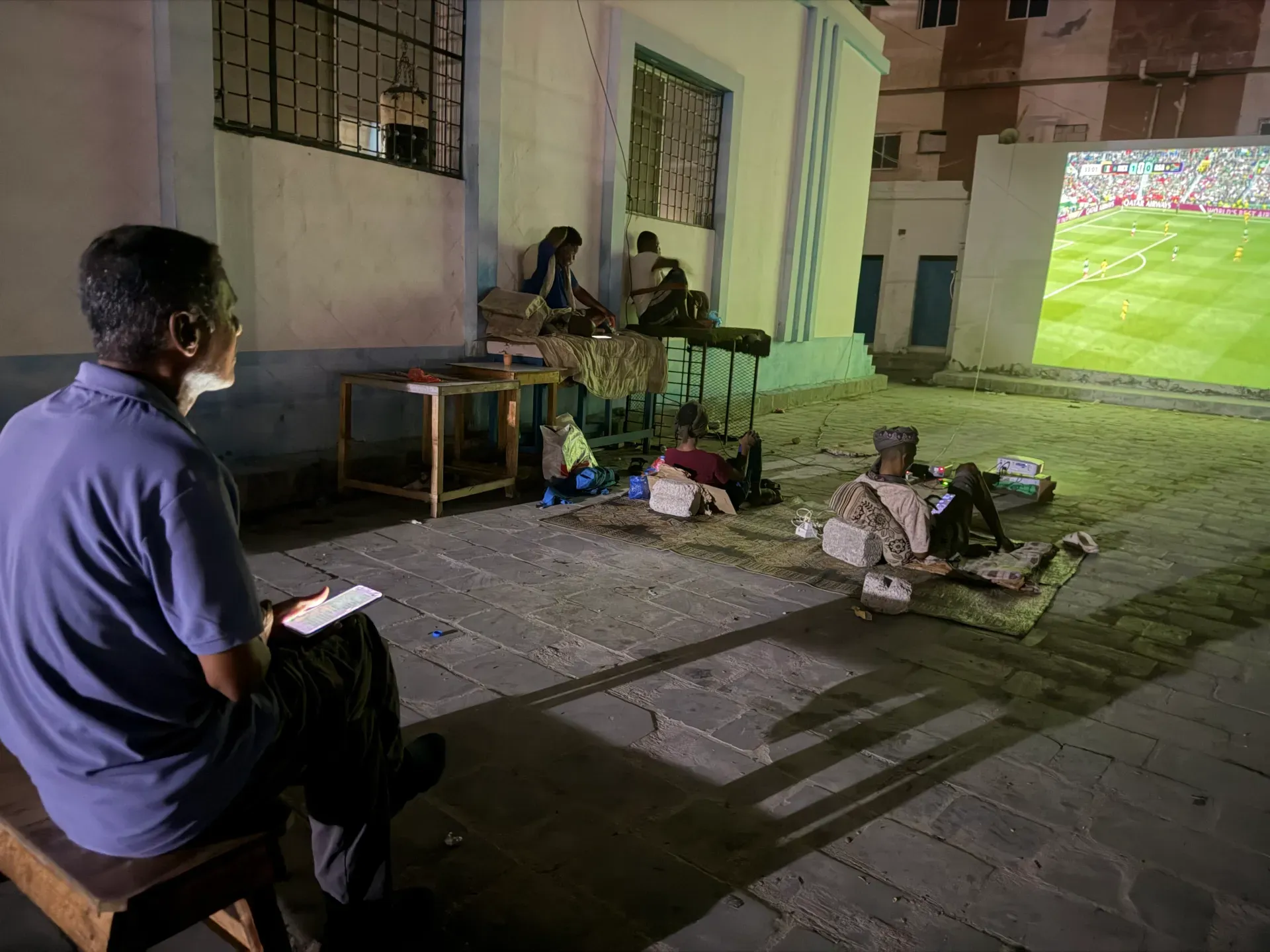
Shortly before the opening match between South Africa and Mexico, the sound of generators echoed through the area and the projector came to life just minutes before kick-off.
The courtyard was dark and the floor was paved with worn stone flags. Two men sat chewing qat, stimulant leaves widely consumed in Yemen, leaning their backs against cement blocks. Some others rested on a raised platform, scrolling through their cell phones while they chewed. The heat and humidity were intense; everyone was sweating.
Adel quickly went into World Cup mode.
“The Mexicans will continue attacking until they score a goal,” he said, looking at his old cell phone to review notes he hoped to use later in his analysis for local television or social media.
His prediction came true shortly after, when Mexico scored the first goal. “Now I see games through the eyes of an analyst and not as a casual fan,” he explained. “There are few spectators here, as you can see, since neither team is very popular. Matches between big teams, like Brazil, or Arab teams, tend to attract much larger crowds of fans.”
In 1982, the FIFA World Cup was held in Spain, just a few years after television first came to Mukalla and other cities in the former People's Democratic Republic of Yemen (PDRY), more commonly known as South Yemen.
Adel was 12 years old at the time and clearly remembers where he and other fans would gather to watch the games.
“That was like a first lover etched in memory,” he said with a smile. “Although I was only a child at that time, I still remember the names of the players and the stadiums where those matches were played. Brazil had one of its greatest generations, with stars like Zico, Falcao and Eder. They gave magnificent performances. The tournament was marked by the hard play of the Italian defenders, especially [Claudio] Gentile, whose violent tactics went unpunished.”
Adel found himself glued to the television with his father and brothers, watching the tournament together.
“The atmosphere around the games was family-oriented; we loved sports,” he said. “Those who didn't have televisions gathered at neighbors' houses to watch together.”
At the time, matches were recorded in Aden, the capital of South Yemen, and then sent on tape by bus to the Mukalla television station, meaning fans there watched the matches a day later. “As it was the first tournament that people experienced on television, they were deeply impressed and enjoyed the matches as if they were live.”
![Escaping homes where power outages, intense heat and high humidity have turned rooms into ovens, football fans in Mukalla gather in public places and cafes to watch World Cup matches. [Saeed Al-BatatiAl Jazeera]](https://www.aljazeera.com/wp-content/uploads/2026/06/Escaping-homes-where-power-cuts-intense-heat-and-high-humidity-have-turned-rooms-into-ovens-football-fans-in-Mukalla-gather-at-public-venues-and-cafes-to-watch-World-Cup-matches.-Saeed-Al-BatatiAl-Jazeera-1781797964.jpg?w=770&resize=770%2C578&quality=80)
In January 1986, thousands of people were killed and injured in Aden when infighting broke out between rival factions of the ruling Socialist Party. Months later, when the dust settled and the defeated soldiers fled to North Yemen, the victors consolidated control over the country. That same year, Mexico hosted the World Cup.
Adel was 16 years old and glued to the same television in the same room of his family's house. “I was in high school and watching games with a deeper appreciation for the game, not just as a spectator,” he recalled. “That tournament was [Diego] “Maradona.”
In 1990, the year North and South Yemen were united, Mohsen was a 20-year-old footballer playing as an amateur for local clubs. Watching the World Cup in Italy, he studied tactics and skills, replicating them during training sessions and matches in Sanaa, Aden, Hodeidah and Taiz.
But the unit's honeymoon didn't last. In 1994, civil war broke out, and when the World Cup began in the United States, the fighting spread fear in Yemeni cities.
“That was the worst World Cup I've ever seen in my life,” he said. “It was the most difficult tournament because people were worried about the war and what would come next. Security was unstable and frequent power outages made it even more difficult to follow the games. I would watch one game and then miss three.”
Looking against the odds
As Adel grew older, he resumed his role as a spectator of the game, rather than a player.
Yemen was also going through a less tumultuous period after the 1994 civil war, when then-president Ali Abdullah Saleh and his predominantly northern forces emerged victorious. Relative stability followed, and the 1998, 2002, 2006 and 2010 tournaments were easy for Adel to follow.
But then came the 2014 World Cup in Brazil, just as Yemen sank deeper into instability. Al Qaeda in the Arabian Peninsula (AQAP) intensified attacks, while Houthi rebels expanded beyond their stronghold in the north. “The country was entering a new political and economic crisis,” Adel said.
Mukalla has largely avoided battles within the city in the 12 years of war that followed, with some exceptions, such as the late 2025 conflict between the internationally recognized government and the separatist Southern Transition Council.
It is often financial problems and lack of services that prevent Adel from watching his favorite sport.
But despite power outages, mounting economic pressures and criticism from those who see sport as a luxury in a country beset by crises, Adel remains determined to continue a ritual that has sustained him for more than four decades.
“I see sports as a relief from difficulties,” he said, shifting on the wooden bench as the glow of the giant screen illuminated his sweat-soaked face. “People ask why we talk about football when there are so many problems. What do they want us to do, commit suicide? Sports give us a brief escape from all the difficulties around us.”
And Adel has a prediction for this year's winner: France.