Supported by the governments of Benin, Kenya, Namibia, Nigeria and Togo, Africa Umoja AI builds on the momentum of the Global AI for Good Commission to promote trustworthy and inclusive AI in Africa, by Africa and for Africa.
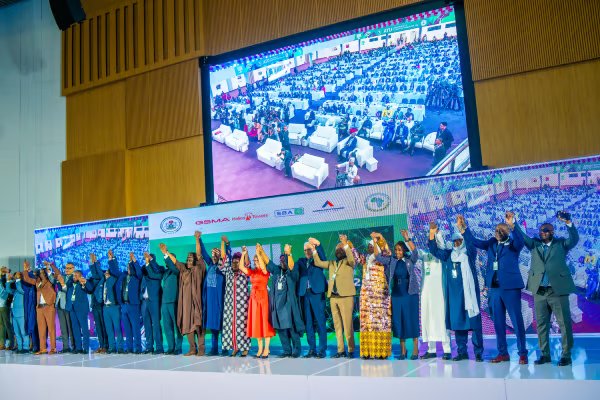
July 24, 2026, Abuja: The GSMA supports the Abuja Ministerial Declaration on Meaningful Connectivity for Africaby Ministers and Heads of Delegation at the African Telecommunications Union (ATU) Plenipotentiary Conference (CPL-2026), describing it as an important milestone in strengthening Africa's digital future through evidence-based policies, investments and regional collaboration.
The Declaration commits African governments to promote policies that promote meaningful connectivity, digital inclusion, technology-neutral regulation, resilient digital infrastructure and locally relevant digital services. It also reinforces the importance of collaboration between governments, industry and development partners to close the continent's connectivity and use gaps.
Throughout the conference, the GSMA has worked alongside governments, regulators and industry leaders to support these shared ambitions through practical policy engagement, evidence-based research and new collaborative initiatives designed to accelerate Africa's digital transformation.
Speaking during ATU-GSMA African ICT Regulatory Leaders ForumPolicymakers and regulators explored how stronger evidence-based regulation, greater regulatory harmonization and future-proof policy frameworks can create an enabling environment for investment, innovation and sustainable digital growth across Africa. Drawing on insights from the GSMA Digital Africa Index, participants also examined future-proof approaches to satellite regulation, highlighting how technology-neutral licensing frameworks can support innovation while extending connectivity to underserved communities.
Caroline Mbugua, Senior Director of Public Policy, Africa, GSMA, saying: “The Abuja Ministerial Declaration sends an important signal that African governments share a common vision to deliver meaningful connectivity through modern, evidence-based and investment-friendly policies. “Its emphasis on digital inclusion, technology-neutral regulation, resilient infrastructure and stronger regional collaboration reflects the practical policy foundations needed to accelerate Africa’s digital transformation.”
ATLAS Umoja AI released
In support of the ambitions set out in the Abuja Declaration, the GSMA, the Ministry of Communications, Innovation and Digital Economy of Nigeria, the Ministry of Economy and Digital Transformation of Togo, the Ministry of Information, Communications and Digital Economy of Kenya, the Ministry of Information and Communications Technology of Namibia, the Ministry of Innovation and Digital Transformation of Benin, Awarri, Zindi, Pawa AI and Mozisha announced today ATLAS Umoja AI –a new pan-African initiative to strengthen collaboration on AI in African languages.
Designed to complement national AI programs, ATLAS Umoja will bring together governments, industries and researchers to share expertise, data sets and best practices, helping to develop reliable and scalable AI that better reflects Africa's languages, cultures and development priorities. The initiative aims to accelerate innovation, attract investment and scale African-language AI across the continent.
The launch builds on momentum from the newly created AI for Good Global Commission. Ministers from Nigeria, Namibia and Togo, who sit on the Commission, have committed to supporting Africa Umoja, demonstrating how African leaders are turning global ambitions for trustworthy and inclusive AI into practical regional collaboration.
Angela Wamola, Africa Director, GSMAsaying: “The future of AI in Africa must reflect Africa's own languages, communities and development priorities. ATLAS Umoja brings together governments, industries, researchers and innovators to build AI in African languages at scale. By making AI and digital services available in the languages people speak every day, the initiative will help address two of the biggest barriers to Internet adoption: digital literacy and locally relevant content, supporting efforts to close Africa's usage gap and expand meaningful connectivity across the continent.”
Dr. Bosun Tijani, Honorable Minister of Communications, Innovation and Digital Economy of Nigeria saying:“Artificial intelligence will be a technology that defines Africa's future, but its benefits must be based on our own languages, cultures and knowledge systems. Nigeria is proud to have taken the first step through N-ATLAS and is equally proud to see that vision evolve into continental ATLAS Umoja AI. By working together with governments, researchers and ecosystem partners across Africa, we can build AI that is more inclusive, locally relevant and accessible to millions of people, while strengthening Africa's digital sovereignty and creating new opportunities for innovation, education and economic growth.
Silas Adekunle, Founder and CEO, Awarri aggregate: “Awarri is proud to support ATLAS Umoja AI and bring lessons from N-ATLAS, which has demonstrated what is possible when you bring together African language data, local technical talent and practical AI applications. This is an important opportunity to help build AI systems that work for African languages and communities.”
Celina Lee, CEO and co-founder of Zindi concluded: “The future of AI in Africa will be built by the people who best understand their languages, cultures and communities. Through ATLAS Umoja AI, we have the opportunity to empower local researchers, data scientists and developers to solve significant challenges, strengthen national AI capabilities, and ensure that AI in African languages is developed by Africans, for Africans.”
In addition to the launch of ATLAS Umoja AI, the GSMA continued discussions with policymakers at the ATU Conference on future-proof regulatory frameworks, including satellite connectivity, spectrum policy and technology-neutral licensing. Drawing on the GSMA Satellite Regulation Handbook, discussions explored how modern regulation can encourage investment, expand meaningful connectivity and support the ambitions of the Abuja Declaration.
Together, the Abuja Declaration, ATLAS Umoja and continued collaboration between governments, regulators and industry represent an important step towards expanding meaningful connectivity, accelerating digital inclusion and supporting Africa's digital transformation.
-ENDS-
About the GSMA
The GSMA is a global organization that unifies the mobile ecosystem to discover, develop and deliver innovation critical for positive business environments and social change. Our vision is to unlock the full power of connectivity so that people, industry and society thrive. Representing mobile operators and organizations across the mobile ecosystem and adjacent industries, the GSMA offers its members three broad pillars: connectivity for good, industry services and solutions, and outreach. This activity includes policy advocacy; address today's biggest social challenges; underpin the technology and interoperability that make mobile devices work; and provide the world's largest platform to bring together the mobile ecosystem at the MWC and M360 series of events.
Media contact
GSMA Press Office
press [email protected]