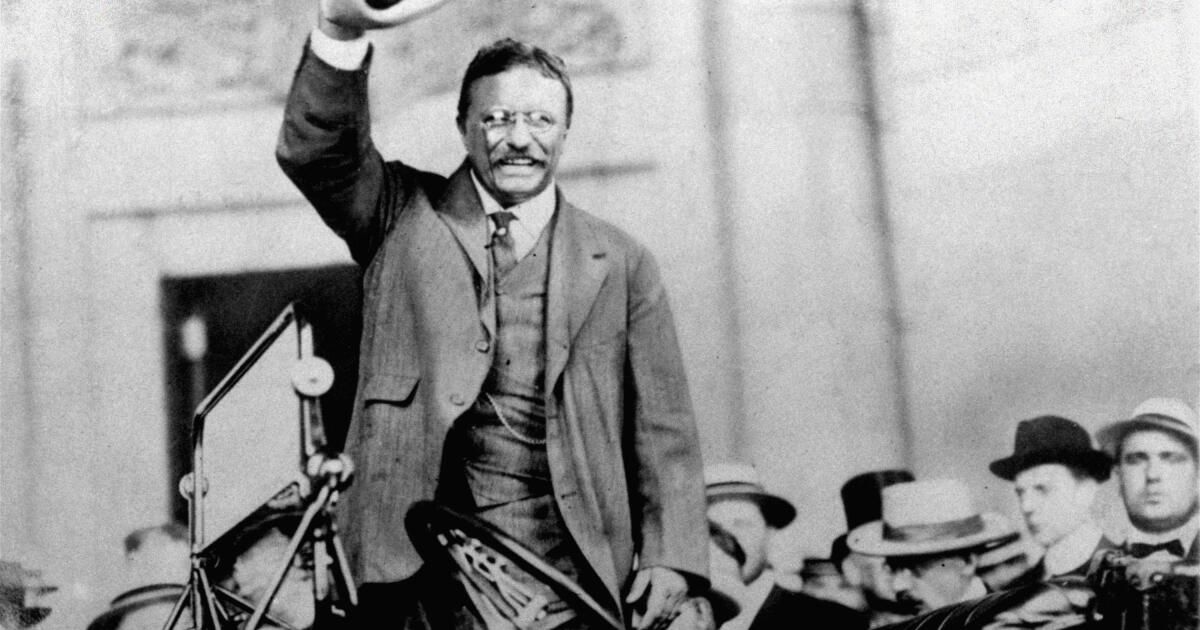
On Columbus Day 1915, a crowd of nearly 2,000 packed New York's Carnegie Hall to hear Theodore Roosevelt explains what it meant to be an American. Although the nation shared ties of blood and culture with many lands, the former president explained, “we are a new and different nationality.” Possessing its own “culture and civilization,” the nation depended on the commitment of its people to its distinctive principles and heritage for its survival. In that fight, Roosevelt declared that “there is no place in this country for a hyphenated Americanism.”
His speech joined an ongoing, still persistent debate about the nature of American identity: whether people from other countries could one day become fully American, whether “Americanism” derived from blood or from a set of ideas. Then and now, the answers to those questions would shape how the nation responded to the diversity around it. Should the United States restrict immigration, closing its doors to peoples other than its white Anglo-Saxon Protestant majority? Should he, as Roosevelt hoped, combine multiple nationalities into a uniform melting pot? Or could it encompass what one of Roosevelt's contemporaries, the journalist Randolph Bourne, called his “unique sociological fabric” – many cultures “mixed, but not fused”?
The issue could not have been more urgent when Roosevelt addressed a largely Italian-American audience at a critical moment in the nation's history. As World War I consumed Europe, many Americans worried about the loyalties of the country's immigrant populations should the United States enter the conflict. Many Americans traced their ancestry to Germany and the lands of the Austro-Hungarian Empire that would become enemies; Millions of Irish Americans hated the British, who would become America's main ally. How might they react to a declaration of war?
But Roosevelt's Columbus Day speech reflected a deeper and lasting concern. Between 1880 and World War I, 20 million foreigners had immigrated to the United States. Nearly 7 million people entered the country between 1900 and 1910 alone. That was almost 10 times the annual average of the 1850s, the previous great wave of arrivals. By 1915, newcomers and their young native children made up the majority of many major American cities.
No wonder, then, that in the early 20th century, Americans wondered whether the nation could adapt to this massive wave of immigration and still retain its national identity and democratic institutions. Many saw the newcomers as a deadly threat; For these nativists, the white Anglo-Saxon Protestant heritage defined America. Promoting a racial or ethnic version of American nationalism, nativists viewed immigrants as genetically inferior. They not only undermined the racial purity of the nation, but also degraded its culture with their rude customs and spicy foods. Unable to vote and easily manipulated by corrupt bosses, immigrants, nativists insisted, also threatened American democracy.
At Carnegie Hall, Roosevelt attacked those ideas. “Hyphenated Americans,” he explained, referred to those who did not embrace the nation’s democratic heritage: many of the “best Americans I ever knew were naturalized Americans, foreign-born Americans.”
Championing a civic notion of national identity, Roosevelt made clear that being American was not a question of where you came from, what religion you practiced, or what food you ate. “Americanism,” the former president insisted, “is a matter of spirit and soul.” It involved unwavering loyalty in times of trouble and devotion to the ideals that the United States was “founded to perpetuate”: civic and religious liberty and equal opportunity. Roosevelt mocked those who emphasized their status as native Americans, who placed themselves separate and above their fellow citizens based solely on their ancestry. They had divided their Americanism as much as the immigrants who still professed loyalty to the lands of their birth.
But generous as he was, Roosevelt's civic nationalism did not welcome ethnic diversity. It drove assimilation into a single, composite American culture. On the one hand, that inclusive vision allowed almost anyone to become an American. On the other hand, however, Roosevelt insisted that the newcomers discard their cultures. This melting pot version of civic nationalism prohibited any type of mixed or dual identity.
A year later, Bourne joined the debate in the Atlantic Monthly. Like Roosevelt, the young journalist dismissed the racial nationalism of the nativists; that “belligerent and exclusive inbreeding” had led the nations of Europe into a war that he still hoped the Americans could avoid. The nation, he asserted, should be “what the immigrant will help make…and not what a ruling class, descended from those British lineages who were the first permanent immigrants, decides America will become.”
Bourne found Roosevelt's vision unrealistic and undesirable. Immigrants naturally preserved many aspects of the cultures they brought to the United States. They founded foreign-language newspapers and schools, supported ethnic businesses, and cultivated the “literatures and cultural traditions of their countries of origin.” Advocating an “ideal higher than the melting pot,” Bourne envisioned a cosmopolitan, “transnational America.” By embracing cultural diversity, the United States would cast aside “tired old nationalism” and become a new and entirely different kind of nation: a tapestry of distinct groups living side by side. Bourne found it impossible “not to be moved by the incalculable potentialities of such a novel union of men.”
This debate from the beginning of the 20th century has repercussions on contemporary political struggles. A year ago, Vice President JD Vance took up Roosevelt's question in a speech at Claremont Instituteasking “in 2025 what will an American be?”
Rejecting his predecessor's rooting of American identity in a set of “creedal principles,” Vance attacked the idea that immigrants who embraced American ideals had greater rights to citizenship than native-born Americans who rejected democratic principles (whom some groups labeled “extremists”), even though “their ancestors were here at the time of the Revolutionary War.” The United States, Vance asserted, “was not just an idea.” It also involved ties of blood and land; It was a “particular place with a particular people.”
More than a century ago, in the midst of another era of mass immigration and global conflict, Theodore Roosevelt and Randolph Bourne began a still-unresolved debate about the meaning of the United States. Should American identity be defined by race and ethnicity? Or out of fidelity to a set of ideas? Should the nation function as a melting pot requiring assimilation to a common set of norms? Or could it aspire to become a mosaic of diverse groups that retain their distinctive identities? Now, 110 years later, on the nation's 250th anniversary, those questions remain unresolved.
Bruce J. Schulman is a history teacher at Boston University.