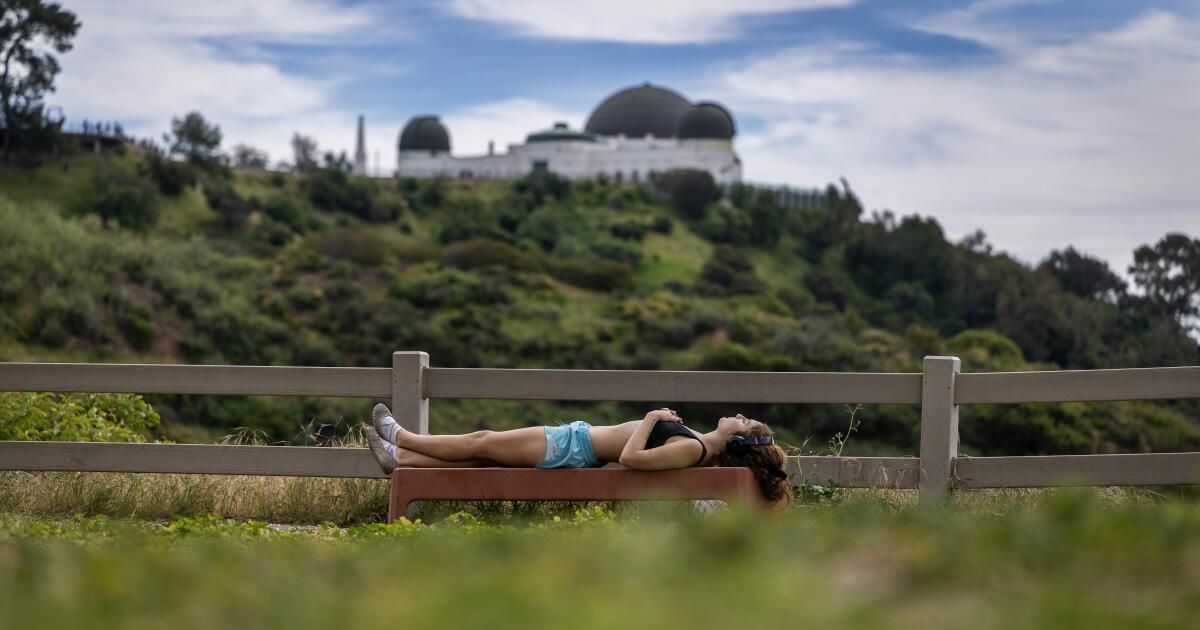
to the editor: Thanks to columnist Patt Morrison for her wonderful story of some of our parks and the lack of parks in the city of Los Angeles (“Feeling a little crowded in the park? Why are Los Angeles park spaces falling short?” May 6).
Readers should also know about the current effortas part of charter reform, to place a measure on the ballot in November to allow our city parks to receive adequate funding.
Our entire city park system, including all recreation programs, senior centers and other services provided in those parks, has had the same percentage of the city budget. since 1937.
As a recent member of the Charter Reform Commission, I urge Angelenos to contact their City Council members and ask to put a measure on the November ballot so we can move from 0.033% to 0.066% of the city's annual budget for our parks (yes, you read correctly; still less than 1% of the annual budget).
Everyone knows the value of parks, open spaces, recreational programs, etc. Can we persuade our council and then our voters on this important issue?
Mona Field, Eagle Rock
..
to the editor: I appreciated and agreed with Morrison's lament about the lack of parks in Los Angeles. If only that 1927 plan she mentions hadn't been dropped at the end of the Santa Monica Pier, never to see sunlight!
But there's one big oversight: Topanga State Park it is said be the largest wilderness area within a city limits anywhere in the world. That may not help the good people of Maywood or others “who truly deserve the dignity of beautiful parks” near them, but surely our 11,000 acres of beautiful wild nature count for something.
Susan Hanger, Topanga
..
to the editor: Kudos to Morrison for pointing out the need for more park space in Los Angeles. How appalling that there is more paved parking space in the city than park space.
Morrison touched only the tip of the problem. Even park spaces, with their acres of grass, do not solve the serious problem of declining biodiversity in our community and in the world. Of course, concrete inhibits the interaction of flora and fauna, but a massive expanse of grass is basically an ecological desert. Grass is useful for picnics and children's play areas, but otherwise it doesn't serve us well.
We need to bring back native plants in abundance to encourage biodiversity, not just in parks, but outside as well. Patios, balconies, window boxes and container gardens can be magnets for native wildlife. Imagine dividing strips, shopping center boundaries, and corporate office building roofs planted with native flora, in hopes of creating corridors for the movement of native wildlife.
Los Angeles is home to almost 4 million people that depend on biodiversity to survive. We don't have to live in a concrete jungle.
Margaret Baker Davis, Claremont