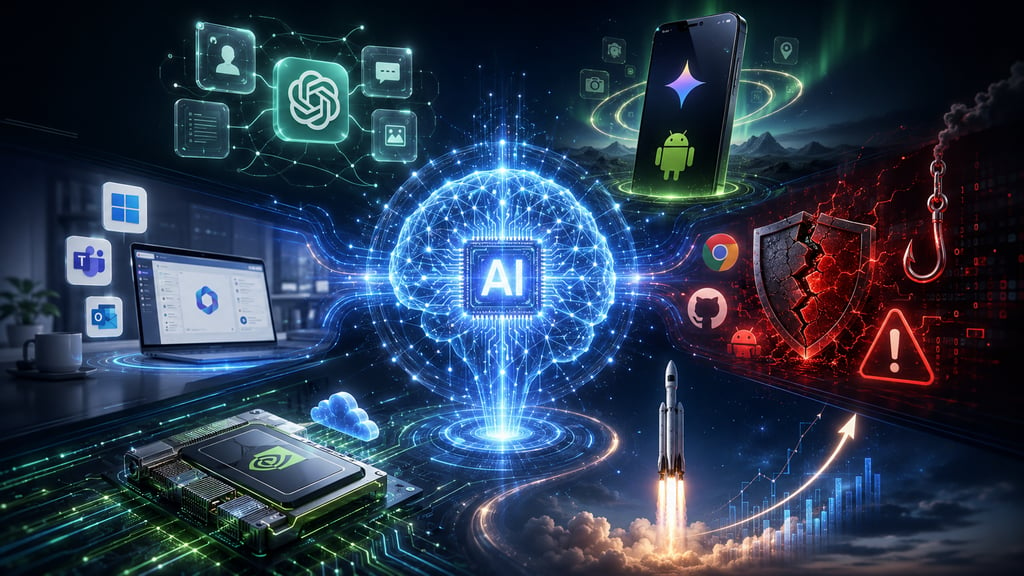
AI continued to move closer to the device, the workflow, and the boardroom this week, with OpenAI, Google, Microsoft, Anthropic, Nvidia, and Zoom powering smarter assistants and tools on devices, while security researchers continued to find new ways for those same systems to deviate. Add to that major Android and web server failures, AI-enabled scams, and SpaceX's record-breaking IPO plans, and the message was clear: the next era of technology is arriving quickly, bringing with it productivity gains and a suspiciously large number of flashing warning lights.
Featured news
AI assistants and on-device intelligence take center stage
OpenAI introduced Dreaming V3, a new memory system for ChatGPT that integrates details from previous chats into user profiles. The update doubles storage for Plus and Pro users and adds privacy-focused features like temporary chats. While the system improves personalization, it also raises new privacy concerns as ChatGPT surpasses 1 billion monthly users.
Google DeepMind launched Gemma 4 12B, a 12 billion-parameter multimodal AI model that runs entirely on devices with 16 GB of RAM. Capable of processing text, images, audio and video offline, Gemma 4 12B supports a 256K context window and reduces reliance on GPUs in the cloud, delivering privacy and cost benefits for developers.
Microsoft introduced Scout, an always-on AI assistant built into Teams, Outlook, and Windows. Built on the OpenClaw framework, Scout automates scheduling, communication, and task management as part of Microsoft's shift toward agent-first workflows and a consumption-based AI model.
To expand its AI ecosystem, Microsoft also revealed Project Solara, an Android-based operating system designed for devices controlled by AI agents. The platform supports adaptive interfaces and business management tools, and pilots are already underway in the retail and healthcare sectors.
AI Hardware and Cloud Partnerships Expand
Nvidia and Microsoft jointly introduced RTX Spark, an Arm-based superchip that combines a 20-core Grace CPU with a Blackwell RTX GPU and up to 128GB of unified memory. The chip powers the new Surface Laptop Ultra and promises a petaflop of AI performance on the device, with Spark-powered PCs expected this fall.
Pinterest signed a $4 billion cloud and AI deal with Amazon Web Services through 2031. The deal leverages AWS Trainium and Graviton chips and includes a migration to Kubernetes to improve scalability and efficiency, boosting shares of both companies.
Insider information
AI governance and security in the spotlight
At Build 2026, Microsoft introduced Microsoft Execution Containers (MXC), an operating system-level sandbox that restricts AI agents' access to files, networks, and user interface elements. The feature improves business trust by enforcing real-time containment and governance through Microsoft's security suite.
Anthropic launched Claude Opus 4.8, an artificial intelligence model that emphasizes honesty and transparency. The update features dynamic workflows that support up to 1,000 subagents, a faster and cheaper mode, and improved code failure detection. The company's valuation now surpasses that of OpenAI as it pursues more reliable enterprise AI.
AI-free search gains momentum
DuckDuckGo saw a 70% increase in US iPhone installs and record search traffic following backlash over Google's AI-powered search results. The privacy-focused engine also launched Chrome and Firefox extensions to preserve AI-free search, while competitors like Brave and Bing saw parallel growth from AI-wary users.
AI productivity tools expand
Zoom introduced ZoomMate, an AI workspace that transforms meeting discussions into actionable tasks and documents on platforms like Salesforce, Jira, and Slack. The new AI Productivity Suite allows users to generate documents and slides directly within Zoom, integrating seamlessly with competing collaboration tools.
Security alerts
Critical vulnerabilities and exploits
A zero-day flaw in GitHub's browser-based VS code allowed attackers to steal OAuth tokens with a single click, exposing private repositories. Researcher Ammar Askar revealed the issue, prompting Microsoft to issue mitigations and advise users to clear cookies and review access tokens.
Researchers discovered a new HTTP/2 “Bomb” exploit capable of crashing major web servers, including NGINX, Apache, IIS, Envoy, and Cloudflare Pingora, by abusing HPACK compression and flow control. Patches are available for NGINX, Apache, and Envoy, while IIS and Pingora remain vulnerable.
Google released its June 2026 Android update, fixing an actively exploited privilege escalation flaw and more than 120 other vulnerabilities, including a no-click remote exploit. Pixel devices received the patch first, followed by other vendors.
AI and Platform Security Risks
A vulnerability called False Context Alignment allowed crafted notifications from apps like WhatsApp and Slack to manipulate Google Gemini on Android devices. Google fixed the issue on the server side last November and recommends revoking access to Gemini notifications for added security.
ChatGPhish, a new rapid injection exploit, embeds malicious instructions into web pages. When ChatGPT summarizes such pages, it may display phishing links, fake alerts, and tracking pixels. OpenAI has been notified but has not yet published a fix.
A flaw in Meta's AI support bot allowed attackers to reset Instagram passwords and hijack accounts, bypassing two-factor authentication. The exploit affected several high-profile users before Meta implemented a fix.
Browser and device protections
Google Chrome introduced Device-Bound Session Credentials (DBSC), which binds session cookies to a device's hardware security module. The feature prevents cookie theft attacks and is enabled by default on Windows and macOS, with administrator app options available.
Android is adding fake call detection to combat AI voice scams. The feature, rolling out for the first time on Pixel devices, uses RCS handshakes to verify callers and warn users about potential spoofing or AI-generated voices.
Data breaches and fraud
Charter Communications confirmed a breach by the ShinyHunters group that exposed data from up to 13 million Spectrum customer accounts. The attack, triggered by a voice phishing scam, compromised both customer and employee information.
The FBI reported nearly $900 million in losses from AI-related scams last year, with the increase led by voice cloning scams. The criminals used short audio clips to impersonate victims' relatives or colleagues, leading to fraudulent money transfers. Experts urge users to verify calls and limit public audio sharing.
Industry reorganizations
Main market movements and IPO
SpaceX announced plans for a record $75 billion initial public offering, setting a share price of $135 for its Nasdaq debut on June 12. The offer targets a valuation of $1.77 trillion, surpassing Saudi Aramco's record, and gives Elon Musk more than 82% of voting power, fueling speculation about a possible merger with Tesla.
Policy and regulation
President Trump signed an executive order establishing a voluntary AI vetting process, allowing the NSA to review border AI models for 30 days before launch. The move is aimed at identifying cyber risks, but has drawn mixed reactions from industry leaders and security advocates. OpenAI has instead called for mandatory federal oversight.
Corporate acquisitions and product changes
Asana acquired no-code agent builder StackAI for $75 million to strengthen automation of its AI-powered workflow. The acquisition enhances Asana's execution tools and positions it more competitively against monday.com and ServiceNow.
Meta is developing an AI pendant and new smart glasses as part of a plan to sell 10 million wearable devices by the end of 2026. The pendant records talks for Meta AI processing, raising privacy concerns, while Apple's competing AI glasses have reportedly been delayed until 2027.
A leaked roadmap revealed that Disney plans to phase out the Hulu app by the end of the year as part of Project Gemini, consolidating streaming operations under Disney+ to streamline content delivery and improve ad targeting.
YoIf you would like to see more of our newsletter, check out the Tech Insider Daily Archive.