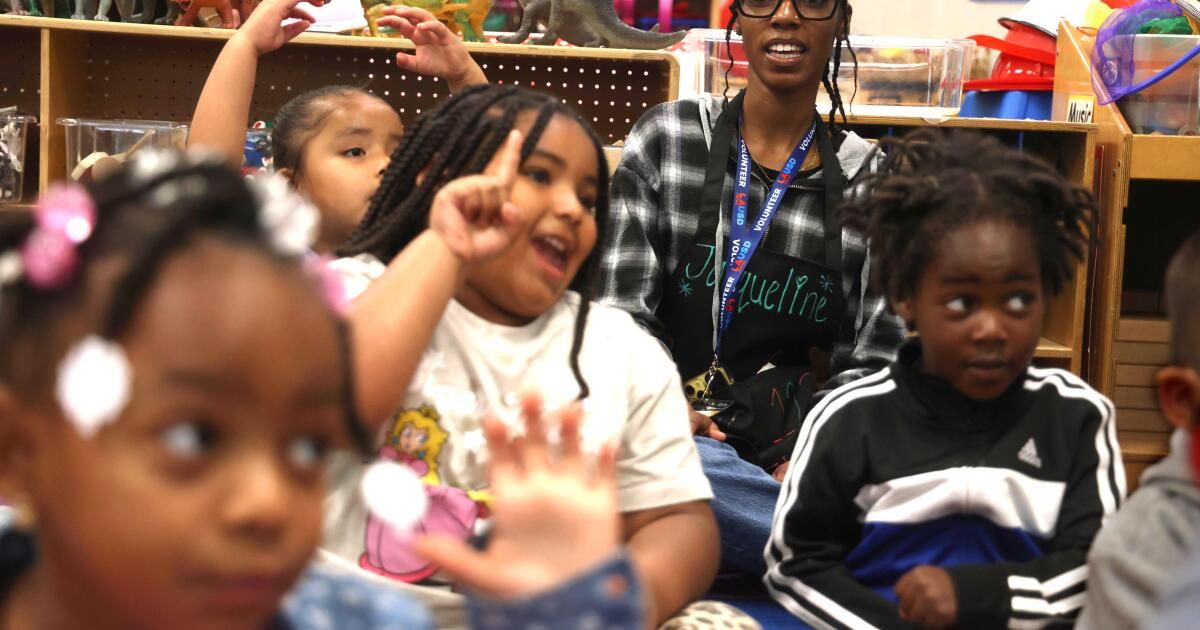
An experiment with preschoolers is underway in South Los Angeles, aimed at solving a persistent problem in the region's stressed daycare industry: a lack of workers.
In a partnership between a Los Angeles Unified adult school and an early education center, sharing a campus, adult students receive free job training plus convenient access to the field work hours they need to obtain their child development assistant permit.
“We know that there is a huge need in that space and that many of our adult education students have this interest and these competencies,” said LAUSD board member Kelly Gonez. “It's really about creating a path that helps them meet the requirements and be able to get into the field.”
This small-scale experiment, and the goal to expand it, comes as LAUSD embarks on an ambitious plan to expand its footprint in early education, an initiative unanimously approved by the school board in April. The district's planned expansion aims to provide access to affordable child care while building early loyalty with local families to help stem declining enrollment.
Engage in our community-funded journalism as we delve into child care, transitional kindergarten, health and other issues affecting children from birth to age 5.
Part of that effort includes investing in the workforce. Twice a week, students from the Maxine Waters Employment Readiness Center travel to the early education center's classrooms. They lead story time, serve breakfast on plastic plates and sippy cups, lead musical and movement activities, and manage tears and disruptive behavior.
“Why not let them get hands-on experience? Why just let them sit back and watch?” said Rory Johnson, child development instructor at the adult school.
Student Carmen Esquivel, who graduates this week, said the course, “from the beginning until now, has been an eye-opener. You don't have to just be a TA and work and just help out. You can actually continue your education, and I'll be able to lead my own class one day.”
Instructor Lucretia Henderson, who teaches young children at the Bradley Early Education Center, which shares a campus with the Waters center, says she makes an effort to “think out loud” as she works, narrating so that adult students can understand how she relates to children. She helps them recognize developmental moments, such as when a child turns a book on his own when he realizes it is upside down, indicating that he recognizes the letters.
“There's nothing like reading it in a book versus experiencing it in a classroom,” Henderson said.
Child care staff need
The child care industry has faced a challenging employment landscape: a shrinking workforce. About 20% of lead and assistant teachers in Los Angeles County leave child care centers annually, according to a 2025 study by the Center for the Study of Child Care Employment at UC Berkeley. Turnover among assistants is even higher in family day care centers, reaching 28%.
Free job training programs like the one run by LAUSD offer an opportunity to reduce barriers to entry and can serve as a starting point for other child care careers, said Elena Montoya, associate director of research and policy at the UC Berkeley center. Grant programs often help cover additional costs such as books and CPR training, Johnson said. Still, low wages remain a problem, making child care compete with other options available at the same school.
LAUSD adult schools operate seven child development programs throughout the district, although how students complete their field work varies.

Adult school student volunteer Diana Campos (center) works with a preschooler at the Bradley Early Education Center in Watts on May 5.
(Genaro Molina / Los Angeles Times)
At the Waters center, 137 students have completed the program since 2020. About a third of its students enter a job in the child care industry, Johnson said. Others continued their studies or went into other industries. About a third of students working in the industry have returned to their jobs at LAUSD, either in an early education center or a transitional kindergarten classroom, according to their records.
As part of the journey, Johnson tailors classroom support to help her students who want to advance in their careers. For those who want to earn their associate's or bachelor's degree and become a master teacher, she encourages them to visit schools and makes applying to college part of their coursework. For students who want to open their own family child care home, she helps connect them with resources to create a business plan.
Johnson also checks in with all of his peers every three months after completing the program to offer additional guidance.
Since Waters formalized the partnership in 2021, another adult school has adopted the agreement and a second will follow soon. There may also be opportunities to establish similar partnerships as additional early education centers open near other adult schools, said Pia Sadaqatmal, the district's head of transition programs.
in the classroom
The adult center classrooms mimic the look of an early education classroom, with cubicles.
Adult students start the day with morning songs and dances, which helps them get used to the job of educating 2- and 3-year-olds. In addition to learning how to prepare lessons and solve behavioral problems, they complete child-like activities, such as painting and playing outside using toy hoops and bouncy balls. It's designed to take adults out of their comfort zone and into the world of children, Johnson said.

Preschool children dance during Cinco de Mayo celebrations at the Bradley Early Education Center in Watts on May 5.
(Genaro Molina / Los Angeles Times)
Esquivel remembers a particular course assignment. Using a handmade puppet with big googly eyes that she found at Walmart, Esquivel read “Snuggle Puppy!” out loud while his teenage daughter recorded.
It took about 15 tries, he said. It wasn't easy, but it made her more comfortable being playful and creative, skills she said she needed in the Bradley Early Education Center classroom.
“It takes me back to my childhood,” Esquivel said. “I never imagined myself doing voices. That's another thing I learned in this course: you don't have to be so serious all the time.”
Now that Esquivel graduates, she will enroll at East Los Angeles College to complete the requirements necessary to become a lead teacher.
LAUSD's Early Education Expansion
District administrators are expected to deliver an early learning plan by September to increase the number of affordable child care options available to district families, build relationships with local child care providers, and build a stronger pipeline to the early education workforce.
Officials say the Bradley Early Education Center's approaches to these key issues could serve as a starting point for an LAUSD expansion into the industry.

Maria Lopez, center, works with preschool children at the Bradley Early Education Center, located on the campus of the Maxine Waters Employment Readiness Center, in Watts on May 5.
(Genaro Molina / Los Angeles Times)
Adult school students can enroll their own children in the Bradley Early Education Center, so they can attend classes and study. The early education center is the first to test evening care, a pilot program it implemented in the fall to meet the needs of parents who work during the day and attend evening classes or work at night.
“The pilot being conducted at the Bradley Early Education Center is a way to provide greater opportunities for the students and young children we care for, but also to help shape the next generation of early childhood educators,” said Gonez, who introduced the resolution on early learning. “It's a win-win situation.”
This article is part of the Times' early childhood education initiative, which focuses on the learning and development of California children from birth to age 5. To learn more about the initiative and its philanthropic sponsors, visit latimes.com/earlyed.