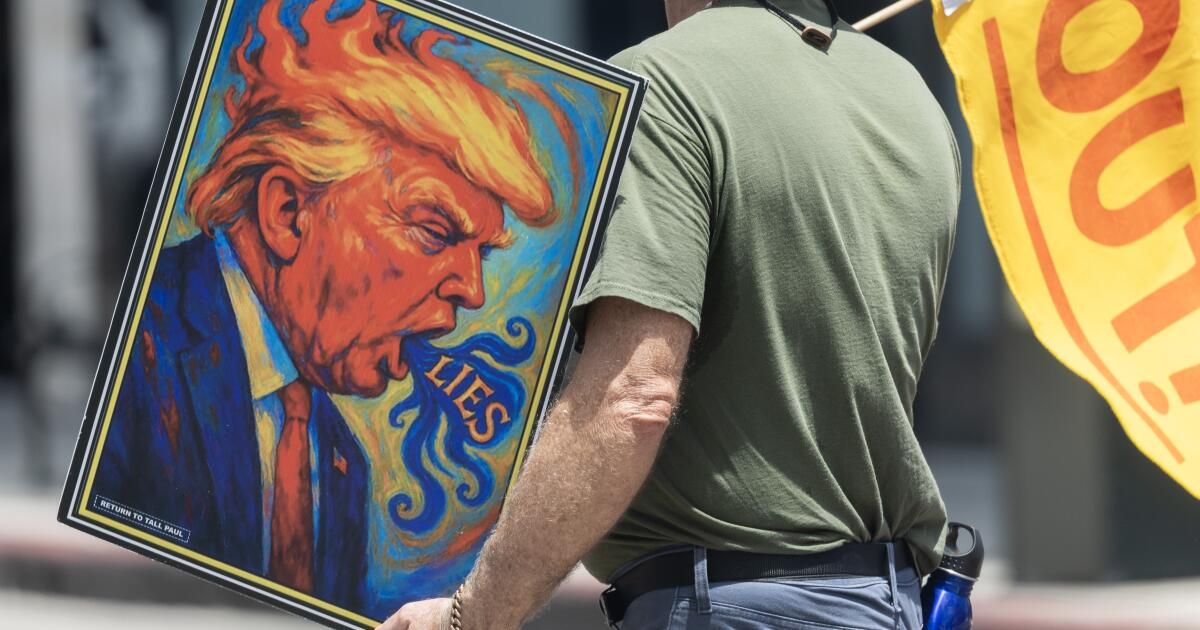
About 50 protesters gathered Saturday morning in Pasadena as part of a national action to honor the lives lost during immigration enforcement operations and in detention centers during the Trump administration.
They wore ruffles around their necks, strung with yellow thread, with the smiling faces and names of some of the 75 people who have died since January 2025.
“Killed by ICE” was printed above a photo of each person, including local resident Roberto Carlos Montoya Valdez, a 52-year-old man killed while trying to flee immigration agents who arrived at a Home Depot in Monrovia last year.
The Los Angeles residents, part of the San Gabriel Foothills Indivisible group, carried American flags and signs that read “No ICE, No War” and “Stop ICE Killings.”
“Good morning, Pasadena,” Betsy Hanger, an organizer with the group, shouted into a megaphone as she walked through an intersection. “Honk for democracy. Honk if you want ICE off our streets now.”
A chorus of horns sounded as drivers showed their support.
Organizer Andra Clarke held a sign in each hand that said “Neighbors say ICE out.” The sign around his neck bore the name and photo of Francisco Gaspar-Andrés, a 48-year-old man who died in a Texas detention center in December.
Heba Turner was among the protesters who demanded justice for those killed by ICE agents.
(Myung J. Chun / Los Angeles Times)
Clarke, 61, said the group has been meeting at the intersection of Colorado Boulevard and Fair Oaks Avenue every Saturday since March. Last weekend, they celebrated civil rights activist John Lewis.
This Saturday, however, his attention was focused on ICE.
“Now 75 people have died at the hands of ICE,” Clarke said. “At first they told us, 'Oh, they're going to go after criminals, people who are the worst of the worst.' That's a lie; that's not what's happening.
“They're targeting communities, they're targeting people of color. It's fascism…Anyone who cares about humanity should care about what's happening.”
Clarke said she was deeply affected when she learned of the two recent deaths at the hands of ICE.
The event was also a vigil in honor of Lorenzo Salgado Araujo, 52, who was killed by an ICE agent in Houston on July 7 while driving his construction equipment to a job site, and Johan Sebastián Guerrero, 25, who was shot and killed by an ICE officer in Maine during a traffic stop earlier this month.
“It's like, again? It just doesn't end. It feels like it never ends: the evil.”
Shortly before noon, Clarke used a megaphone to read aloud the names of the dozens of dead. After reading each name, Hanger hit a singing bowl and the vibrations resonated in the corner where they stood. Sometimes he said “unidentified man” or “four unidentified women.”
Next to them was a poster with a photograph of Daphy Michel, a 31-year-old woman found unconscious at a bus stop in Pittsburgh after ICE released her “in cold winter conditions and without care for mental health episodes or notification to her family members.”
“Let's take a moment of silence for all those who were kidnapped,” Clarke said, bowing his head.

“It's like, again? It just doesn't end. It feels like it never ends – the evil,” said Andra Clarke, an organizer with San Gabriel Foothills Indivisible.
(Myung J. Chun / Los Angeles Times)
Among those gathered to listen was Leticia López, a 65-year-old South Pasadena resident whose voice shook as she spoke about the impact of hearing about another arrest or death related to police operations.
“It goes to my core,” he said, beating his chest. “It's not getting better, it's getting worse. I just feel like I need to do something.”
Lopez, who was wearing a T-shirt that said “Immigrants are not criminals but the president is,” said his mother and grandmother were forcibly repatriated from Arizona to Mexico.
His mother, who grew up in Mexico, later met his father there. He moved to the United States in the 1950s as a bracero. Hearing today's stories, he said, “triggers everything they went through.”
“When I see this happen, what I feel is generational trauma,” he said. Lopez said people around her carry passports and documents in public to prove they are citizens.
“Because they are afraid that ICE will profile them, detain them and kidnap them. When my son goes out, I worry,” she said of her 28-year-old son.
Later that afternoon, about four miles away from the Home Depot in Pasadena, organizers nailed dozens of white crosses into the ground with photos of the dead, most of them men. Those attending the vigil placed flowers on crosses in a makeshift cemetery.
“Shot to death by ICE,” read one with a photo of Keith Porter Jr., who was killed by an off-duty ICE officer in California.
Several of them contained details of how the deaths unfolded. A man died after a tractor-trailer hit him while fleeing an ICE raid in Florida. A Cuban immigrant who died in a detention center (his death was later ruled a homicide). A Mexican national who fell 30 feet to his death during a raid in California.
Among the photos on crosses were Renee Good and Alex Pretti.
“Are we going to wait until 70 more die to do something?” asked Marlom Portillo, an educator with the National Day Labor Organization Network, as he stuck more crosses into the ground.
“What they want us to do is forget them,” Portillo added. “We will never tire of denouncing this atrocity.”
“There are more people who died than there are people here protesting,” Monrovia resident Kathleen Vallee observed to her friend. “And that says a lot about us.”
Vallee said that when he attended the “No Kings” protest, it was “packed.” Only a dozen people had gathered about 20 minutes into the vigil.
“My stomach turns,” Vallee said, hands clasped. “This seems to be seeping from the sewers into our democracy and that motivates me.”
As the small crowd gathered, protesters held signs that read “Every person is sacred,” “we stay safe” and “neighbors say ICE go away.” One woman carried a handmade sign that said, “Who will they come to next?”
Sheri Lochner, a 64-year-old Monrovia resident, is part of East Pasadena Community Defense Corner, a small group that “provides support and a sense of community” to day laborers.
Lochner said he watched immigrant agents capture six or seven men in an Oct. 1 ICE raid at the Monrovia Home Depot.
“How un-American,” Lochner said, as he surveyed the rows of crosses. “This is not right.”
She added that her mother, who voted for Trump the first time, agreed with her.
“I speak, I will not remain silent,” she added.