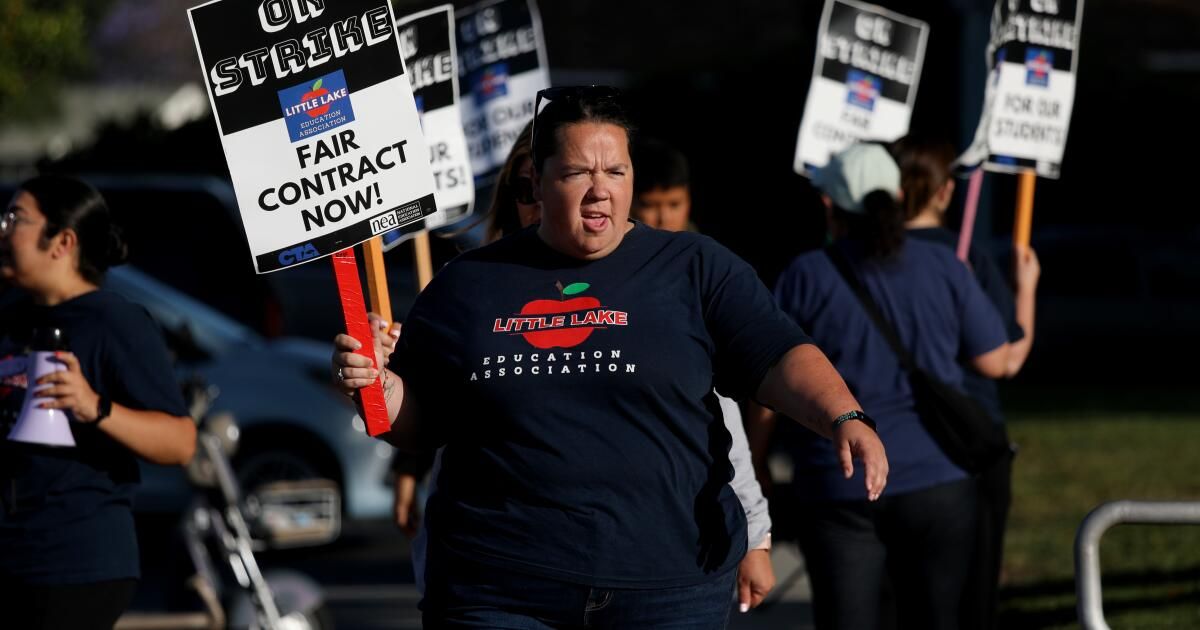
The small Little Lake school district, which primarily serves low-income families in southeastern Los Angeles County, has become the site of one of the longest teachers' strikes in state history (hitting the 10-day mark on Wednesday) as its 200-member union grapples with major issues affecting districts across California.
Teachers have retreated as health care costs rise by $14,000 a year for some, overcrowded special education classes and proposed increases in class sizes in a district struggling with declining enrollment and past spending unsustainable. Teachers aren't asking for a pay raise, but their high-cost benefits amount to a big pay cut.
While an agreement seemed close and negotiations would resume Wednesday afternoon, the dispute has taken its toll. Although schools are open with substitutes, the strike has consumed about 6% of the academic year. Most parents have kept their children at home as they struggle to manage disrupted work and home routines, especially difficult in a school system where about 80% of students qualify for free or reduced-price lunch due to family poverty. Typically, teachers have lost several thousand dollars in salaries that they are unlikely to recover.
“We're trying to stay positive, but every day feels like a punch in the gut,” Sabrina Ireland, a sixth-grade math and science teacher, said at Wednesday's picket line outside her campus, Lake Center Middle School. “I'm losing sleep… We have some teachers that both husband and wife teach here. They have no income right now.”
It's hard for Little Lake to stand out next to the mammoth Los Angeles Unified School District, which has about 390,000 students. A Los Angeles Unified strike was dramatically averted with hours to spare on April 14 in a conflict that drew local and national attention for weeks.
But this district, with seven elementary schools and two middle schools, is enduring a devastating strike affecting about 3,400 students from Santa Fe Springs and parts of Norwalk and Downey.
In terms of instructional days lost, Little Lake ranks high. Earlier this school year, teachers went out for 12 days in the major Twin Rivers Unified School District in northern Sacramento County. Teachers at New Haven Unified in Union City in Alameda County went on strike for 14 days in 2019. And an Oakland teachers' strike in 1996 lasted about a month.
Teacher demands across the state
Numerous shorter strikes and near-strikes have unfolded across the state this year, part of a loosely coordinated effort by the California Teachers Association. to align union contract expiration dates and benefit from collective strength. The union called the effort “We Can't Wait.”
The issues emerging in Little Lake echo dynamics in LAUSD and elsewhere.
“Across the state, educators have won life-changing health care benefits and support for special education and forced districts to create the safe, stable classrooms our students deserve,” said Gabriella Landeros, spokesperson for the California Teachers Association.
Generally speaking, district budgets across the state are likely to be slightly larger, level or somewhat smaller, and schools could still get a big boost when the state budget is adopted in June.
Martin Gonzalez, 13, left, a seventh-grader at Lake Center Middle School, and Sebastian Escobedo, 11, a sixth-grader at Lake Center Middle School, join striking Little Lake teachers at Lakeland Elementary School on Wednesday in Norwalk.
(Gary Coronado/For The Times)
But cost pressures have increased rapidly in many regions. In Little Lake, as in Los Angeles Unified, the cost of services for students with disabilities and the percentage of students identified with disabilities has increased significantly. Health care costs have also risen rapidly.
Meanwhile, enrollment is declining, offsetting the benefit of state increases in per-pupil spending. Inflation has hit hard in recent years, while leading employee groups, especially in urban areas, to fight for wage increases to keep pace. This comes as the one-time pandemic relief aid has expired.
Thousands more for healthcare
In Little Lake, strike supporters say they are fighting over issues that justify sacrifice. Starting in January, monthly premiums for the health plan used by many teachers increased from zero to $1,400 a month paid for 10 months each year, a huge reduction in take-home pay.
To walk back that accusation, district officials proposed increasing the average class size for kindergarten through fourth grade from 24 to 1 to 28 to 1, according to the district. Union negotiators want to keep class sizes where they are.
District officials acknowledge their proposals are painful, but said they face an unsustainable financial situation.
“We are at a fiscal point where the district can no longer support 100%” of health care premiums, Interim Superintendent said. Monica Martinez-Johnson, a career district employee who started as a teacher.
An investigative report backed up that account, but also noted that the district suddenly ended health subsidies on Jan. 1, when a previous agreement expired. Employees were immediately forced to pay around 40% of the cost of their monthly premiums.
“This decision… has soured the relationship and [affects] all aspects of this reopened bargaining,” said Donald S. Raczka, who prepared an investigative report, issued April 12, as chairman of a panel that included district and union representatives.

Jennifer Conforti, center, a teacher at Lake Center Elementary School, pickets at Lake Center Middle School in Santa Fe Springs on Wednesday.
(Gary Coronado/For The Times)
Dollars and sensitivities
The financial implications of the strike are difficult to calculate at this time, but the district does not necessarily lose money. Substitutes earn $500 a day, but there are fewer substitutes than teachers, and striking teachers lose their pay.
In-person student attendance has ranged from 18% to 31%, which will mean a loss of funding related to student attendance. The district's annual operating budget is $73 million, of which salaries and benefits are $53 million, according to the district.
Many parents and students have joined teachers on picket lines.
“We've held out for so long that we don't want them to walk away from an agreement that doesn't benefit them,” said Melissa Maggard, who has two daughters at Lakeland Elementary School.
Therapist Sherry González has kept her fourth-grade son at home, rescheduling work hours and hiring babysitters. Your child receives special services for a disability at Lake Center Elementary School and routines at home are more difficult without this support.
“I don't feel comfortable taking him in during a strike with submariners who don't know my son's needs,” Gonzalez said. “As parents it has been difficult. It has been very frustrating. We feel worn out, tired and we feel like we are ignored and not listened to.
“Seeing this drive a wedge between the community is painful,” he added. When asked how he had been trying to cope, he responded: “Crying.”
What's next?
The upheaval included the sudden resignation of then-Supt. Jonathan Vásquez a week after the strike. After a 10-hour negotiation session on Monday, an altercation or feared altercation (accounts vary) resulted in the district calling the police.
One possible deal in the works includes employees paying zero to $630 per month in health care premiums, depending on their choice of health plan. Class sizes would not increase. Budget cuts would be necessary. In the spotlight are six intervention teachers who serve students who need intensive academic help.
This week the union was pushing for a one-time $4,000 bonus to its members, but not a permanent raise. The salary range for teachers ranges from $58,752 to $118,363.
Negotiations resumed Wednesday afternoon at a location considered safer than the district headquarters.