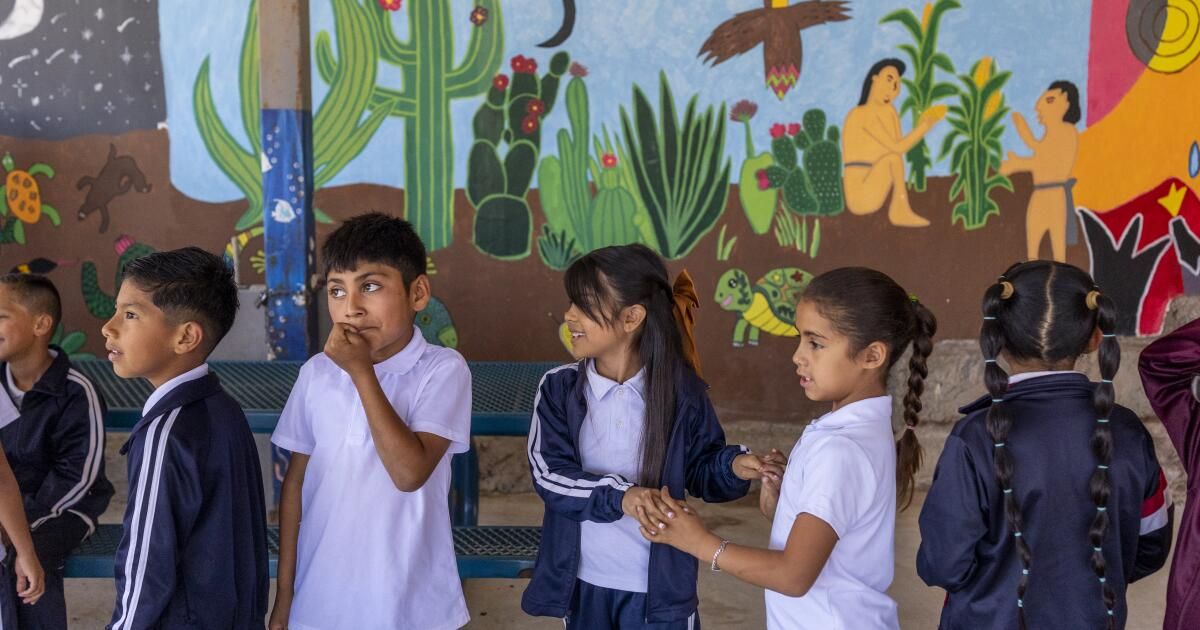
ENSENADA, Mexico — In an arid hillside town southeast of Ensenada, where electricity and plumbing are scarce and stray dogs abound, a treasure can be found on the grounds of an elementary school.
You can't see it from the street, where the city's palette ranges from dusty brown to brick gray. But pass by the principal's office, climb a small slope, and you'll be rewarded with an 80-foot-long mural exploding with color.
Equally impressive, however, is how the mural's creation bridged cultures, bridged age differences, and erased borders.
I learned about the treasure town known as El Paraíso in Maneadero several weeks ago from a pickleball friend named Tom Wiley. He and his wife, Dana Bonda, are retired lawyers who have spent decades escaping to Ensenada's south coast, where they have become involved in various local causes.
Small houses adorn the hills near El Paraíso in Maneadero in Mexico.
Wiley showed me a book hot off the press called “Mural Project.” It tells the story of how the project came about, with photographs of the 12 young artists at work. One of them, 13-year-old David Vásquez García, says in the book that his creation of Mexican folk art was part bull, part cockroach, and part imagination.
I liked what I saw and headed south to see the mural.
Wiley and Bonda told me the backstory. Bonda volunteered at art classes organized by French expatriate Bernard Brunon and his American wife Nancy Ganucheau. Bonda also volunteered on a bookmobile project started by expats Debra Blake and Carol Woodruff, who split their time between Southern California and Baja California.
The mobile library program was carried out on the campus that houses both the Colosio School and the Bocanegra School. On his visits, Bonda noted that the bare cinder block wall along the patio could use some life.
How about a mural? he thought.

Mariana Rodríguez Elizarraraz leafs through an art book during a food and clothing distribution near El Maneadero.
Bonda funded the project through a nonprofit he had founded years earlier, and toward the end of the 2025 school year, the students took up the challenge. With Brunon's guidance, they began by drawing small-scale sketches and eventually dipping brushes into paint cans.
They worked through the summer and applied the finishing touches just in time for the fall semester. The mural greeted hundreds of students who had just returned from summer vacation, and townspeople came by to see what all the talk was about.
Almost before the paint had dried, the mural caused a sensation.
Before seeing it for the first time, I traveled with volunteers past the school and along the unpaved roads of the city, which is home to families who resettled here from Oaxaca and other regions of southern Mexico to work in fields of cabbage, strawberries and other crops. The schools are bilingual, meaning that instruction is in Spanish but also in Mixtec and other languages.
We headed to a hilltop church, Casa de Gracia, for the monthly clothing and food donation organized by volunteers. That day a stroller would be auctioned.

David Vásquez García hugs Carol Woodruff during a food and clothing distribution near the Colosio School.
“A stroller is a lifesaver here,” Woodruff said as mothers with small children appeared from all directions as they climbed the winding dirt paths.
When the young people saw Woodruff, they called her name and ran to hug her. Her Spanish is strong and her heart is big, and she is the one mothers often call when they are hungry or sick or need to talk to someone they trust about the burdens they carry.
Woodruff and her husband, Gary, had driven trucks up the hill, hers filled with donated clothing and his with tables and other supplies for the raffle. Blake, who co-founded the bookmobile with Woodruff, arrived a few minutes later with food and more clothing.
Some of the young muralists appeared, including David, who arrived on his bicycle. He was the one who said his creation was a combination of cockroach, bull, and imagination, and I told him I couldn't wait to see the mural for the first time.


Details of a mural made by local students and families at Luis Donaldo Colosio Murrieta Elementary School
Danna, 16, another of the young artists, helped distribute clothes along with her grandmother and her mother, María Magdalena Gracida, who told me she appreciates not only the volunteers' donations, but also their commitment to the families.
I had a copy of the “Mural Project” with me and David read it with fellow artist Mariana Rodríguez Elizarras, 13. Mariana said they learned many artistic techniques, but the real thrill was the experience of creating something together.
Mariana has a serious side: a look of confidence and determination.
I asked her what she wants to be as an adult.
A lawyer, he said. Or an artist.
Or both.
Not far from the church there is a group of several houses that share a latrine and an outdoor wood-burning grill for communal cooking. Mariana took me to her house, where a framed certificate of academic achievement hung on the wall. He removed the frame to reveal several more certificates securely secured beneath the first, like a stack of reminders to keep climbing.
As we walked down the hill to school, I thought about how these relationships have been built at a time when the broader narrative of immigration and international relations is much darker.
“We are immigrants here,” Wiley said. “And as far as I know, we have been welcomed.”

Nancy Ganechau, left, shows Ricardo, 26 days old, with his mother, Christina, during a food and clothing distribution near El Maneadero.
Baja transplants seem to come in all shapes and sizes, including taxpayers, land grabbers, and gentrifiers. Some fled the North to escape President Trump's policies, some fled the liberal policies that preceded him, some moved South out of economic necessity.
Among the volunteers I met, the motive seems to be more personal than political. Scott Kennedy, an American expatriate artist who helped on the mural project, called the experience one of the great pleasures of his life. His direction to the students, Kennedy said, was “give the wall a chance and see what you can do.”


1. Juan de Dios Ramírez González, principal of the elementary school, stands in front of part of the mural he helped contribute to. 2. Felipa Sánchez Cruz in front of an Alebrijes that she helped paint at the Luis Donaldo Colosio Murrieta elementary school.
I'm not an art critic, but I would say they created a small masterpiece.
Actually, not that small. The mural, which is whimsical and reflective at the same time, measures almost 100 feet long and 10 feet high. Includes mythical creatures, the Aztec calendar and local landscapes, all in vibrant primary colors rich with emotion.
One of the artists, 13-year-old Yoselin Pacheco Ruiz, seemed particularly pleased as students and adults milled around. I asked him why he was smiling.
“Because I am very happy with the mural,” she said, her eyes shining.

Part of a mural made by local students and families at the Luis Donaldo Colosio Murrieta Elementary School in Ensenada.
The wall did not initially cooperate. It was cracked, water was leaking and the repair was an expensive headache. Emmanuel Hurtado, the school's superintendent, said he was impressed by the perseverance of the adult volunteers. Wanting to help people, he said, “is something they carry in their hearts.”
Hurtado said he had watched the kids grow up on this campus and was proud of them. Under Brunon's direction, he saw them take advantage of the local environment as well as the Oaxacan culture from which many of them came.
“All of this came from the children's ideas,” Hurtado said. “They just told them, ‘Think of something native to you, something emblematic.’ And they did.”
Some of the parents and even a grandfather helped, and director Juan de Dios Ramírez added the last character of the mural. He told me that his Aztec rain god was painted in recognition of the agricultural economy that supports the students' families.

Students leave classes at Luis Donaldo Colosio Murrieta.
(Ronaldo Bolaños/Los Angeles Times)
As the students celebrated their achievement with a lunch of tacos, their admiration for Brunon was clear. To them, he was the one who made it both a learning experience and a love fest, and they hovered around him.
“In the end, I think they didn't want it to finish,” Brunon said, explaining that when they finally finished the mural, they insisted they needed to make touch-ups here and there.
It was Brunon who produced the book that tells the story of the El Paraíso de Maneadero treasure, and when it was published earlier this year, he gave one to each of the students and others who participated.
Danna and her mother each received a copy, and the mother, Maria Magdalena, said she keeps her books sealed in a bag to protect them.
“It's very valuable to me,” he said, “because it was a great achievement, after a lot of hard work, and we are very proud of them.”