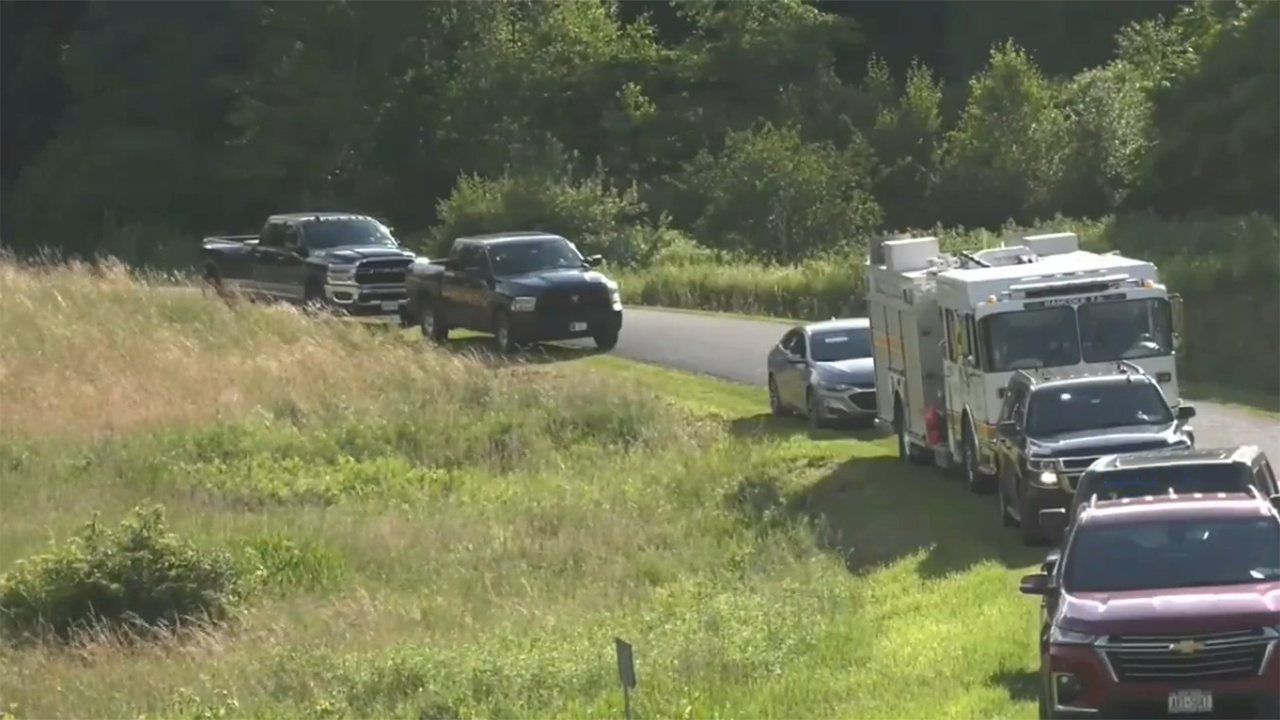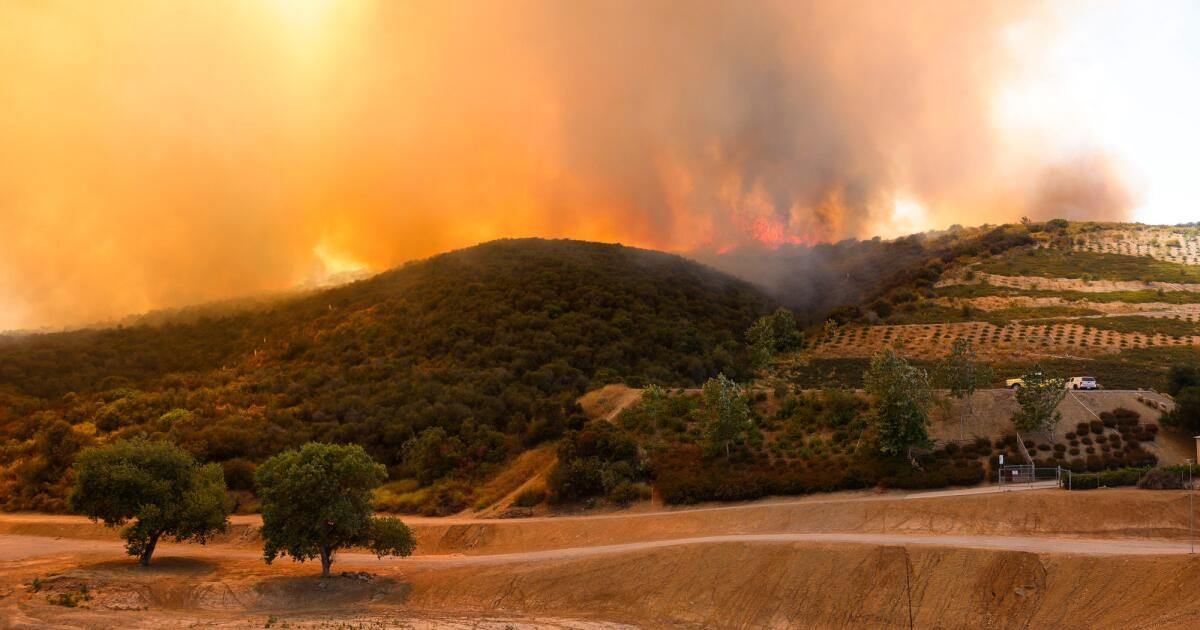
California has seen an increase in wildfires, from Siskiyou County to San Diego.
Southern California has taken the brunt of the surge. Nearly a dozen fires have collectively consumed more than 26,000 acres of varied terrain in the region over the past week, across remote island chaparral and brush-covered hills that border neighborhoods. Six people have been injured and about 45,000 more remain under evacuation orders. At least one house has burned.
This level of activity may seem unusual for May, but experts say that is increasingly no longer the case as climate change pushes back the start date of what has traditionally been considered peak fire season.
There are currently five fires of 1,000 acres or larger burning in Southern California, which UCLA professor and hydroclimatologist Park Williams described as abnormal for this time of year, but not unprecedented according to a data set of past fires he maintains.
He pointed to a study that suggests human-caused warming has brought forward the start of fire season by six to 46 days in most of the state, primarily by drying out vegetation. “So the fact that fire season is starting now in Southern California is pretty predictable, given that it's been really abnormally dry and warm.”
The region hasn't seen much precipitation since December; The rest of the rainy season was mostly dry, except for a few episodic rains, he said. Meanwhile, the western United States as a whole experienced record heat between January and March, rapidly melting mountain snowpack, he added.
Most of the fires burning in California right now started during an offshore wind event that engulfed much of the state, said Battalion Chief David Acuña of the Department of Forestry and Fire Protection. Although the winds were not as strong as during the Santa Ana events sometimes seen in the fall, they combined with extremely dry fuels to create a dangerous situation, he said.
Swaths of the region are covered in grasses that grow and then die each year, creating what Acuña described as a mosaic of layers. “You can imagine all of Southern California is like a haystack right now, waiting for just one spark,” he said.
Too often, humans are the source of that spark: It is estimated that people start 95% of wildfires statewide, and in lower elevation areas of Southern California, that number is believed to be even higher. The state's largest fire of the year, the 16,942-acre Santa Rosa Island Fire in Channel Islands National Park, is believed to have been started by a shipwrecked sailor who set off flares to get the attention of rescuers. The 1,698-acre Sandy Fire in Simi Valley, responsible for most of the evacuations, may have been started by a tractor driver who hit a rock and generated a spark, police said.
In fact, human ignitions have decreased significantly in Southern California over the past 30 years, probably because people have learned to be more careful and population growth has fragmented the landscape, Williams said.
However, the region has not seen a coincident reduction in the amount of area burned by wildfires or the rate at which people are exposed to fire danger, he said. He attributed this to the increase in temperature related to climate change, as well as the decrease in precipitation, factors that favor the burning of plants. He also noted that people continue to move into wildfire-prone areas amid a statewide housing shortage.
Across California, 1,521 fires had burned 48,135 acres as of Wednesday, compared to a five-year average of 2,163 fires burning 23,867 acres at this time — significantly fewer fires but more area burned, Acuña said. “What that tells me is that we have a lot more fuel on the ground that ignites and burns faster,” he said. “Combine that with higher temperatures and more wind, and that's how these fires are getting so big, so fast.”
Climate change played a role in driving the abnormally warm temperatures that helped dry out fuels this spring, although it's hard to say to what extent without more research, said climate scientist Alex Hall of UCLA, who found that global warming accounted for about 25% of the extreme dryness of vegetation that led to last year's firestorms in Los Angeles.
“Otherwise, I believe the factors that led to this surprising fire explosion in Southern California were due to a series of events that we know from the historical record,” he said. Large fires in the spring typically coincide with an abnormally dry end to the rainy season, and gusty winds are also known to increase fire risk, he said.
It's unclear what the increased activity portends for the rest of the fire season. Some forecasters predict that Northern California will see a higher-than-normal incidence of major fires due to dry vegetation, but the outlook for Southern California is less clear.
The region typically experiences its most damaging fires when the Santa Ana winds blow in the fall, and it is not yet known how prevalent or strong they will be, or whether winter rains may reach the area first.
Still, Hall said, “because of the dry conditions at the end of the rainy season here this year and the warm temperatures, we're not starting in a good place.”