Pillarhenge is an eyesore. Since construction at the Eagle Rock site, nicknamed for a decrepit colonnade, first stopped in 2008, the only thing that has accumulated faster than trash and graffiti were epithets from outraged community members.
While many saw a ruin at the corner of Colorado Boulevard and Holbrook Street, one local artist saw an opportunity. One of the site's 36 pillars, the tallest in the middle, could be a perch for a large, pink, screeching bird.
“It was a vision and I knew we would do it,” says the artist who goes by the name Flod and is finally ready to share his story. Flod insists on anonymity because “isn't it more fun to leave it a secret?”
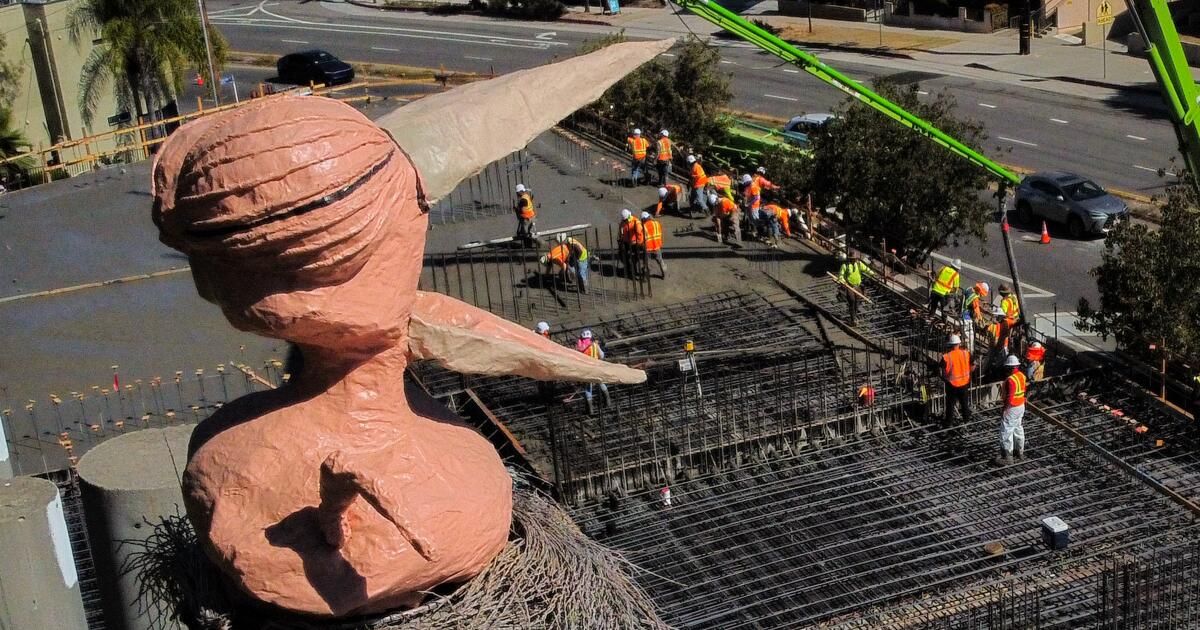
Pinky watches workers pour concrete at a construction site known as Pillarhenge because of its colonnade.
Flod gathered tomato cages, chicken wire, paper, glue, and pink house paint. “I really like recycling, so I didn't even buy materials for it. It was just supposed to be funny, maybe last a day,” he says. That was more than a decade ago.
One day in 2014, Flod's young adult nephew, a climbing expert, helped him hoist the 4-foot, approximately 10-pound paper mache sculpture over the 70-foot pillar. Fits perfectly. Since then, the bird, affectionately nicknamed Pinky, has inspired a movement. There are custom t-shirts, various fan art, an online forum, and a dedicated group that keeps constant watch. Pinky's fame grew even as the bird folded, shed and faded with each turn of the calendar.

-
Share via
As much as the locals hate Pillarhenge, they idolize Pinky. And now that construction has restarted on the site of “The One on Colorado,” a six-level mixed-use development with 31 units, the bird’s future is uncertain.
“There's a lot of love for this crazy bird,” says Jonathan Ford, who has a direct view of Pillarhenge from his backyard. “It's iconic.”
While the discarded elements are through lines in Flod's sculptural work, it is the community impact that separates Pinky from the rest. “I've done other things that I really like, but this one definitely exceeded expectations many times over,” he says.

Flod, the artist behind Pinky, watched in the dark as the bird's popularity grew.
A lone artist steps forward
Flod never set out to be found. I was happy to enjoy Pinky's celebrity from the shadows. That changed in April 2023, when unknown construction workers unceremoniously removed the disintegrating Pinky from her nest.
General contractor Enrique Valdez of Azteca 111 Builder Inc. was tasked with cutting the ratchet straps holding Pinky, apparently ending the bird's reign.

Construction manager Enrique Valdez saved Pinky after worried locals yelled at him when he removed the molting bird from its perch.
Then something unusual happened when Valdez descended in the elevator with Pinky's remains. Valdez remembers: “Some people stopped and yelled, 'Don't take Pinky!'” Distraught locals approached Valdez with videos of the act they had taken on their cell phones. “They asked me if I was going to bring him back and showed me the Facebook page.”
The Facebook page, Goodbye Pillarhenge Park, has been the center of the Pillarhenge story since 2015. As soon as clips of Pinky's elimination were posted, the comments started coming in: “Sad day for the proud bird,” “End of an era,” “The bird was the best thing about Pillarhenge.”
“I didn't know Pinky had so many fans!” Valdez laughs as he describes the situation he found himself in.
The protective attitude of the community saved Pinky from the landfill. Valdez deposited Pinky in a warehouse belonging to the site's owner and showed him the Facebook posts about Pinky's removal. The site has changed hands several timesthe last owner being Ara Tchaghlassian, founder of the retailer American Tire Depot.
“I told him, 'It looks like we have a legend on our hands,'” Valdez explains.
After stabilizing the slope, the development team discussed remaking the bird with the help of the original artist. But no one knew who he was.
“People have just ended decades of this ugliness,” Annie Choi, owner of Found Coffee across from Pillarhenge, says of the site. “But it also has this weird claim to fame, you know,” he says, as a regular customer walks into the store wearing a Pinky T-shirt.

When construction manager Enrique Valdez removed the deteriorating Pinky in 2023, he placed it in a storage unit until Flod, the artist, could be found.
As a career documentary filmmaker, I'm always looking for quirky stories from Los Angeles. I have been photographing Pillarhenge for over eight years, mainly on black and white film. I met Valdez in May 2023, shortly after construction had restarted. He invited me up an elevator to photograph the site from above and asked if I knew who had made Pinky, which he had removed just a few days earlier. I offered to do some research.
While fruitlessly tapping into my connections to Los Angeles street art, Valdez posted on Goodbye Pillarhenge Park: “We are looking for the original artist to restore the bird.” It included photographs of Pinky, headless and abandoned, but safe among piles of crammed file boxes.
Unbeknownst to its 800+ members, Flod had been lurking in the public group for years, silently celebrating each new mention of Pinky. Valdez's publication presented a unique moment of decision for the reclusive artist: responding risked abandoning a mystique he had long cultivated; but ultimately the lure of an authorized Pinky reboot proved too tempting to turn down.
Strengthening Pinky, but for how long?

Beyond site-specific work, Flod also creates masks as part of his artistic practice.
Tiptoeing into Valdez's DMs with “Maybe I know the artist”, the two agreed to meet at the warehouse where Flod revealed his identity, refusing compensation and asking only for access to Pillarhenge. Pinky's corpse then returned home to Flod, who set about removing the rotting skin from the chicken wire skeleton, which he reused for his next version, covering it with a cloth dipped in paint, instead of paper and white glue, to better resist the elements.
Tellingly, the exterior of Flod's home studio is Pinky's exact shade of pink. In the courtyard, multicolored concrete sculptures adorn almost every corner. Inside, there are hand tools, musical instruments, and partially completed paper mache projects everywhere. “Watch out for the spikes,” Flod warns, as I maneuver around an oversized paper mache mask covered in spikes that protrude a foot long. “I can't fix them if they break.”

Skull masks are a particular theme in Flod's work.
The back room of Flod's studio is like a butcher's refrigerator, where dozens more masks hang from the ceiling, each one more extravagant than the last. There's a bug-eyed rabbit, a blue donkey, and several variations of what appear to be skulls. “That's Charles E. Fromage.” I repeat the name and Flod adds, “Do you understand?”
Pinky isn't Flod's first foray into site-specific social commentary. On a hike in 2005, Flod came across a truck tire stuck between two rocks in Malibu Creek. Returning to the site with a bag of cement, he made a mixture with sand and water from the stream bed. After smearing it on the immovable trash to make it look like it was just another river rock, he titled the piece “Reinventing the Wheel.” Then there was the 2015 collaborative effort “Stella the Steelhead,” a 35-foot fish skeleton filled with trash pulled from the Los Angeles River, which a group of artists, environmental activists and volunteers towed behind an adult tricycle along the river's bike path.
Just two months after his rescue, in December 2024, Pinky's rebirth was announced in Eastside LA as “a Christmas miracle.” However, a storm soon damaged Pinky's reinforced fabric wing and the bird was temporarily removed for repairs. It was around this time that Ford moved near Pillarhenge. One morning he went out with his coffee and noticed something… pink.
“I texted my neighbor and he responded immediately: 'Pinky's back! Oh thank God, I didn't know what happened. I love that thing!' And I just went, so this is normal.”
During Pinky's pit stop, my 10-year-old daughter Margaret Green and my friends Ezra Cunningham and Meta Nalepa found the bird on a nearby road while delivering their neighborhood newspaper. Flod, a subscriber, acknowledged that he was the creator of Pinky. Margaret's article, “Pink Bird: Eagle Rock Artist Found,” includes a rare photograph of Pinky away from her nest atop a pillar.
In response to being discovered by elementary school reporters, Flod gushes: “That was a really cool part of [Pinky’s] history. It definitely means a lot to me. That kind of thing is everything.”
Now, time is running out for the bird as the rising tide of concrete, scaffolding and rebar obscures Pinky from the view of pedestrians along the south side of Colorado Boulevard. A few more months and… “Well, you'll still be able to see Pinky from the highway,” says Valdez, who expects construction work to be finished in about two years.

Someone made an egg to accompany Pinky to the top of Pillarhenge. Flod promises it wasn't him.
At Goodbye Pillarhenge Park, one member's recent comment betrays what many may not be willing to admit: “I will miss Pillarhenge.”
Recently, a giant egg appeared in a nest on top of the pillar next to Pinky's. “I had nothing to do with it!” Flod insists. Rumors are swirling about what will emerge when the egg hatches: life-size bronze? Historical plaque? Although it's not that grand, Valdez says discussions are taking place about the bird's future.
“If Pillarhenge is completed and Pinky walks into the lobby or something, I guess it's fine,” Flod concedes. “We need more housing.” Then, the artist's acquiescence gives way to a defiant smile: “But I want the bird to win.”