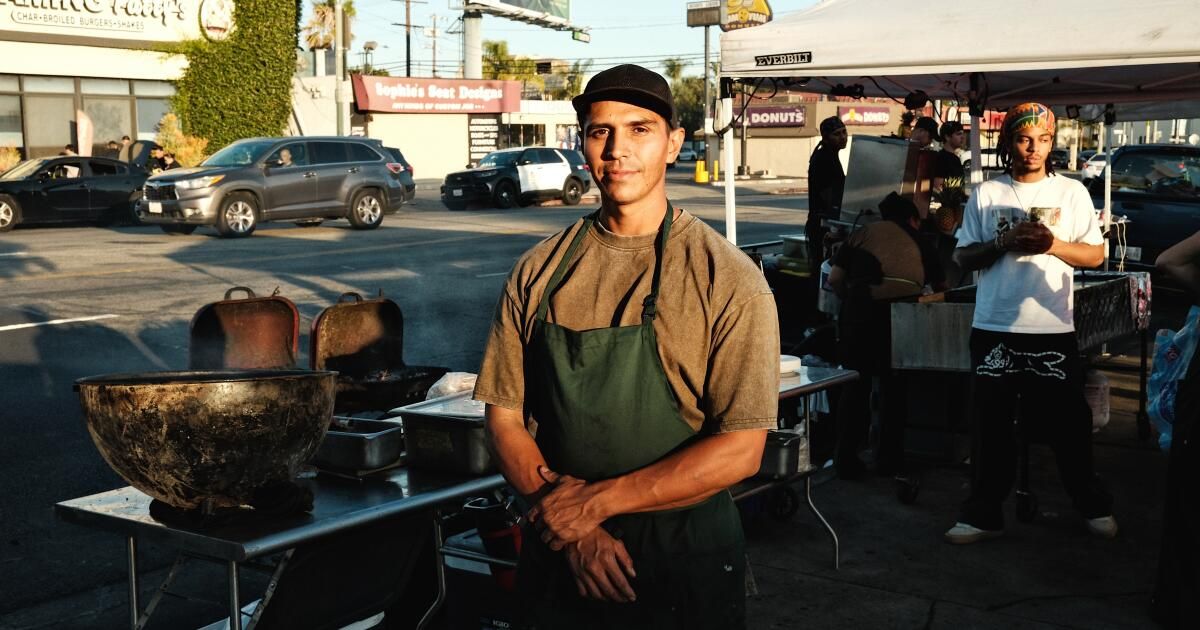
For months, no one waited in line at Asadero.
But Emiliano “Rubén” Martínez believed in his fledgling taqueria and its charcoal-scented steaks, and felt Angelenos could still embrace his premium steak tacos despite the cost. As the inaugural chef of taqueria Mírate Los Feliz, he had cooked artisanal tacos that fetched $9 or $10 each; Selling tacos on the street was another story.
“No one wanted to buy a five or six dollar taco,” he said.
His patience paid off. Now, the meat-centric taco stand is drawing thousands of people to the edge of the Pavilions parking lot in Hollywood, with waits of up to three hours for grilled Wagyu, USDA Prime or Angus tacos along with pork al pastor, pan-roasted chicken and a sticky chile filling. Asadero is joining the ranks of Los Angeles taquerias like Sonoratown and Tacos Los Cholos, as well as newer faces like Tacos Royale, by serving fire-kissed beef tacos. Martínez says there is space and a price for everyone.
“Culturally we always look for that cheap taco stand to go to eat, but there are 32 regions in Mexico and each one cooks differently,” he said. “Even in my neighborhood where I grew up there were different types of tacos.”
Their signature is the four-ounce gaonera, a thinly sliced rib eye steak cooked over mesquite charcoal. On another grill, thicker skirt steaks sizzle over the coals before being diced for flank steak tacos. Crispy, griddle-fried beef trimmings, available to top any taco or to use as a taco filling, are priced at just $1 to minimize waste.
Asadero's signature gaonera taco at Hollywood's meat-centric taco stand.
(Stephanie Breijo / Los Angeles Times)
All Asadero beef is lightly seasoned with salt, Sonoran style, to let the meat's flavor shine, while options like al pastor involve a multi-day marinade made with homemade tepache. All are available in locally made flour or blue corn tortillas.
While the menu is inspired by roast meats from his family's farms in Vizcaíno and La Paz, Martínez's setup is based on his years cooking at some of Las Vegas' highest-volume restaurants, where he catered banquets for 10,000 people. Like a kitchen with traditional stations or areas for specific tasks, Martínez runs multiple grills for specific steaks, a designated team oversees the trompo and meats on the main griddle, another team heats tortillas on another, and one team member only hands out the rib tacos, as they are cooked to order.

Guests line up at Hollywood Asadero's taco stand.
(Stephanie Breijo / Los Angeles Times)
Nearby is a table full of homemade sauces: a smoky tatemada for al pastor, a sesame-filled macha, and a bright green sauce best used to cut some of the fattier steaks.
Martínez grew up in Mexicali surrounded by his family's kitchen, but never considered a career as a chef. When he moved to Las Vegas to continue his education in psychology, he found himself in the kitchens of casinos and hotels to finance his studies. He didn't expect it, but in 2011 Martínez fell in love with the hustle and bustle of the industry.
“The culture in Las Vegas is very rooted in how good you can be in front of others,” he said. “Everyone who cooks is competitive and I finally took one job, two jobs, three jobs.”

Al pastor tacos, roast filet and flank steak at Asadero.
(Stephanie Breijo / Los Angeles Times)
His first sous chef role came just six months into his tenure at T-Bones Chophouse at Red Rocks Casino, where he learned the intricacies of steaks: dry aging, preparation, the perfect char. He cooked at Caesar's Palace, Belaggio, Palazzo and the José Andrés restaurant group, which helped him understand kitchen management, especially at high volume.
“Somehow you are enchanted by the cuisine,” Martínez said. “After that, I became very good at it.”
When he moved to Los Angeles in 2016, he began working at the Cheesecake Factory, Bottega Louie, the W Hotel, and then Mírate, where he cooked with the late, influential Alta California chef Joshua Gil. He ate street food from the city all the time and turned to it for inspiration when he started his own operation.
Martinez set up a booth in Sylmar as a proof of concept while he focused on catering orders for movie studios. As he gained momentum, he moved Asadero to the more central and current Hollywood location in February 2025.
It took three or four months, but local residents began to arrive little by little. Some weeks, customers were so scarce that Martínez couldn't afford to offer his now signature rib taco.

While Asadero's exclusive gaonera and arrachera tacos cool on grills, the others are prepared on the grill.
(Stephanie Breijo / Los Angeles Times)
“Those regulars were what kept us alive in the beginning,” he said.
Hollywood resident Luke Skywalker (real name) is one of those guests. The self-described “meat and potatoes kind of person” said he visits Asadero three or four times a week and has considered himself a fan for almost a year.
“I watched how he keeps the stall very clean and then I started watching how he prepares the food,” Skywalker said. “Everything is fresh. He makes his own condiments every day. I haven't seen any type of competition that does anything like that. He's not a cook, he's a chef.”
Mentions on the LA Food Podcast and Infatuation this spring prompted lines that lasted up to three hours, according to Martínez; He went from serving 100 clients in eight hours to 1,000 clients in four hours. He scrambled to ramp up production to meet demand, leaning on his years at high-volume hotels and casinos in Las Vegas to train more staff and speed up service. Now the line moves faster (often only 15 or 20 minutes waiting) despite being 20% to 30% busier.
When local resident Sean Mann started visiting Asadero, there were no lines. But he's thrilled to see the stand's success, even if it means having to wait longer for his weekly chicken burrito.
“[Martinez] It's deserved because they put a lot of love into the food,” Mann said. “They make everything fresh over charcoal and you can taste it. You can taste it when you put love into it.”

Charcoal grilled rib eye steaks at Hollywood Asadero taco stand.
(Stephanie Breijo / Los Angeles Times)
But when there are more customers, there is more scrutiny. Martinez previously made her own corn tortillas, which sparked ire on social media for breaking easily. Recently, he switched to blue corn tortillas from Truth Organics Tortilleria Kernel in Boyle Heights.
Even with thousands of positive posts and interactions on social media, there are still comments criticizing the price.
“It's not like we're trying to make money,” Martinez said. “Flat steak was $7 a pound a month ago, now it's $11. We have to charge just to be able to give them that quality… I think it's just the culture. French cuisine and Italian cuisine are highly regarded, but we just got the first Mexican Michelin award.”[-starred] restaurant, right? “So there is that opportunity for recognition.”
It has also had to hire more staff to cope with the increased demand for catering.
Martinez is overwhelmed by the support and hopes to capitalize on it. He wants to expand with a food truck by the end of the year and eventually make his dream of owning a brick-and-mortar restaurant a reality. For now, there are small black barbecue joints of prime steaks on a Hollywood sidewalk, and a small line always forms near the smoke.
Asadero is at 723 Vine St., Los Angeles and is open Thursday through Sunday from 6 to 11:30 p.m.