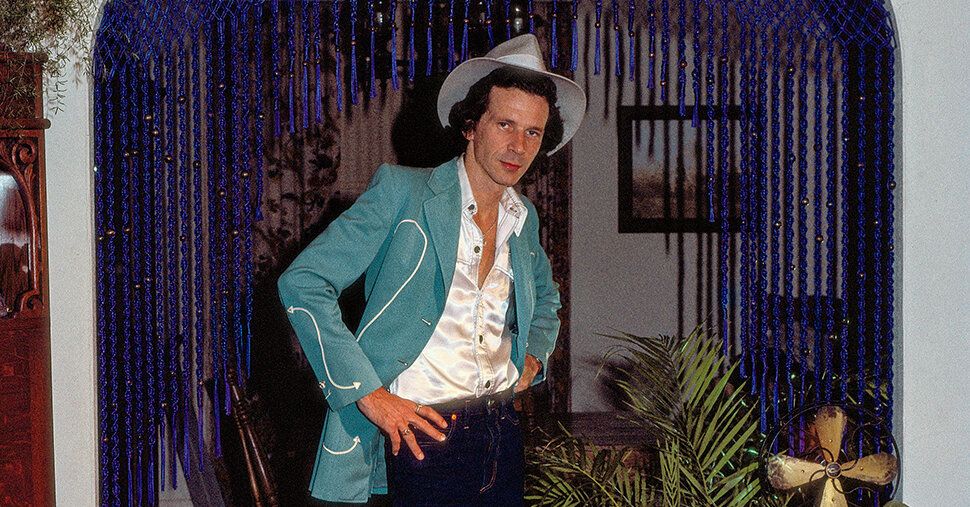
He once memorably described a country song as “a three-minute soap opera,” and signature songs like “Drinking Thing,” “She's Actin' Single (I'm Drinkin' Doubles)” and “In Some Room Above the Street” illustrated his point: These short, sharp musical melodramas, delivered in a high, flashy vibrato, cut through the placid country-pop of the era to reach the top of the charts.
During the second half of the '70s, Stewart found success as well as a diverse group of fans, including Bob Dylan, the Allman Brothers, Waylon Jennings and The Clash. But after a few years, the hits suddenly dried up. His label, RCA, attempted to team Stewart with up-and-coming singer-songwriter Dean Dillon for a pair of duet albums. When that failed to revive his career, Stewart left the label in 1983.
A writer's obsession
Around this time, McDonough caught one of Stewart's rare appearances in New York City at the Lone Star Café. McDonough hoped to find a “pompadoured, naked-suited song salesman” who would replicate his radio hits. Instead, the concert turned out to be a revelation. “In addition to his honky-tonk material, the guy could play piano like Jerry Lee Lewis, play stinging Southern rock like the Allmans, sing a ballad like Bobby Darin and play acoustic blues that would make Tommy Johnson nod his head,” McDonough said. “It just blew me away.”
At the time, McDonough was working as a sound editor for films, but seeing Stewart reoriented his life. He spent the next few years pursuing the singer, who had abandoned his career and disappeared in Fort Pierce, where he lived a hermetic and hedonistic existence. Determined to drag Stewart back into the spotlight, McDonough finally pinned him down in 1987 and spent 10 days and 10 nights interviewing him at his home. Over the course of intense conversations and occasional fights (Stewart liked to throw knives in McDonough's direction), the pair formed a strange and deep kinship.
The experience formed the basis of an extensive profile of Stewart published in the Village Voice in 1988, which launched McDonough's writing career. The story also revived Stewart's fortunes, as he returned and recorded a trio of albums for California indie roots label HighTone Records before retiring once again.