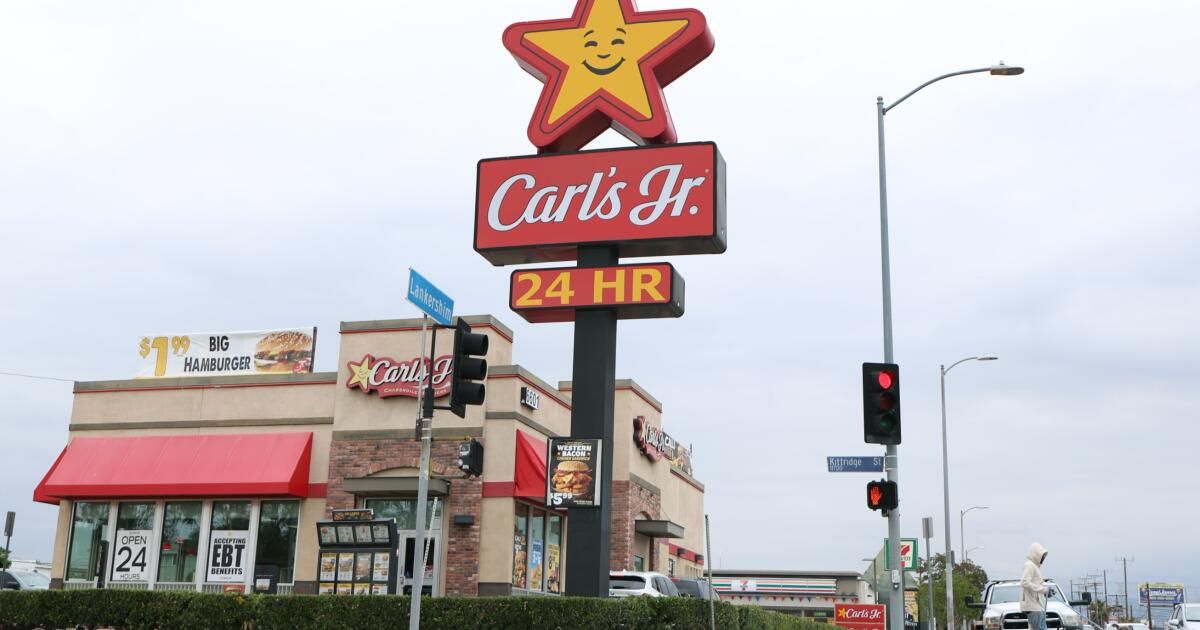
A Carl's Jr. franchisee is trying to close and sell its 59 California locations after filing for bankruptcy in April.
The franchisee, Harshad Dharod, who has locations primarily in Southern California, intends to close 10 of the locations he controls and find a buyer for the rest, according to a broker who helps find buyers.
In previous bankruptcy filings, Dharod had blamed California and Carl's Jr. for his stores' problems. Dharod said Carl's Jr.'s lack of support and innovation and an increase in labor costs from a $20 minimum wage left him unable to cover his expenses.
Dharod could not be reached for comment.
A spokesperson for Carl's Jr. and its parent company, CKE Restaurants, said they are aware of Dharod's decision to sell.
“This situation is specific to the financial and business circumstances of this individual franchisee,” the spokesperson said. “This has no impact on the operations of any other Carl's Jr. locations.”
National Franchise Sales will oversee the sale, which spans Southern and Northern California.
A spokesperson for the brokerage said it already has interest from potential buyers. The spokesperson said that when a franchise changes ownership, employees and managers usually keep their jobs.
Carl's Jr. began in 1941 as a hot dog cart on the corner of Florence and Central in Los Angeles and grew to become one of the region's best-known burger chains. It opened its first restaurants with expanded menus in Anaheim in 1946. Its smiling yellow star was born in the 1950s and quickly spread throughout California throughout the 1970s.
Although it moved its headquarters from Carpinteria to Tennessee in the last 10 years, its menu still reflects its California origins, with dishes like the Cali XL, a double cheeseburger. The chain was one of the first to spot the meatless trend and introduced plant-based burgers and the grilled turkey burger. In the early 2000s, it made waves with ads pointing to its California origins.
This year it has struggled to remain relevant amid new competitors and fast-food consumers who are becoming more demanding about what they will pay and eat, analysts say.
Like most restaurants, Carl's Jr. has been struggling to attract customers at a time when many are increasingly concerned about inflation and the health of the economy. Some chains are cutting prices. Smaller chains cannot compete well in price wars. Those without a strong brand identity or fan base have been suffering.
Dharod told the bankruptcy court that business had particularly worsened over the past two years, leaving him without enough access to cash to cover salaries, rent, supplies and insurance. Although his outlets have generated more than $6 million in monthly revenue, they have been losing more than $600,000 a month this year.
He had to ask for special permission to use his daily cash flow to finance expenses, or risk running out of money and being forced to close his stores.
A small group of the roughly 1,000 employees who work for the franchise say efforts to cut costs to a minimum have left them overworked, understaffed and exposed to violence.
Some say they get injured because they have to do the work of several people. Some detailed violent interactions with customers, including robberies and physical assaults, and said the company failed to provide safety training. Some have staged multiple strikes in recent months to draw attention to their concerns.