The cruise ship at the center of the deadly hantavirus outbreak is expected to arrive in Tenerife, part of Spain's Canary Islands, early Sunday morning to allow its passengers to disembark, Spanish officials said.
Spanish passengers on the ship, the MV Hondius, will disembark first, the country's Health Minister Mónica García said during a joint press conference with Spain's Interior Minister on Saturday.
Belgium, Great Britain, France, Germany, Ireland, the Netherlands and the United States will send planes to evacuate passengers from their countries, said Spanish Interior Minister Fernando Grande-Marlaska.
The European Union will send two planes to pick up passengers from other European countries, and the Netherlands will evacuate non-European citizens whose countries cannot send planes, he said.
“Spain can assure the entire world that this will be managed properly and that there will be no additional contact beyond what has already occurred on the ship,” García said.
Once all passengers have left the ship, the Hondius will sail to the Netherlands to be disinfected, Grande-Marlaska said.
Of the 147 people currently aboard the ship, according to its operator, Oceanwide Expeditions, none are showing symptoms, the World Health Organization said.
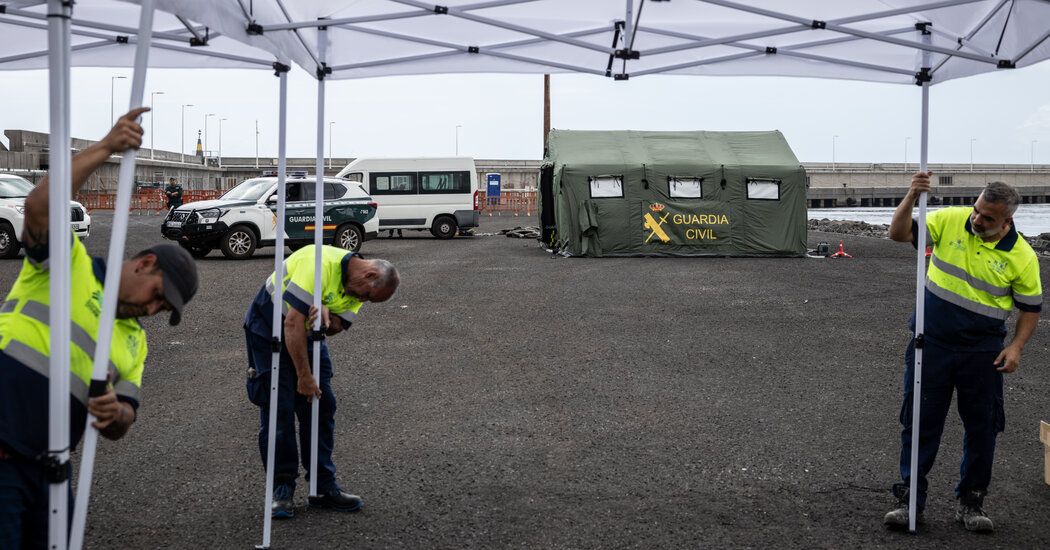
Once the Hondius arrives in Tenerife, the largest of the Canary Islands, passengers will be taken ashore at the port of Granadilla in sealed and guarded vehicles through a corridor cordoned off to the public, Tedros Adhanom Ghebreyesus, director general of the World Health Organization, said in a letter Saturday addressed directly to “the people of Tenerife.”
The passengers will then be repatriated to their countries of origin, he stated.
Health workers have assessed the exposure level of each passenger and the risk to the general public remains low, Maria Van Kerkhove, WHO's director of epidemic and pandemic preparedness and prevention, said during a briefing on Saturday.
Any passenger showing symptoms will be transferred to a separate plane and flown to the Netherlands for treatment, it said.
Dr Adhanom Ghebreyesus said he would be in Tenerife to personally supervise the operation and pay his respects “to an island that has responded to a difficult situation with grace, solidarity and compassion”.
He assured local residents that they did not have much to fear.
“This is not another Covid,” he said.
The Hondius left Argentina on April 1 with 114 passengers and 61 crew members. Three passengers have since died, one of whom was confirmed to have the virus, according to the WHO.
Garcia said Saturday that a test performed on a woman hospitalized in Alicante, Spain, and suspected of having hantavirus, had come back negative.
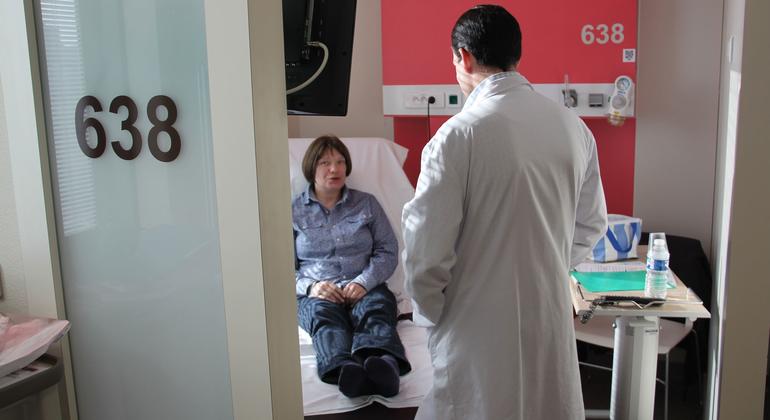
The woman had been on the same plane as one of the three passengers who died and had shown mild symptoms, including a cough. A second test will be performed in 24 hours to confirm the result, García said.
Seven of the 17 Americans who were on the ship have already returned home, according to the Centers for Disease Control and Prevention.
The agency said Saturday that the remaining American passengers would be evacuated to the University of Nebraska Medical Center in Omaha.
Although the center has a quarantine unit, the CDC said passengers would not be quarantined, but rather would be monitored and evaluated over a 42-day period, in some cases in their homes, in coordination with local jurisdictions and other government agencies.
Some stay-at-home riders may be asked to limit outdoor activities that involve prolonged interactions with others, the agency said Saturday.
It was not immediately clear how many American passengers would be able to remain at the Nebraska medical center and how many would be sent home for monitoring.
All remaining American passengers are asymptomatic and hantavirus testing is not recommended, according to the CDC. People without symptoms cannot transmit the virus, the agency said.
Researchers in South Africa and Switzerland have confirmed that the hantavirus cases aboard the Hondius involve the Andean strain of the virus, which is mainly found in South America and is the only hantavirus known to spread between people.
Early symptoms of infection include fever, chills, body aches, and headaches. As the disease progresses, it can cause difficulty breathing and, in severe cases, lung or heart failure.
Scientists around the world have been working, in some cases for decades, to develop treatments and vaccines specifically targeting hantavirus, but without much success.
Lynsey Chutel contributed with reports.