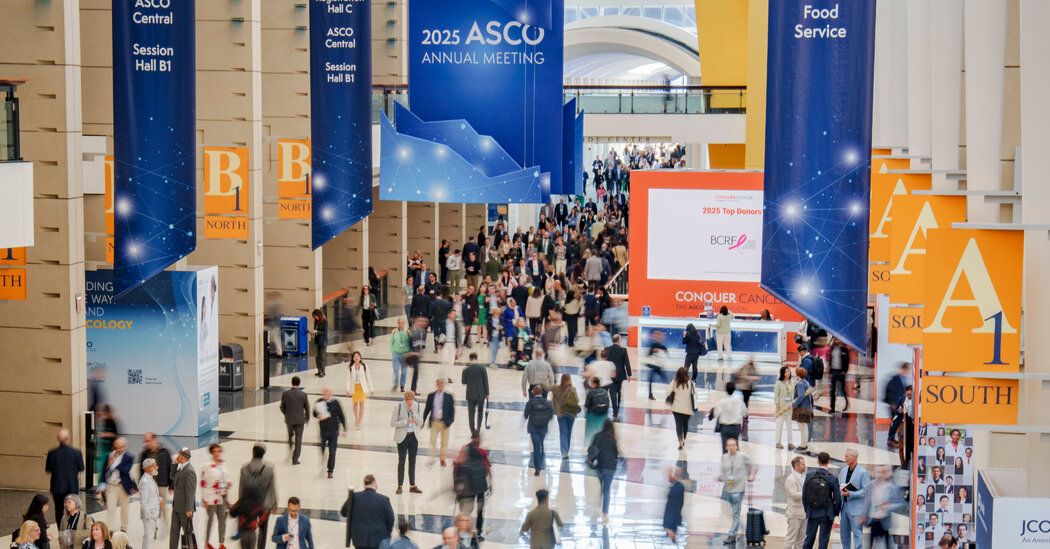
For decades, an annual meeting of oncologists has featured drug trials that were conducted primarily in American and European hospitals.
But at this year's meeting, to be held in Chicago this weekend, there are signs everywhere of China's rise as a drug development powerhouse and the threat many believe it poses to American biotech.
The clearest sign: In what appears to be the first time, one of the five coveted keynote topics of the conference will be the presentation of a clinical trial conducted solely in China.
That milestone at the meeting of the American Society of Clinical Oncology, or ASCO, reflects the dizzying growth of China's biotech sector. In just a few years, it has gone from a sleepy industry to a giant that rapidly invents and tests cutting-edge drugs.
“This tells us that the Chinese biotech industry has arrived,” said Dr. Otis Brawley, a Johns Hopkins professor who has attended the ASCO meeting every year since 1989.
But a growing contingent of American officials, executives and doctors fear that the shift of pharmaceutical innovation to China poses dangerous risks to American research, patients and biotech workers. They raise concerns about the loss of control over new drugs and about ceding the United States' long-standing dominance in the field.
While Chinese companies churn out patents, medical journal articles and new clinical trials, American biotech startups say they are struggling to keep up and face profound disadvantages.
“I think the concerns are valid and very real,” said Dr. Robert Califf, former commissioner of the Food and Drug Administration. “The United States is being seriously threatened.”
As tensions between Washington and Beijing have risen, Democrats and Republicans have sounded the alarm about the United States' dependence on China for generic drugs and raw materials.
Particularly targeting China, President Trump signed legislation prohibiting government agencies from contracting with certain foreign suppliers of biotechnology services in adversary countries. China's move toward developing cutting-edge drugs introduces a new dimension of risk, critics say.
There is another concern. Will the drugs work as well in American patients as they do in Chinese patients?
For reasons researchers don't fully understand, Asian lung cancer patients tend to live longer and respond better to immunotherapies than people of other ethnicities, according to some studies.
However, China has a very high rate of smoking and former smokers tend to have worse outcomes when they get lung cancer. Further complicating the picture are differences in treatment: The cancer drugs typically used in China are often not the same as those in the United States.
“Overall, things are looking better in China,” said Dr. Peter Marks, who was a longtime FDA official before resigning last year. “It's a tense area right now. I think a lot of us have real concerns.”
Dr. Marks, who has since joined Eli Lilly as an executive overseeing its work on infectious diseases, emphasized that he was not speaking for Lilly.
On the other side of the debate are those who warn that limiting competition from China would deprive Americans of new medicines. Ultimately, they say, the best data, no matter where it comes from, should prevail.
In clinical trials, “at the end of the day, patients either do well or they don't,” said Bob Duggan, co-CEO of Miami-based Summit Therapeutics.
Summit bought the rights to China's experimental drug, ivonescimab, which will get top billing at ASCO. The company is testing the drug in separate studies in American patients and is looking to bring it to market in the United States and other parts of the world. The Chinese company that invented the drug, Akeso Biopharma, already sells it in China.
China's growing influence
In recent years, the world's largest pharmaceutical companies have been filling their portfolios by turning to China, where prices are low, regulatory hurdles are fewer and development timelines are fast.
So far this year, about half of these major deals have involved a drug from China, up from almost nothing in the 2010s, according to DealForma, which tracks pharmaceutical industry transactions.
That trend will be clearly demonstrated at ASCO. Beyond ivonescimab, other presentations feature experimental cancer drugs invented and tested in China that have been acquired by large drugmakers such as Pfizer, Merck and Bristol Myers Squibb.
In particular, the drug acquired by Merck impressed the field with results, announced earlier this month, showing that it slowed tumor progression in Chinese patients with advanced lung cancer.
A Chinese company typically retains the rights to sell its drug in China. Big drugmakers buy the American rights, rejecting offers from American startups that are developing similar drugs.
China's critics also point to an increasingly worrying pattern. Chinese drug developers are rushing to essentially copy American inventions. To protect themselves, some American biotech startups have imposed new secrecy measures, such as refusing to publish papers or present posters at conferences.
As Robert F. Kennedy Jr., the US health secretary, told lawmakers at a hearing in April: “China is eating our lunch.”
In March, Chris Klomp, a top Kennedy lieutenant, described the current climate to attendees at the Conservative Political Action Conference. “It's not about missiles and tanks,” he said. “This is about labs and life-saving drugs. Right now it's a war with China against American innovation and biotechnology.”
For now, large multinational pharmaceutical companies are developing most of the drugs invented in China for introduction to the US market. But some fear that if more Chinese companies take a direct role, American patients could become dangerously dependent on the Chinese government for access to vital brand-name medications.
There is a risk, Dr. Marks said, of “creating a new Strait of Hormuz.”
Rep. John Moolenaar, R-Mich., has called for banning the FDA from reviewing data from China and curbing deals between major U.S. drugmakers and Chinese companies. But their proposals have not gained much traction.
Dr. Richard Pazdur, who was long the FDA's top cancer drug regulator and briefly led its broader drug division late last year, was well known for refusing to approve cancer drugs based on data collected solely in China.
Now, “regulators must prepare for an environment in which some therapies with substantial patient benefits may be studied primarily, or even exclusively, in China,” Dr. Pazdur warned in an op-ed in JAMA that he co-wrote in March.
Emily Hilliard, a spokeswoman for the Department of Health and Human Services, said the FDA evaluates whether the trials are “adequate and well-controlled, reliable, and applicable to the U.S. patient population targeted by the drug.”
ASCO's global influence
Seven oncologists founded ASCO in the United States in 1964, and as the field has grown globally, so has the organization.
In the world of cancer research, there are few greater honors than winning one of the top four or five presentation slots at the annual conference. Oncologists around the world identify and curate the most important, practice-changing science.
ASCO CEO Dr. Clifford Hudis said this was the first time the group could remember that one of those places went to a study that enrolled patients only in China. The closest precedent came in 2021, when one of the headlines involved a trial of an immunotherapy drug that was conducted primarily in China, with some sites in Taiwan and Singapore.
Dr. Hudis said his organization was “focused on results that can improve outcomes for patients, regardless of where they live.”
But this year's unusual selection has been generating buzz in medical circles for weeks. Dr. Christoph Westphal, a biotech venture capitalist, called the top billing at the conference “a coming-of-age moment for China.”
Chinese medicine against lung cancer
The moment of truth for the China-only study of ivonescimab comes on Sunday, when the data will be presented.
The drug, administered as an intravenous infusion, combines two attacks on a tumor. With one strategy it unleashes the immune system and with another it deprives the tumor of its blood supply.
The study, which involved more than 500 patients newly diagnosed with advanced lung cancer, looked at survival rates in a group that received the drug and in a group treated with a different immunotherapy. (Both groups also underwent chemotherapy.)
The drug used in the comparison group, Tevimbra, is not approved for lung cancer in the United States, where patients typically receive the successful Keytruda immunotherapy along with chemotherapy.
Because the Chinese trial did not examine whether its drug prolonged life more than Keytruda, American oncologists will have to try to analyze what the results mean for American patients, said Dr. Roy Herbst, incoming director of the Dartmouth Cancer Center.
Akeso, which funded the study, declined an interview request.
Summit has requested FDA approval of ivonescimab based on the results of a global study conducted in the United States, Canada and Europe. The FDA said it would decide in November whether to approve the drug.
In April, Summit revealed early results from another key global study in U.S. patients that sharpened questions about how well ivonescimab will work outside of China. The company said the drug failed to meet a statistical standard that, if successful, could have accelerated regulatory approval.
The disappointing results sank Summit shares. The company will now wait for final data from the study, which is expected later this year.