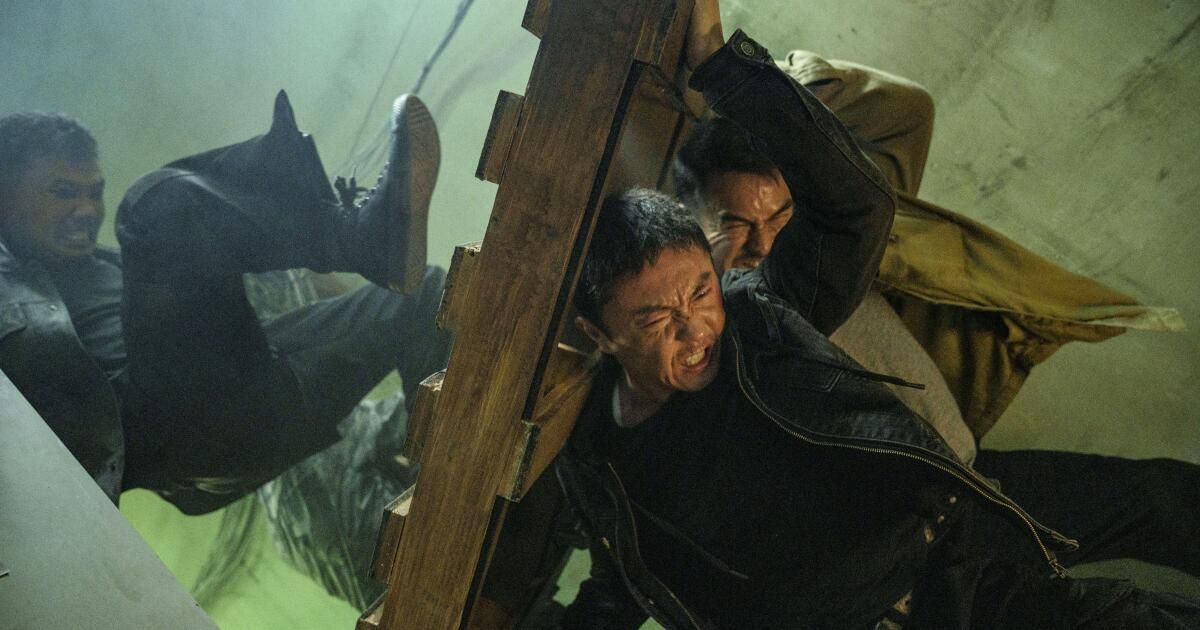
The action scenes in Kenji Tanigaki's “The Furious” are unlike any other film in cinema. Imagine a choreographed fight by ants, swarms of elbows and legs fighting to emerge victorious. Lots of flailing knees catching and tripping. A man swinging a ball peen hammer at a horde of incoming bad guys, knocking them unconscious as he scales their piled-up bodies like a cheerleading pyramid.
Meet the next Asian cinematic fighting style to hit Hollywood just as Hong Kong's wire-fu spawned “The Matrix” and Indonesia's “The Raid” spawned “John Wick.” In five years, Keanu Reaves will fight like this. (Though after decades of popularizing advances in fistfighting, he's earned the right to relax.)
Fights are the only reason to watch “The Furious.” As for the story, it is from memory: a father (Xie Miao) must rescue his kidnapped little girl (Yang Enyou). Hit the four credited screenwriters with a rubber mallet if you've heard that before. The only narrative novelty is how audaciously cruel the film is to children. Children are slapped, shot with arrows, and hung in traffic: torture that is played seriously, but the impact they cause makes you laugh.
To be fair, Rainy, a kidnapped 9-year-old girl, is very cute, with solemn eyebrows and a conscience that continually puts her in danger. Pushed into a dungeon of other children, she even hits a lame boy who deserves it.
Our setting is “somewhere in Southeast Asia,” according to the introductory text. I guess no country wants to blame a child trafficker (Joey Iwanaga) who orders his henchmen to kidnap new minors as casually as ordering takeout. Or perhaps the vagueness arises from a mix of Thai, Indonesian, Vietnamese, Chinese and American actors. It is not necessary to shake hands in a shared language when the group speaks with their fists. When they are forced to speak, a pair of dubbed voices sound plaintive.
To further reduce the dialogue, the main protagonist is mute. I'll accept that script choice. A nameless handyman with a mysterious past that receives and requires no explanation, Miao's face is very expressive. So is his temper, which accelerates from zero to 60 in an instant. When Rainy is thrown into a van, literally thrown backwards like a ball of a sports sock, her father immediately chases after her in flip-flops that deliver a visceral shock every time her vulnerable foot hits the pavement at full speed.
The haunting electronic score is by Flying Lotus, Elliot Leung and Olivia Xiaolin. But really what I will remember is the desperate sound of those sandals and then, the crunch of a broken neck.
The police wherever this is are ineffective. “You're bleeding all over my counter,” one complains when Miao runs to a police station to report the crime. Instead, the father teams up with an undercover reporter (Joe Taslim of “The Raid” and the recent “Mortal Kombat” reboot) who is trying to find his wife (JeeJa Yanin), a fellow journalist who is also pursuing the head of this crime syndicate. (Turns out there are some.) The stunning Yanin, a black belt in taekwondo, sets the bar high in the opening scene, fighting off two bullies who lift her high in the splits.
One of the attackers is 5-foot-2 dynamo Yayan Ruhian, who was so charismatic as the evil Mad Dog in “The Raid” that he not only appeared as a different character in the sequel, but even beat his way into a small role in the “Star Wars” universe. Here, Ruhian diversifies his skill set, killing people at a distance with a bow and arrow, which seems like a trap. Eventually (and fortunately) he will put down those weapons.
The new name we need to learn is Kensuke Sonomura, a veteran stunt director who is making his biggest impact in the West to date. Sonomura's style is volumetric; It dares to discover unexpected axes of movement. In his hands, that old cliché where a circle of ninjas challenge the hero one at a time becomes a sphere of ninjas that simultaneously envelop the hero from above and below. A hallway fight doesn't develop linearly. Instead, the attackers fill the space to the ceiling, forming what I can only describe as a Dagwood knuckle sandwich. However, Sonomura is governed by gravity. Their combatants do not float, but rather climb on each other's backs.
Sonomura fans can identify his technique at a glance. Barely contained by a screen, it resembles a microscope slide packed with bacteria. Cinematographer Meteor Cheung doesn't need to do much more than park his camera on a tripod and move it from side to side, occasionally looking down in alarm like a librarian peering over his glasses. But its color palette is so dirty that it becomes an obstacle. Does there have to be a dark basement? that dark? (For another angle on Sonomura's genius, look for the “Baby Assassins” trilogy, all the more appealing for having good scripts.)
Here, perpetual motion becomes physical comedy. The featured villain of “The Furious,” a bald thug played by Orange County native Brian Le, moves like a brute from an 8-bit video game, swinging his ankles before falling and booming. (You may remember Le as the pantsless security guard in “Everything Everywhere All at Once.”) As huge as Le is, he jumps horizontally, throwing his muscles into the air. Another time, he wipes the floor with an opponent (no, really) using his body to clear a path through the bloodshed.
Combining Tanigaki with Sonomura is a pleasure. The director is a long-time action coordinator whose mentor is Donnie Yen; Likewise, Sonomura has begun to run his own meticulously organized chaos. This display of their combined talents (one epic, the other intricate) comes as they are both transitioning to the boss in charge. The fact that Lionsgate is giving what could be its only team-up a wide release demonstrates the studio's confidence that it will be one of the defining stunt films of the decade. They're right to think so: “The Furious” will definitely leave its mark.
'The Furious'
In Mandarin, Tagalog and English, with subtitles.
Classified: R, for violence and strong, bloody language.
Execution time: 1 hour, 53 minutes
Playing: Opening Friday in wide release