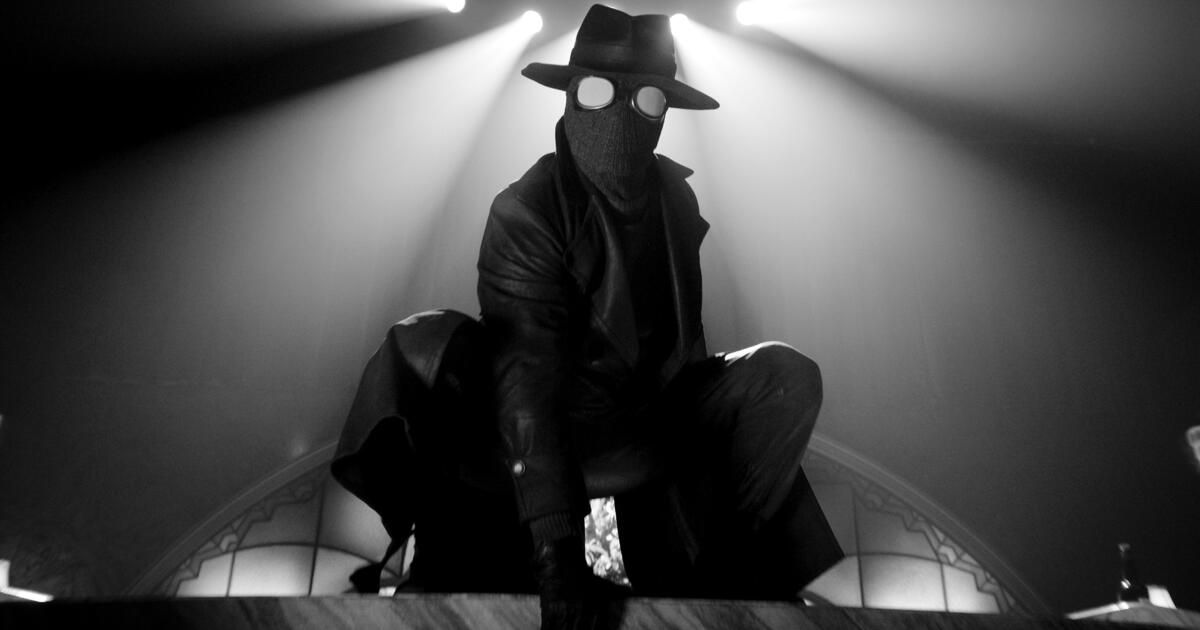
The infinitely exploitable Spider-Man is back in “Spider-Noir,” a retro story set in a recognizable New York in an inconsistent 1933 (judging by a preponderance of cultural references). There is comic book precedent for this version of the character, simply called Spider, although research tells me that, costume and superpowers aside, he is different in almost every way. I don't think that will be a problem for most of you.
Shot in “authentic” black and white, the eight-episode series, which premieres Monday on the MGM+ channel and streams Wednesday on Prime Video, is something of a gimmick, but it offers a reasonable and (imperfectly) period-appropriate approach to the material. (Stylistically, it belongs to a later decade.) A colorized version available, which seems mainly a concession to younger viewers who refuse to see anything in black and white, works less well, flattening and softening the image, making the special effects seem less special, the expressionist cinematography less expressive, and the ordinary scenes more artificial. You probably know which one I would choose, but you know.
Nicolas Cage, in his first live-action television role, plays Ben Reilly, a down-and-out private detective, who adds whiskey to his morning coffee kindly provided by his knowledgeable secretary, Janet (Karen Rodriguez), and barely scrapes by in the occasional divorce case. Five years earlier, as the Spider, he was a super-powered town guardian; but he abandoned it after the love of his life was killed by the Spider. In this variation, she's the one who told him that with great power comes great responsibility, that hackneyed Marvel homily, quoted in this world as if it were the work of Abraham Lincoln and not Stan Lee. But Reilly, who calls himself a coward and claims not to be a hero, views his mutant abilities as “a part of me that I wish never existed. Without power, there is no responsibility.”
Naturally, in the Spider's absence, things have gone to hell in Gotham. “The city is a mess,” says Reilly’s best and only friend, unemployed journalist Joe “Robbie” Robertson (national treasure Lamorne Morris, being real, relatively speaking). “People could use a hero.”
“Well, I hope they find someone,” Ben says.
Robbie Robertson (Lamorne Morris) is a journalist and Ben Reilly's best friend.
(Aaron Epstein/Prime)
However, you won't be surprised when, much against his will, Reilly falls into a web of intrigue; involving the city's smuggling crime boss, Silvermane (Brendan Gleeson, serving a full Irish breakfast), whose superpower is that he has very pretty hair; Silvermane's sort-of lover, femme fatale nightclub singer Cat Hardy (Li Jun Li), a bird in a gilded cage; and Cat's bodyguard, Flint (Jack Huston), who has disappeared. You also won't be surprised to learn that other super-powered entities will show up to give our hero, who will soon be strolling around town, never losing the fedora on his masked head, someone his size to mess with.
To coin a phrase, some are born with superpowers, some become superpowered, and some have superpowers imposed on them, and in all cases this comes with its share of tragedy and trauma, for both the heroes and the villains. If there's a theme for “Spider-Noir,” beyond “making another Spider-Man show,” it's this, and there's a column of sadness that runs through the series, its best and most depressing feature (and, taking “noir” as the word is, appropriate for the genre).
The cinematography and production design, achieved through any combination of backlot shots, dressed locations, digital environments, and black magic, work better and worse (though never badly) from shot to shot, but Alfred Hitchcock used background projections and model trains, and it's nice to see Manhattan before those pencil-thin supertowers started polluting the skyline. (It is the city as King Kong knew it).
The pace can be slow at times. The music goes everywhere except the period depicted and the characters quote lines from movies that haven't been released yet. The writing and acting boldly flirt with clichés and caricatures, which, as the show is 100% pastiche, drawn from films more than three-quarters of a century old, could hardly be avoided and isn't really a problem. (In a way, that's the point.) You might see a scene lifted from Orson Welles' “The Lady from Shanghai,” narrative echoes of “Casablanca,” a line that echoes James Cagney's last words in “White Heat,” come to mind.) But the overall what and why of the story is clever, and the conclusion satisfying.
Cage, who voiced a different version of the “Spider-Noir” character in the animated film “Spider-Man: Into the Spider-Verse,” is a good choice for the weary detective. (The series is about 75% detective story, 25% superhero) Metafictionally, he will do an Edward G. Robinson impression, mouthing Cagney's dialogue sitting alone in the theater. But the main model is Humphrey Bogart, whose appearance is quite reminiscent of Cage; Bogart played Sam Spade and Philip Marlowe in the films most associated with those characters, whose biting humor creator and writer Oren Uziel seeks to replicate here, quite successfully. One can forget that Cage, who finds a middle ground between playing a part and playing a person, is a good comic actor, and not just a weirdo.