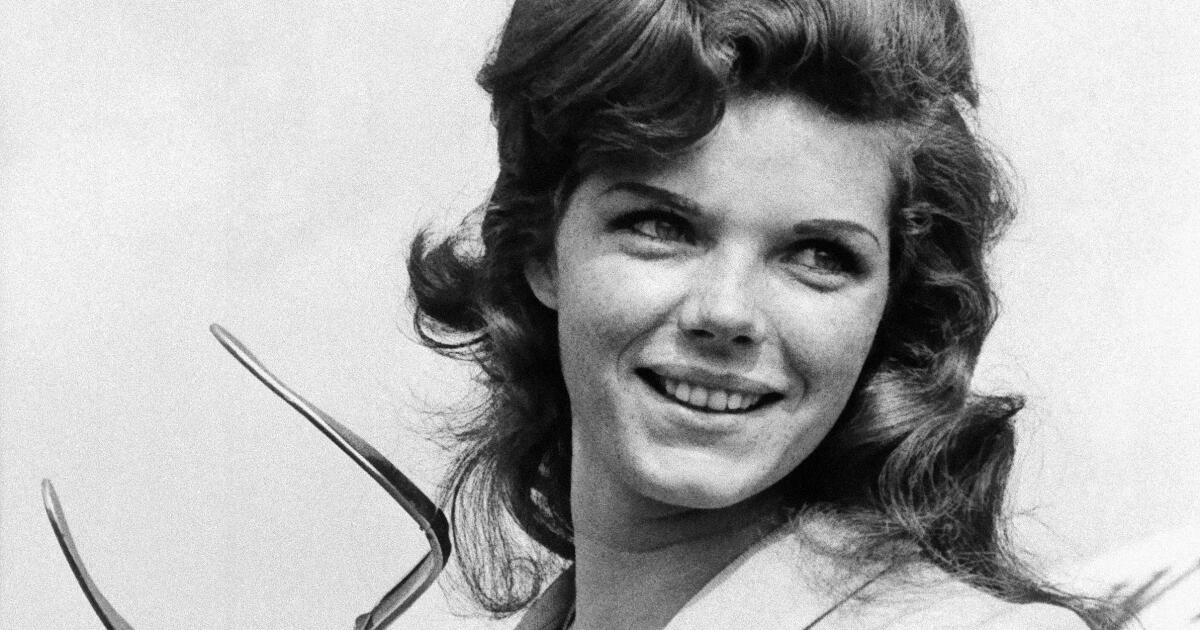
Samantha Morton didn't want to hum during that scene in “The Odyssey,” the scene everyone's talking about, when, as the sorceress Circe, she turns Odysseus's men into pigs, literally molding them into their true wild selves.
It wasn't in the script. It just happened. And when Morton finished, she looked at director Christopher Nolan, waiting for him to say something like, “Maybe try it without humming, Samantha.”
But Nolan didn't say anything, so Morton did it again, and the music swirling inside his head, which he now remembers as a symphony of glass harmoniums and theremin, continued to pour out while Circe went about her witch business, disturbing her gluttonous guests, who are busy slurping and gulping down her stew.
“Apparently these are sounds that can drive you crazy,” Morton, 49, tells me, reclining in her bed at the Chelsea Hotel in New York. “So, to transform men, the magic not only came from my hands but also from my sounds.”
Samantha Morton as Circe in “The Odyssey,” directed by Christopher Nolan.
(Melinda Sue Gordon/Universal Pictures)
Morton unashamedly believes in magic. How else, he asks, can you explain how a girl who was shuttled between children's homes and a dozen foster families, only to live on the streets of Nottingham, England, at the age of 14 with a criminal record, is here talking to me now, drinking green tea at Chelsea?
“It has to be guardian angels and love, and it's not like I suddenly got good at acting and got a job,” says Morton, a veteran who's been at it for 35 years, dazzling audiences and stealing scenes for the likes of Steven Spielberg, Jim Sheridan and, now, Nolan. “I have always believed that everything is possible and there is no doubt here,” and he caresses his heart, “because I have always felt this immense love for me coming from another entity.”
When Morton learned that Nolan wanted to reunite with her for “The Odyssey,” she says she cried. If that sounds dramatic, no apologies. She compares it to being an athlete who qualifies to represent her country in the Olympics. He had spent decades honing his craft for that phone call. When the time came, he flew to Los Angeles in January 2025 during the wildfires and embarked on what would become the best job interview of his life.
I ask him what he remembers from that meeting.
“I think it turned out really well,” Morton responds, laughing.
Morton told Nolan that he hadn't read “The Odyssey,” which, when you leave school at 12, makes sense. Upon returning to England (she and her husband live in East Sussex with their children, Edie, 18, and Teddy, 12), she recalled that yes, she knew a little about “The Odyssey” from having seen it parodied in an episode of “The Simpsons.” (“We're crazy about 'Simpsons' in our house,” he says. “Like, angry.”)
But Morton doesn't believe in getting bogged down in research, ever since she starred in a British television production of “Jane Eyre” when she was 19 and carried around a heavily highlighted copy of Charlotte Brontë's book, desperate every time the adaptation deviated from the novel. From that moment on he stuck to the script and his own imagination.

“It has to be guardian angels and love, and it's not like I suddenly became good at acting and got a job,” Morton says of her career. “I have always believed that anything is possible.”
(Ebru Yildiz / For The Times)
Thinking about Circe, Morton recalled going to the library with his father (“We had nothing and we were beyond poor, but he always had a library card,” he says) and found Howard Pyle's book of fairy tales “King Stork.” She remembers being hypnotized by the evil witch in the story. She remembers other witches from popular tales like Baba Yaga, terrifying characters but also, she says, “women who possess an innocence that had been eroded over the years by the harshness of life.”
Morton makes a playful verbal evasion when discussing the practicalities of filming the scene in which Circe transforms Odysseus's men, saying that in the days when behind-the-scenes features were prevalent on DVDs, she routinely declined to participate.
“I didn't mean to be misleading, but it was like: This is my private moment. This is for me,” he says. “I like the idea of a little mystery.”
But a moment later, she laughs and dives in, remembering that her husband showed her an Instagram post from Nolan's set that revealed how the film's Cyclops was, in fact, a puppet.
“Oh my gosh, I love puppets!” Morton raves and walks away telling me how much he loves Jim Henson and that “The Dark Crystal” is one of his favorite movies of all time.
What you will say about your “Odyssey” scene is that there were no digital effects. It was all real and “on camera” and she was so focused that she barely remembers any of it, just flashes.
“That's not CGI,” says Morton. “That's human brilliance and a connectivity of mine as a performer, almost dancing and feeling like one. And I don't want to say it was sexual, but I wanted it to be very sensual when she's with the men and the animals, like, you know, she's almost one with them.”
“What was so nice about that?” Morton begins and then stops, wondering if he should pull back the curtain on the creative process. She keeps going. “There was one day on set where Chris was like, 'Okay,' and he stuck his hand in because I was a little scared. It's like that scene in 'Raiders of the Lost Ark' where he sticks his hand in the thing and you're like, 'Oh no!' I was a little nervous, but Chris did it first. “I think he really cut his finger.” She laughs. “You know, he's going to go in first, like going into the cold sea water. I felt protected and supported through that whole process.”
When Odysseus's men arrive at Circe's house, hungry and asking to be fed, Circe seems scared, which is understandable. She is alone and these soldiers have a history of looting and taking what they want. And yet she is a powerful sorceress. Is Circe really scared or is she tricking them to lure them in?
“I played it like she was really scared because she was caught off guard,” Morton says. “I also wanted to play someone of all ages, so in that scene I played her as a 16-year-old girl. And then in other scenes, I play her as a 90-year-old woman or a 49-year-old woman or a sister or a mother, a grandmother. I just wanted her to be ageless.”
Morton, caring for Circe, emphasizes that transforming Odysseus's men was not purely vengeful.
“It's not just hate,” he says. “It's not just hurt. It's not just anger. It's almost like a Zen master within the teaching goddess role as well. 'Be careful what you wish for,' gluttony, greed, all these things.”
There is also a righteous feminist rage beneath the scene, a modernization that fiercely and disturbingly updates “The Odyssey.” It's another reason why people leave the theater talking about Morton.

“In some strange way, the movie lived or died by that character,” director Nolan says of Morton's Circe, a creation of pure acting and no digital sorcery. “She was the support point.”
(Ebru Yildiz / For The Times)
Nolan believes that “The Odyssey,” in some strange way, “lived or died for that character; she was the fulcrum.” He told The Times that “after one of his takes, the crew gave him a big round of applause.” Emma Thomas, Nolan's producing partner and wife, later recalled that the last time that happened was with Heath Ledger in “The Dark Knight.”
Morton makes a point of telling me how much Ledger meant to her, since she was cast opposite him (and Odysseus himself, Matt Damon) more than 20 years ago in Terry Gilliam's 2005 fantasy adventure, “The Brothers Grimm.” Miramax boss Harvey Weinstein overruled Gilliam and removed Morton from the film because, in his eyes, she was not attractive enough.
“And Heath fought for me with such kindness and compassion,” Morton says. “To me, he's right up there with Philip Seymour Hoffman. There's something otherworldly personal about what they gave, such sincerity and vulnerability and absolute dedication to the craft. They leave a mark on your heart.”
This is not the first time Morton has invoked the heart in our conversation. He took his son Teddy to New York for the premiere of “The Odyssey” because he wanted to show him the place where his creative spirit was born. Morton first came to New York as a teenager to do press for “Emma,” returned a year later to promote “Jane Eyre” and then didn’t dare leave, “couch surfing” at his friends’ apartments so he could immerse himself in the city.
“New York stole my heart,” Morton says. It was there that he first dabbled in literature, devouring Charles Bukowski, wandering the aisles of St. Mark's Bookstore, watching Kim's Video movies, and devouring hash browns and eggs with ease at the Waverly Diner.
Not long after, Morton landed the role that would earn her the first of two Oscar nominations (at least for now), playing the mute washerwoman in Woody Allen's “Sweet and Lowdown.” The production housed her in a Greenwich Village apartment and when it wrapped, she moved to the East Village.
Only the restaurant remains, but Morton still plans to tour the Village with Teddy, showing off all of Mom's old haunts and, yes, having a cup of soup at the Waverly.
“Life is good now,” Morton says, smiling. “Who knows? Maybe I'll like some hash browns.”