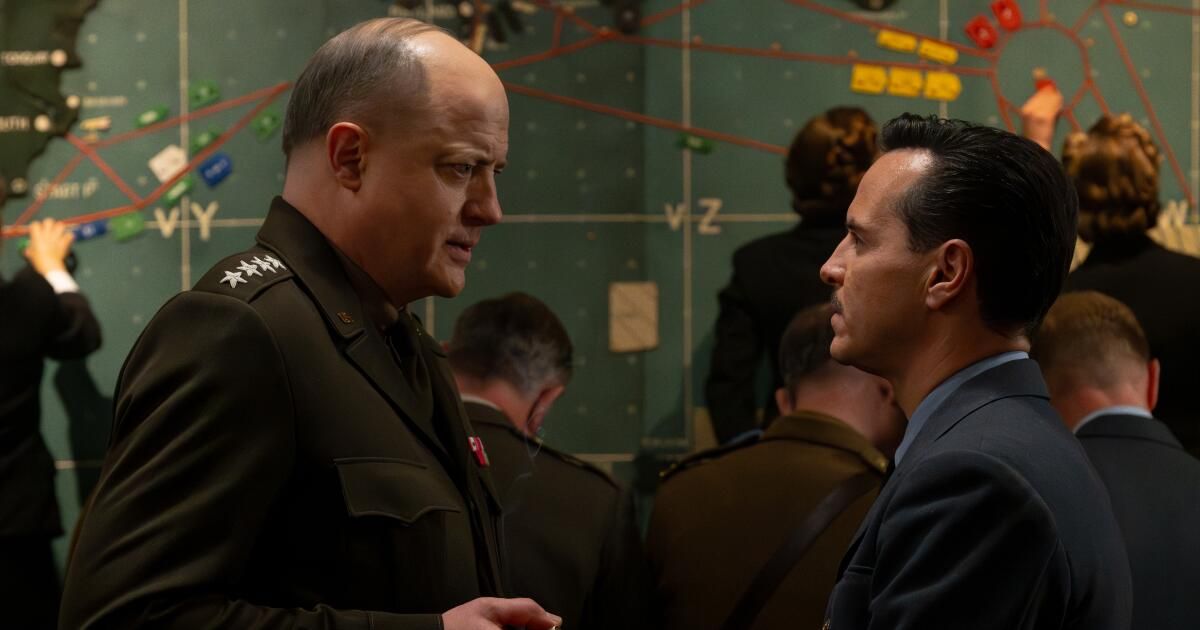
“Pressure,” the new World War II film from director Anthony Maras and writer David Haig, is a hyper-focused look at the days leading up to D-Day with a focus on the weather. It's a single-scene thriller set in the pressure-cooker environment of General Dwight D. Eisenhower's war room on an English country estate. The film builds on a famous 1961 Eisenhower joke to JFK that attributed his success in Normandy, France, to the Allies having “better meteorologists than the Germans.”
If you're skeptical about how exciting a D-Day climate movie could be, “Pressure” takes it as a creative challenge, an argumentative stance from which to begin. Over the next hour and 40 minutes, Maras and co-writer Haig, who also wrote the 2014 play from which the film is adapted, walk us through exactly how important the D-Day meteorologists were, starting with the disastrous D-Day rehearsal, Exercise Tiger.
With the weather app at our fingertips today, it may be difficult to imagine how difficult it was to forecast the weather in the 1940s, especially in northern Europe. That was the situation that Eisenhower (Brendan Fraser) faced just 72 hours before the scheduled release of D-Day, June 5, 1944. But we know that D-Day occurred on June 6, so arriving at that date is part of the film's narrative intrigue.
After a devastating vision of Exercise Tiger, red blood mixing with blue ocean waves and white sand beaches, we are quickly introduced to our protagonist, the group's captain, Chief Meteorologist James Stagg (Andrew Scott), in his cozy home with his pregnant wife before being dragged into critical war planning.
He is severe, concise and sensible. Stagg is the kind of person who wants to be right more than he wants to be liked and insists on careful live data collection, using weather balloons, phone calls and mathematical graphs. His foil is Colonel Irving Krick (Chris Messina), a charming American meteorologist and Eisenhower's hand-picked weather guru, a yes man who relies on selective historical data, and a persuasive speaker whose approach irritates the annoying Stagg. Eisenhower orders the two men to reach an agreement, and “Pressure” follows the ups and downs of their working relationship over several days.
The film becomes a duel between Scott's Stagg and Fraser's Eisenhower: the former is convinced that a storm on June 5 will make conditions less than ideal, the latter bristles at the uncertainty while simultaneously trying to placate a phalanx of military personnel. The troops are requisitioned, the destroyers are in place, the full moon is perfect, the secret of the invasion is delicate. Fraser's explosive performance underscores the immensity of what is at stake, balancing every precarious element of this enormous mission.
Maras, known for another fantastic single-scene thriller based on a true story, 2018's “Hotel Mumbai,” directs and edits, and his films come together like precision clockwork: propulsive and relentless, the italic rhythm of Volker Bertelmann's scores. “Pressure” is skillfully directed, drawing us into this world with a kind of addictive immediacy, and it's also beautifully shot by cinematographer Jamie Ramsay. Maras and Ramsay make the wise decision to shoot the film in richly saturated colors rather than the usual grayish, desaturated look often assigned to period pieces set in this era. It is not harsh or harsh, but rather impressive and charming: a disturbing contrast to the terror and bloodshed of the day itself.
While Fraser gives an outward performance as the tough American general, Scott gives a restrained, mostly tamped portrayal of the repressed and methodical Stagg. But when he finally breaks out with a cathartic last-minute speech about the inaccuracy of Krick's historical forecast, Eisenhower listens. Scott, as seen in “All of Us Strangers” and “Blue Moon,” is very good at this type of acting, processing each emotion internally but letting enough show for the audience to get into his character's emotional state. It's tremendously compelling to watch.
In a calm conversation with Kay Summersby (Kerry Condon), Eisenhower's confidant and close aide, she jokes that meteorologists are boring. Stagg reminds him that the weather itself is not. The climate feeds us, it can destroy us: it governs our existence, he says. “People ask, 'When will the wind stop blowing?' Nobody ever asks: 'W.hello is the wind blowing? What is the wind?'”, revealing himself to be something of a philosophical weather poet. His forecast was the crucial advantage on D-Day and the volatility of weather is increasingly relevant in our lives, especially with our changing climate.
Bored? Never. Exciting and historic? Indeed.
Katie Walsh is a film critic for the Tribune News Service.
'Pressure'
Classified: PG-13, for war violence, gory images, strong language and smoking.
Execution time: 1 hour, 40 minutes
Playing: Opens on Friday, May 29 in wide version