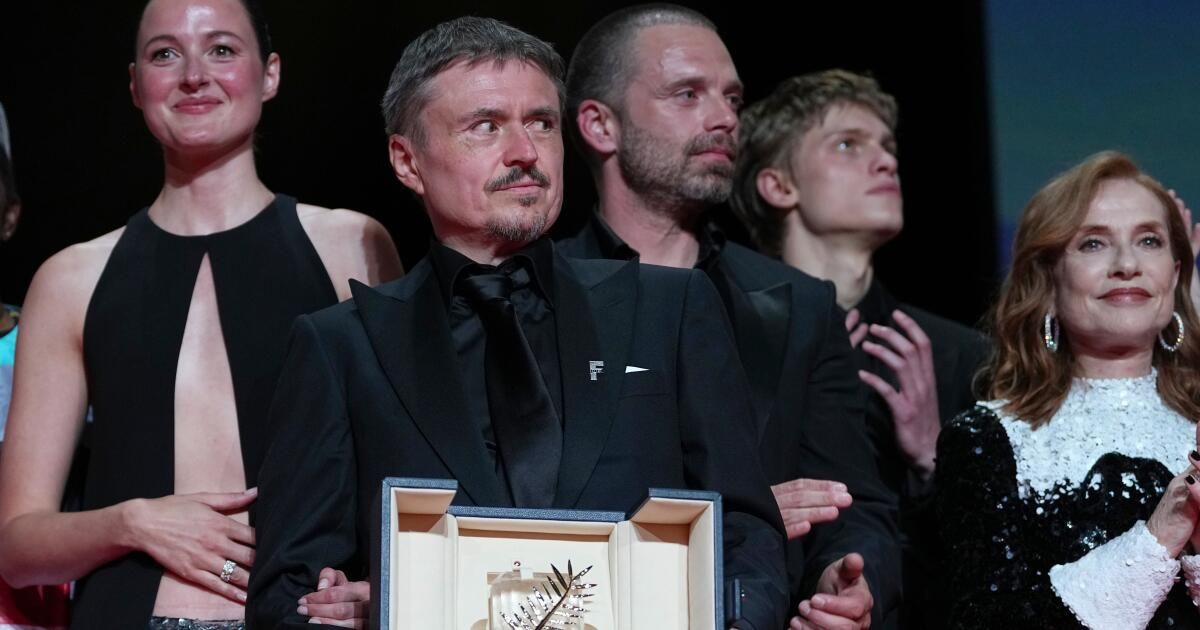
In a tough race for the top prize at Cannes, Romanian director Cristian Mungiu won the Palme d'Or on Saturday for his tense community drama “Fjord.”
The film, a much-admired talking point at the festival, stars Sebastian Stan and Renate Reinsve as religious parents who come into conflict with child protective services in their small Norwegian town to which they have moved with their family.
Mungiu, a previous winner of the Palme for his controversial 2007 abortion drama “4 Months, 3 Weeks and 2 Days,” now joins an exclusive group of 10 filmmakers who have won the Palme twice, an achievement shared by Francis Ford Coppola (“The Conversation” in 1974 and “Apocalypse Now” in 1979) and Ruben Östlund (“The Square” in 2017 and “Triangle of Sadness 2022”), among others. No one has ever won a third Palme d'Or.
Another record, perhaps even more impressive, was established by the distributor Neon, which with “Fjord” extended its winning streak in La Palma to seven consecutive victories, something unprecedented. Those six previous Neon winners, many of whom ultimately went on to win Oscars, are “Parasite,” “Titane,” “Triangle of Sadness,” “Anatomy of a Fall,” “Anora” and last year's “It Was Just an Accident.”
Neon will release “Fjord” in the fall, followed by an extensive awards campaign.
This year's competition's nine-member main jury, headed by Korean director Park Chan-wook and packed with the likes of “The Substance” star Demi Moore, Stellan Skarsgård and “Hamnet” director Chloé Zhao, seemed determined to spread the wealth among as many winners as possible. There were three ties at Saturday's awards ceremony.
The actress award was shared by Virginie Efira and Tao Okamoto, co-stars of Ryusuke Hamaguchi's “All of a Sudden,” a film that many believe could go all the way. Similarly, the actor award was given to Emmanuel Macchia and Valentin Campagne, co-stars of Lukas Dhont's World War I romantic drama “Coward.”
The directing award went to three people – and two films – with a joint win going to Javier Calvo and Javier Ambrossi (better known as Los Javis) for their century-spanning queer historical drama “The Black Ball,” as well as director Paweł Pawlikowski for his exquisite post-World War II psychodrama “Fatherland.” (Pawlikowski half-joked at the podium, “This was a disastrous piece of staging” after the awkward award presentation had him waiting in the wings.)
This year's Grand Prix (essentially second place) went to “Minotaur,” the comeback film of Andrey Zvyagintsev, a Russian director who had been sidelined by a near-fatal bout of long COVID that left him in a coma. His new film, about a wealthy Moscow family, is both an erotic thriller and a denunciation of the amoral oligarchy separated from the war with Ukraine.
The third prize from the festival jury went to the German border drama “The Dream Adventure,” directed by Valeska Grisebach.