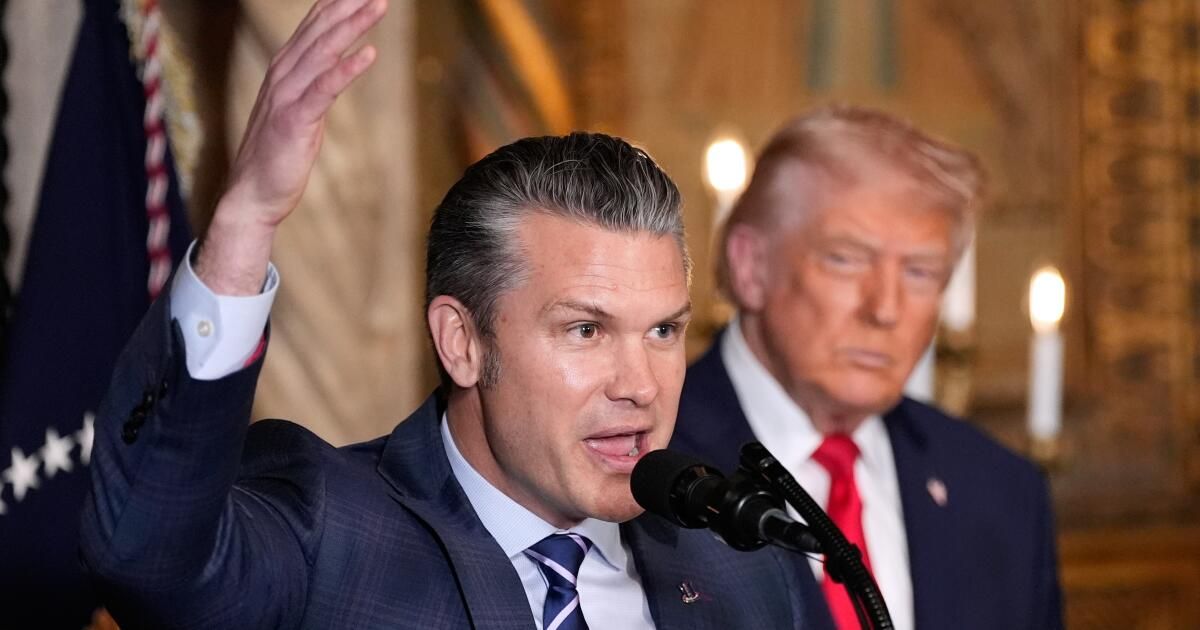
WASHINGTON- The day after Christmas is usually quiet in the country's capital. But President Trump's decision to acknowledge a covert US attack on Venezuelan territory, in an interview with an obscure local media outlet on Friday, sparked a revolt in a sleepy Washington that has become a hallmark of the president.
Officials working on Latin American policy for the administration and who had been closely following reports of refinery fires and other curious events across Venezuela could not immediately determine what goal the president was talking about, three sources familiar with the matter told The Times.
Trump would later detail that the attack targeted an “area of the dock where ships are loaded with drugs.” But the initial confusion within his own government signaled how tight a circle there is within the West Wing in determining whether to climb the ladder toward war with Caracas.
Trump initially confirmed that he had authorized CIA actions in Venezuela in an exchange with journalists in October. While the administration is required to report to Congress on CIA covert operations, stronger congressional authorization is required for the use of military force.
“I authorized it for two reasons, actually. Number one, they've emptied their prisons in the United States of America,” Trump said at the time. “And the other thing, drugs, we have many drugs that come from Venezuela, and many of the Venezuelan drugs arrive by sea.”
The strike comes as Venezuelan authorities have increased the number of US citizens detained in their custody, the New York Times first reported on Friday. Caracas had released 17 Americans and permanent residents held in notorious Venezuelan prisons at the start of the Trump administration.
Evan Ellis, who worked during Trump's first term on planning State Department policy on Latin America, the Caribbean and international narcotics, said it was “unclear whether the initial plan was for this operation to be announced publicly in an interview with the president.” Venezuela's dictatorial president, Nicolás Maduro, “was certainly confused about it,” he said.
“It would make sense for them to do something like that, rather than a military strike, especially now that there's a fine line between military operations and other things,” Ellis added. “My sense is, to the extent the president has acknowledged, that they were the ones carrying out their mission of shaping the battle space in support of broader national objectives.”
But Trump has yet to articulate the full scope of those goals, leaving observers wondering whether regime change in Venezuela is his true and ultimate goal.
Trump has repeatedly told the media that Maduro's days in power are numbered. The administration refers to him and his regime as an illegitimate narco-state that terrorizes American communities. In a bipartisan manner, since Trump's first term and throughout the Biden administration, the United States has recognized a democratic opposition in Venezuela as its legitimate government.
But a military war against drug trafficking would make little sense directed at Venezuela, where only a fraction of the illicit narcotics smuggled into the United States originate. Trump has hinted in recent weeks at other reasons driving his calculation.
Over the past four months, the Trump administration slowly increased its pressure campaign on Maduro, first attacking ships allegedly transporting narcotics and drug smugglers in international waters before announcing a blockade of Venezuelan oil tankers. As a result, Venezuela's oil exports have plummeted by half over the past month.
On Wednesday, the Treasury Department also issued sanctions against four companies that it said operated in Venezuela's oil sector or accompanied oil tankers.
“The Maduro regime increasingly relies on a shadow fleet of vessels from around the world to facilitate sanctionable activities, including sanctions evasion, and to generate revenue for its destabilizing operations,” the department said in a statement. “Today's action indicates once again that those involved in the Venezuelan oil trade continue to face significant sanctions risks.”
Meanwhile, the Pentagon has stationed nearly a quarter of the US naval fleet in the Caribbean since the summer, in what Trump has called an unprecedented “massive armament” in the region.
While Venezuela's current oil production is modest, the nation has the largest known oil reserves in the world, offering significant potential access to future strategic partners. China is currently the largest importer of Venezuelan oil, and at least one tanker under the US blockade has sought protection from Moscow, Maduro's main military ally.
Addressing the blockage in an exchange with reporters, Trump said he had spoken to senior U.S. oil executives about what the Venezuelan market would be like if Maduro were no longer in power. And he suggested that the U.S. government would keep the seized barrels, recalling Trump's campaign throughout the 2010s for the U.S. to control Iraq's oil fields as spoils of its war there.
“We're going to keep it,” Trump said last week, about the 1.9 million barrels of Venezuelan oil seized on the first tanker. “Maybe we'll sell it. Maybe we'll keep it. Maybe we'll use it in strategic reserves. We'll keep it.”
“We will also keep the boats,” he added.