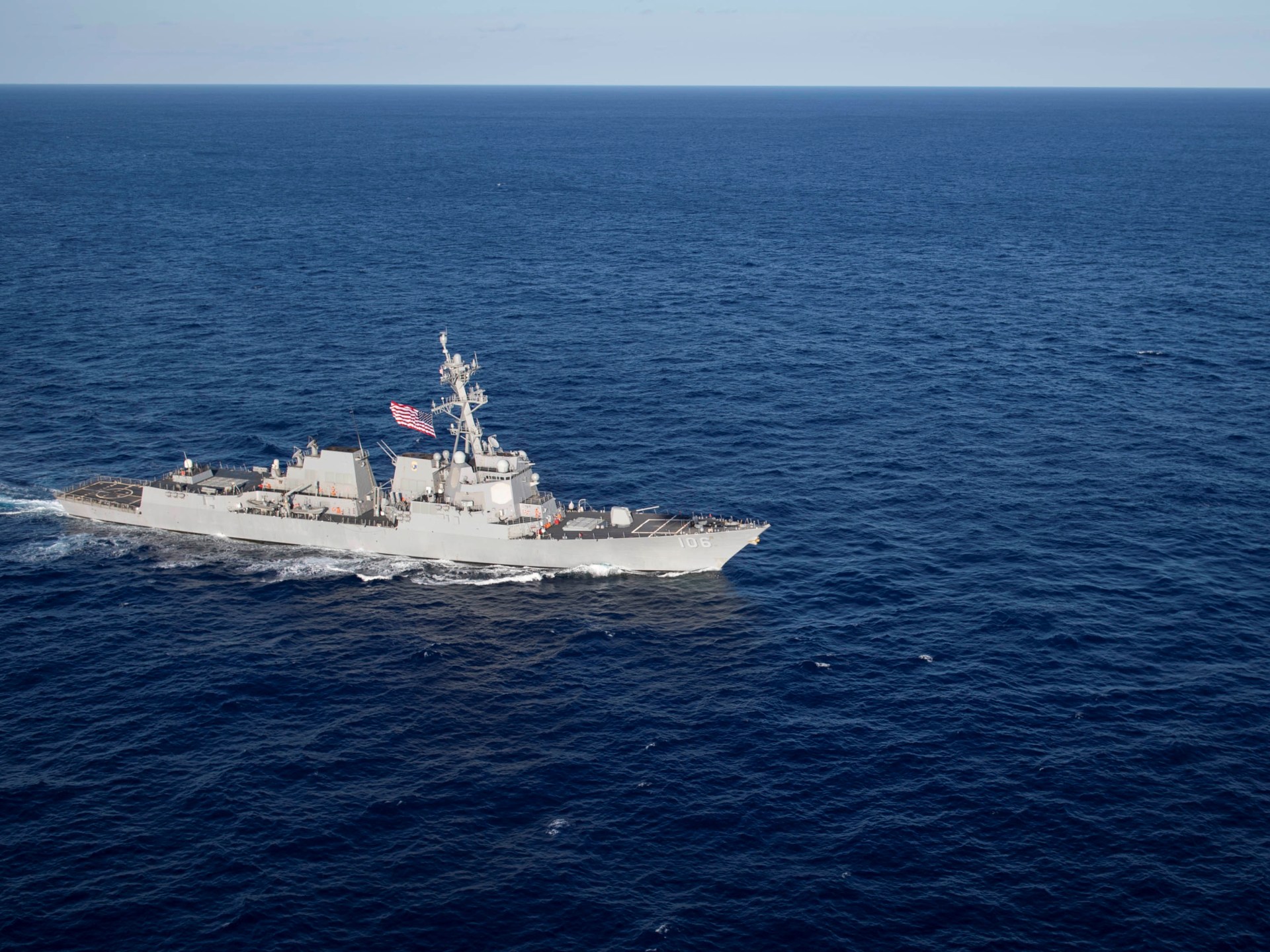
WASHINGTON- Last week, the Defense Department outlined a concise set of military objectives in President Trump's war against Iran, stating that its ultimate goal is to dismantle Tehran's ability to project power beyond its borders. However, it may be targets that the Pentagon has left largely unacknowledged that offer the clearest view yet of Trump's true intentions.
US military strikes have focused on Iran's nuclear, ballistic missile and drone programs, as well as its naval assets, according to US Central Command. But attacks have also increasingly targeted Iran's internal security forces, used by the Islamic Republic to suppress public dissent, according to an analysis by the Institute for the Study of War and Critical Threats Project shared with The Times.
The attacks have targeted at least 123 headquarters, barracks and local bases operated by Iran's paramilitary organizations, including the Islamic Revolutionary Guard Corps and its Basij militia. Regional police forces have also been attacked, mainly in the capital region around Tehran and in western Iran, near areas dominated by Kurdish groups hostile to the Iranian government.
Some of those groups are being armed and supported by the U.S. intelligence community, said a U.S. official, who spoke on condition of anonymity to speak candidly.
Nicholas Carl of the Critical Threats Project said the pattern indicates that the campaign is already underway to set the conditions for a revolution.
“As we pursue these repressive institutions, we are degrading the regime's ability to monitor its population, to repress it,” Carl said. “And so it appears that the strike campaign may be organized around an attempt to erode the regime's ability to repress in those areas.”
Analysts said attacks on internal forces could be larger than they have measured so far, pointing to the difficulty of tracking targets in the war based on publicly available data due to an internet blackout strictly enforced by the Iranian government.

An explosion erupts after attacks near the Azadi Tower near Mehrabad International Airport in Tehran on Saturday.
(Atta Kenare/AFP/Getty Images)
The quieter side of the US campaign suggests a political strategy by the Trump administration that goes beyond simply containing the Iranian government and may instead aim to lay the groundwork for its overthrow.
Trump and his top advisers have been inconsistent in their messaging about their goals for the war, vacillating between calls for regime change and much shorter ambitions, such as an Islamic Republic remaining in power under leadership more accommodating to the United States.
Before the war began, Trump was presented with an intelligence assessment that large-scale military action was unlikely to topple the Iranian government, two sources familiar with the assessment said. The assessment led analysts at the CIA, State Department and Pentagon to advise the White House not to continue the operation. The intelligence analysis was first reported by the Washington Post.

-
Share via
Greasing the wheels for internal unrest, insurgency, or revolution could serve other strategic purposes for the Trump administration beyond effecting regime change, adding new sources of pressure on an Islamic Republic that, if still intact at the end of the war, would face renewed internal pressures at a time of historical weakness.
Rob Malley, chief negotiator of the 2015 Iran nuclear deal and US special envoy for Iran under Biden, said a sustained US campaign that cripples Iran's ability to maintain internal control could mean that “the regime collapses, in the sense that it can no longer govern, genuinely and effectively, the entire country.”
“Right now, what Trump is saying suggests an extremely ambitious, long-term, extremely dangerous campaign that will only end with Iran surrendering, and it is very difficult to imagine Iran surrendering,” Malley said. But the campaign may already be working. “Their communications have certainly been penetrated; they cannot meet without being attacked by Israel or the United States,” he added.

A woman holds a portrait of the late Ayatollah Ali Khamenei at a protest by medical professionals on Saturday outside the Gandhi Hospital in Tehran, which was damaged in an airstrike earlier this week.
(Majid Saeedi/Getty Images)
“Either the regime remains weakened and bloodied, and finds it more difficult to govern a more fragmented and chaotic country,” Malley continued, “or the regime can no longer govern.”
An Israeli official did not deny that internal security forces were under attack, although he said Israel was focused on assassinating Iran's political and security leaders: “levels one, two and three,” the official said. The vast majority of attacks against domestic security services so far have been carried out by the United States.
“Our goal is to weaken the ayatollah's regime, to a point where the Iranian people can choose their destiny,” the official told the Times. “We're not yet at the point where they can do it, but there's still work to do.”
By all indications, the campaign against Iran's military assets has been successful. Iranian ballistic missile attacks against Israel and US forces and allies in the region have decreased by 90% after just a week of combat, defense officials said. Drone attacks have decreased by 83%. More than 30 Iranian vessels, including those used as drone and aircraft launch platforms, have been destroyed, a significant number for Iran's aging and poorly funded naval fleet.
Trump could simply declare victory based on these results alone, said Elliott Abrams, who served as Trump's special representative for Iran in 2020.
“They will weaken as they consume resources and we bomb more and more relevant sites. Air traffic is already resuming,” Abrams said, noting that commercial flights in the region began to resume this weekend. “So I doubt the president needs a prolonged campaign.”
But that would leave the regime in place, leaving open the possibility of a revanchist Islamic Republic that could reconstitute its military and further repress democratic protesters, an outcome that could create a political backlash for Trump, Abrams said, after losing American service members in combat.

A woman runs between closed shops in southern Tel Aviv on Saturday.
(Olympia de Maismont / AFP / Getty Images)
“The outcome remains totally doubtful: the collapse of the regime after a wave of protests, a civil war, an agreement that leaves the regime with a new face,” Abrams added. “It would be a real test for Trump if there was a wave of protests like in January and the regime started shooting again. Can't he do anything? It's unlikely.”
In his opening speech announcing the start of the campaign, Trump addressed the people of Iran and asked them to shelter in place until the US bombing campaign ends.
“When we're done, take over your government. It will be yours. This will probably be your only chance for generations,” the president said. “For many years, you have asked for help from the United States. But you never got it. No president was willing to do what I am willing to do tonight. Now you have a president who is giving you what you want. So let's see how you respond.”
But the president's message became confusing over the past week after he offered conflicting goals in a series of interviews with reporters.
He immediately said he hoped to personally select the next ayatollah, after assassinating Iran's former supreme leader, Ali Khamenei, in the opening salvo of the war. In other interviews, he said that the joint US-Israeli campaign had killed many of the potential leaders Washington could have worked with.
On Friday, Trump called for Iran's “unconditional surrender.” He did not specify whether he was referring to the surrender of Iran's nuclear program, its ballistic missile program or control of the country itself, and in a later interview said it could simply mean “when Iran no longer has the ability to fight.”
Over the past week, Kurdish leaders have shared accounts of Trump and his top advisers reaching out to them and encouraging their involvement in the war, including a ground incursion into western Iran from Iraqi Kurdistan. But the president appears to have put that effort on hold for the moment. “The war is complicated enough without involving the Kurds,” he told reporters Saturday aboard Air Force One.
At Central Command headquarters Thursday, Defense Secretary Pete Hegseth told reporters that Trump is keeping his promise to the Iranian people at the beginning of the war that the time for an uprising will come.

Secretary of Defense Pete Hegseth addresses the audience as President Trump listens during the “Shield of the Americas Summit” on Saturday, a meeting with heads of state and government officials from 12 countries in the Americas at Trump National Doral Golf Club in Doral, Florida.
(Roberto Schmidt/Getty Images)
“No one has done more than President Trump to reopen the opportunity for those who want a free Iran to do so,” Hegseth said. “Ultimately, it is common sense, as he said from the beginning, not to go out and protest while bombs are falling inside Tehran and elsewhere. There will come a time when he determines, or they determine, that it is time to take advantage of that advantage.”
Suzanne Maloney, vice president and director of the foreign policy program at the Brookings Institution and an expert on Iran, said she hopes the government will survive the U.S. attack, “still able to easily outgun and outmaneuver any challenge from the streets.”
But a concerted and prolonged campaign could change that assessment.
“Of course, months of full-scale war could certainly break the system as well,” Maloney said, adding: “I don't think the short-term result will be a stable transition to a more liberal system, but rather a collapse of the state itself and, at least for some period of time, a dangerous vacuum of power and order in the heart of the Middle East.”