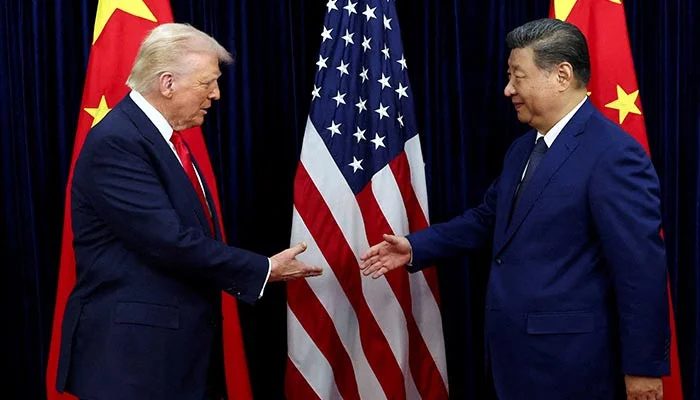
- Trump's visit will be the first by the American president in almost a decade.
- Trump says he expects “long talks” with Xi on Iran.
- The United States and China are preparing to discuss extending a one-year truce in the tariff war.
US President Donald Trump said he would ask Xi Jinping to “open up” China to American companies as he headed to Beijing on Wednesday for a high-stakes summit that will also address the Iran war.
In a sign of Trump's focus on business, Nvidia boss Jensen Huang boarded Air Force One during a stop in Alaska, and Tesla's Elon Musk also traveled on Air Force One to China.
“I will ask President Xi, a leader of extraordinary distinction, to 'open up' China so that these brilliant people can work their magic and help take the People's Republic to an even higher level!” Trump wrote on social media after leaving Washington.
A number of other top CEOs, including Apple's Tim Cook, will also be in Beijing for the visit, the first by a US president to China in nearly a decade.
But Trump's ambitions to increase trade will have to contend with political friction over Taiwan and the war in the Middle East, which has already delayed the trip since March.
As he left the White House, Trump said he looked forward to a “long conversation” with Xi about Iran, which sells most of its U.S.-sanctioned oil to China.
But he also downplayed disagreements, telling reporters that “I don't think we need any help from China with Iran” and that Xi had been “relatively good” on the issue.
However, Beijing is increasingly impatient for peace, and China's Foreign Minister on Tuesday urged his Pakistani counterpart to step up mediation efforts between Iran and the United States.
'What a thing'
This week's trip, the first since Trump visited Beijing in 2017, will include highly anticipated talks with Xi on Thursday and Friday, as well as lavish pomp and ceremony.
The packed itinerary includes a state banquet at Beijing's Great Hall of the People and a tea reception.
Trump said on Monday he would talk to Xi about U.S. arms sales to Taiwan, the self-governing democracy claimed by China, in a departure from the historic U.S. insistence that it will not consult Beijing on its support for the island.
China's controls on rare earth exports, rivalry in AI and the strident trade relationship between the countries are also among the issues the heads of the world's two major economies are expected to address.
The two sides are set to discuss extending a one-year truce in their tariff war, which Trump and Xi reached during their last meeting in South Korea in October.
The tense build-up to the superpower summit was already visible on the streets of Beijing, with police guarding major intersections and checking passengers' ID cards on the subway. AFP The journalists saw.
“It's definitely a big problem,” said Wen Wen, a 24-year-old woman traveling from the eastern city of Nanjing, when asked about AFP about Trump's visit.
“Some progress will certainly be made,” he said, noting that he hopes China and the United States can ensure a “lasting peace” despite the “recent instability in the global situation.”
'Very good relationship'
The United States and China have long sought to stabilize their relationship despite increasingly seeing each other as adversaries in trade and geopolitics.
Trump has repeatedly touted a strong personal relationship with Xi, who he insisted Monday would prevent a Chinese invasion of Taiwan, the self-governing island claimed by Beijing.
“I think we will be fine. I have a very good relationship with President Xi. He knows I don't want that to happen,” he said.
Trump's trip will be closely scrutinized by Taiwan and its Asian allies for any signs of weakening American support.
Beijing has become more confident and assertive since Trump's trip in 2017 and the US president finds himself in a weakened position as he seeks a way out of his war with Iran.
But the summit also comes at an uncertain time for China's economy, which has struggled in recent years with sluggish domestic spending and a prolonged debt crisis in the once-booming real estate sector.