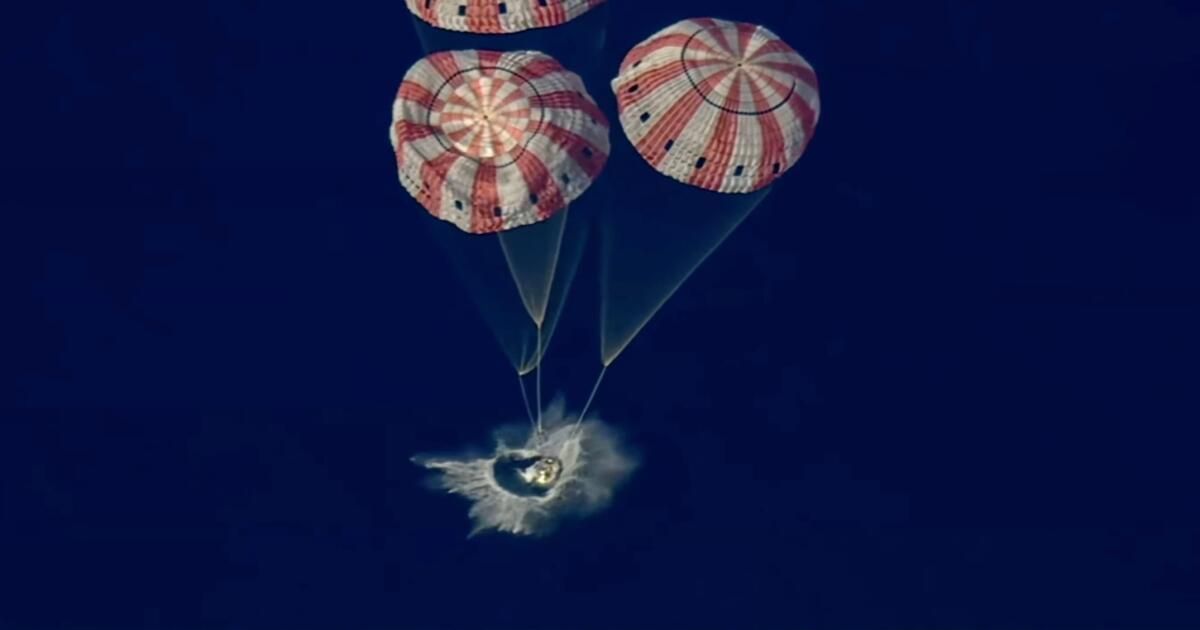
The Artemis II astronauts landed safely off the coast of San Diego at 5:07 p.m. on Friday. After their historic 10-day mission around the moon, the crew and NASA officials are finally breathing a sigh of relief.
“I'm still speechless. Childhood Jared right now can't believe what he just saw,” said NASA Administrator Jared Isaacman, standing aboard a Navy warship helping to recover the four returned astronauts in the Pacific Ocean.
Isaacman was born more than a decade after humans last walked on the moon.
“I've been waiting almost my entire life to see this, and then as NASA administrator, I couldn't be more proud of the entire workforce,” he said.
The return mission was highly anticipated and attracted enthralled spectators from all over the country. The Empire State Building was illuminated red, white and blue to welcome the crew home. Several MLB stadiums showed images of the landing on their scoreboards.
NASA considered the high-energy re-entry, tearing through the atmosphere in a nearly 5,000-degree Fahrenheit fireball at more than 32 times the speed of sound, as one of the riskiest moments of the mission.
-
Share via
Space agency officials' blood pressure rose even higher as experts closely watched the performance of the ship's heat shield, which astronauts rely on to slow down and maintain bearable temperatures.
During the uncrewed Artemis I 2022 test mission, the heat shield unexpectedly broke at more than 100 points. NASA determined that all astronauts on board would have emerged unharmed, but noted that the problem posed a greater risk to future crews. Instead of redesigning the heat shield (which NASA will do on future missions), the agency opted to take the capsule on a steeper trajectory intended to inflict less stress on the materials.
After landing, several minor problems delayed Navy divers as they attempted to remove the astronauts from the capsule.
First, the divers struggled to contact the astronauts inside, although both sides were still able to reach Mission Control. After the Navy crew opened the hatch, ocean currents hampered their ability to deploy inflatable devices around the capsule to stabilize it and help the astronauts exit.
Finally, nearly an hour and a half after landing, the team helped the astronauts out of the warm Orion capsule, to the applause of dozens of flight controllers in Mission Control.
The Navy team then transported the astronauts by helicopter to the Navy warship USS John P. Murtha, about 1.5 miles away, for medical evaluation.
Crews will continue working into the night securing the capsule and guiding it back to the Murtha, which is expected to arrive at Naval Base San Diego early Saturday.
For many NASA scientists and engineers across the country, the work to analyze every data from the capsule has only just begun.
“We're definitely going to want to take a look at the thermal protection system,” Isaacman said. “We want to download all the data they couldn't transmit to us and use it to report back to Artemis III.”
The Artemis Program, an international collaboration led by NASA, aims to put boots back on the Moon for the first time in more than 50 years. The space agency hopes to establish a lunar base as a testing ground for future missions to Mars.
Artemis II, a flyby mission around the moon that took off on April 1, focused on testing life support systems and practicing piloting the spacecraft to make the journey smoother for future crews who will focus on the complex challenge of landing on the lunar surface.

Christian Ramirez, Jr., 8, checks an astronaut suit while waiting for the Artemis II landing viewing party, which features a live broadcast of the splashdown on a big screen at the Columbia Memorial Space Center in Downey on Friday.
(Myung J. Chun / Los Angeles Times)
They solved problems with the capsule's space toilet (several times), piloted the spacecraft by hand, and tested procedures such as shielding from solar radiation in the cargo compartment.
But Monday's flyby, the first time humans reached the Moon since 1972, had emotional significance for the crew and space enthusiasts beyond the technical goals of the mission.
While in space, the crew spoke of the surreal sights of our dusty, rugged natural satellite, which appeared about the size of a bowling ball at arm's length, suspended in nothingness. The astronauts couldn't help but feel a renewed appreciation for our home planet.
“Maybe the distance we are from you makes you think what we're doing is special,” Artemis II pilot and Southern California native Victor Glover said on Easter as he headed to the moon. “But we're the same distance from you and, I'm trying to tell you, trust me, you're special. In all this emptiness, this is a bunch of nothing, this thing we call the universe, you have this oasis, this beautiful place where we can exist together.”
About 25 minutes before the crew returned to our oasis, Artemis II Cmdr. Reid Wiseman radioed Mission Control.
“We have a great view of the moon from window two,” he said. “It seems a little smaller than yesterday.”
“I guess we'll have to head back,” Mission Control responded.