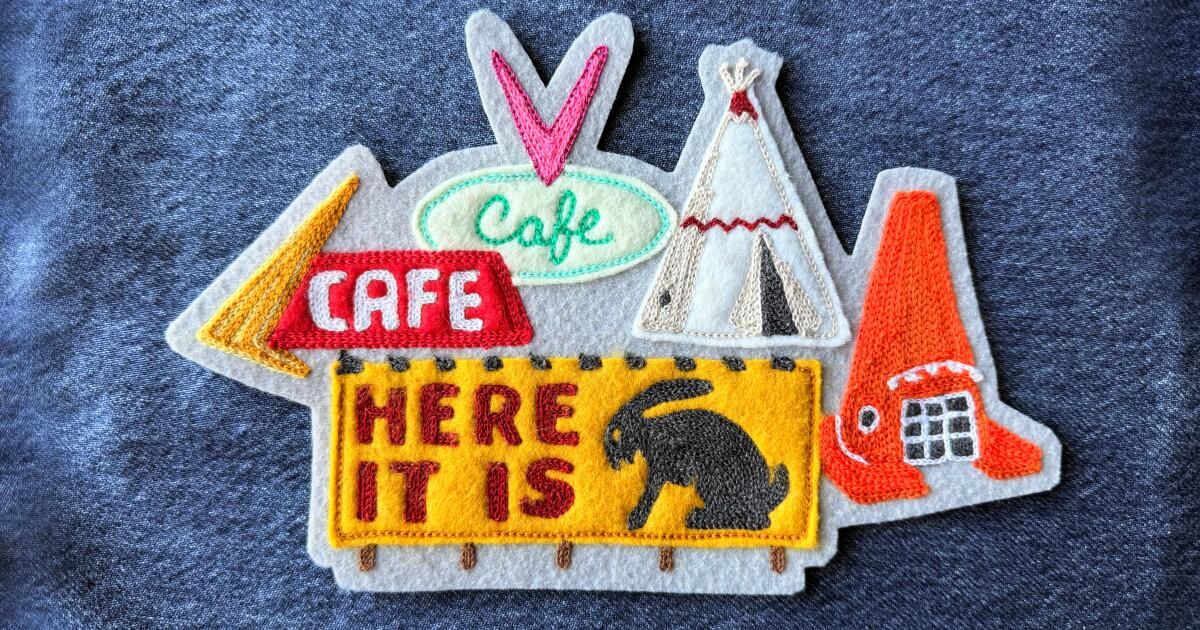
Route 66 has its tendrils throughout Southern California, and especially in the Los Angeles area, passing through Pasadena, West Hollywood and culminating in Santa Monica. But the most loving ode to Route 66 may be at Disneyland Resort, specifically Disney California Adventure.

America's Mother Road Stories, Photos, and Travel Recommendations
Cars Land opened in 2012 as part of a revamp of the theme park, ultimately giving it a stunning piece of land that could rival, and in many cases surpass, those of its next-door neighbor, Disneyland. Flanked by sun-scarred red rocks that look straight out of Arizona, Cars Land is a wonder of a theme park, with its mountain range backdrop slightly reminiscent of the fins of classic Cadillacs from 1957 to 1962. That design element is an homage to the Cadillac Ranch in Amarillo, Texas, where 10 vintage Cadillacs are buried nose-first in soil that to many resembles a 20th-century Stonehenge.
However, before the area was attached to the 2006 film, it was envisioned as a theme park destination dedicated to roadside attractions and trips along the so-called Mother Road. Cars Land is an imaginary area based on a fictional city from an animated movie, but its roots are decidedly real.

Cadillac Ranch, a work of art made from 10 old cars by artist collective Ant Farm in the 1970s, has become one of Amarillo's top attractions. Visitors are invited to add their own spray-painted touches.
(Christopher Reynolds/Los Angeles Times)

The mountain range in the background of Radiator Springs Racers is a nod to Cadillac Ranch. The spikes are designed to look like the tail fins of classic cars.
(Mark Boster / Los Angeles Times)
“We clearly recognize that you're walking down Route 66,” says Kathy Mangum, the retired Walt Disney Imagineer who served as executive producer of Cars Land.
“But you're also not walking on a part of Route 66 that exists anywhere,” Mangum continues. “There's no part of Route 66 where you're looking at a Cadillac surrounded by red rocks. It's the spirit of Route 66. I wouldn't even call it 'the best'. It's just a little bit of this, a little bit of that, and combined it feels real.”
Before those at Walt Disney Imagineering, the company's secretive arm dedicated to theme park experiences, even knew that Pixar Animation Studios was working on the “Cars” movie, an automotive-focused land was in the planning stages for Disney California Adventure. The park opened in 2001 and in its early years had struggled to draw crowds, as audiences focused on the lack of Disneyland-style attractions and grandly designed views.
In an effort to rejuvenate the park, then-Imagineer Kevin Rafferty envisioned an area to be called Car Land, without the “s,” drawing heavily on his family's road trips and roadside attractions and oddities similar to Route 66. Among its featured attractions was one initially called Scoot 66, which was later changed to Road Trip, USA, a slow ride that took visitors on a cross-country journey through the wilderness and the peculiarities of the road, although its showcase scene would have been a trip through a miniature Carlsbad Caverns, a short detour from Route 66.
“It was kind of ironic,” Rafferty, now retired, says of the attraction that was never built. “You were going to see all these roadside attractions that would draw you in, like giant bunnies.”

Mater's Junkyard Jamboree brings the rusty old tow truck character from the movie “Cars” to life in Cars Land at Disney California Adventure. (Mark Boster / Los Angeles Times)

A piece of art in Seligman, Arizona, pays homage to the Disney-Pixar film “Cars,” which was largely inspired by the city. (Mark Lipczynski / for The Times)
Rafferty believed that a place like Car Land would be ripe for exploration in a Disney park, as it would take place from the late 1950s to early 1960s and tap into a collective nostalgia for a time when a vehicle meant the freedom to explore the open road. Today, Cars Land still has some of that timeless energy, with a vintage rock 'n' roll soundtrack and a strip of street filled with colorful neon, whose lights, especially at night, beckon visitors to come closer.
“The reason I thought it would fit in a Disney park, especially Disney California Adventure, is because cars are such an important part of California history,” Rafferty says. “Cars are designed in California, although they are made elsewhere. There are more custom shops in California. There are more design studios in California. There are more car clubs. And all the car songs. 'She's so good, my 409'. It was all the Beach Boys, Jan and Dean.”

The neon signs of Radiator Springs. Flo's V8 Cafe is not a direct match for any Route 66 restaurant, but was inspired in spirit by the Midpoint Cafe in Adrian, Texas.
(Paul Hiffmeyer/Disneyland Resort)
The development of Rafferty's Car Land idea would change course when Imagineering and Pixar finally aligned. But it was also a change that would more formally anchor the area in Route 66 culture, which greatly influenced the film. Both the filmmakers and, later, those at Imagineering, embarked on 10-day research trips along the road led by historian Michael Wallis, author of “Route 66: The Mother Road.” In fact, Pixar was so enchanted by Wallis' tours that they asked the author to lend his voice to the role of the film's sheriff.
Wallis says he drove the teams around in rented Cadillacs. “I like to stop every 300 yards,” Wallis says. “If I'm taking a road trip, I'm on it. So we stopped to get box turtles off the road. I put them in the winter wheat to dance, to pick wild grapes. I introduced them to people I guarantee they would never have met, the great people on the road, and I showed them the natural and man-made sites on the road.”

Although the fictional community of Radiator Springs, “Cars” and Cars Land, does not have a single inspiration, it echoes the landscape and history of several small towns between Tulsa, Oklahoma, and Kingman, Arizona, including Tucumcari, NM, Seligman, Arizona, and Oatman, Arizona. And the single elegant bridge that centers on the grounds' background mountain range looks a lot like Pasadena's Colorado Street Bridge, although there's no roaring waterfall next to it. the original.

Scenes from Route 66 in Seligman, Arizona. The town was one of the inspirations for the fictional town of Radiator Springs from “Cars” and Cars Land.
(Mark Lipczynski / for The Times)

The Cars Land Ridge Center Bridge was inspired by a local landmark. (Paul Hiffmeyer/Disneyland Resort)

The Colorado Street Bridge in Pasadena, an inspiration for the Cars Land structure. (Adam Markovitz)
Elsewhere, Ramone's House of Body Art connects to the U-Drop Inn, a 1936 Art Deco gas station in Shamrock, Texas, that now serves as a visitor center and cafe. The Cozy Cone Motel nods to the Wigwam motel chain, which once included seven locations from Kentucky to California. Two remain in operation along Route 66: the Wigwam in San Bernardino and another in Holbrook, Arizona.
While the Imagineers had visual references from the animated film, Mangum says the research trip was invaluable in bringing authenticity to the park.
“We could walk into a building in Shamrock, Texas, that looks a lot like Ramone's House of Body Art and see that those tiles are made of raised terra cotta,” Mangum says. “So we were able to get the real texture. It's a cinematic world, but it's also a real world.”
Flo's V8 Cafe doesn't directly match any Route 66 restaurant, Imagineers say, but it was certainly influenced in spirit by the Midpoint Cafe in Adrian, Texas.

The Midpoint Cafe in Adrian, Texas, celebrates the midpoint of Route 66 between Chicago and Los Angeles.
(Christopher Reynolds/Los Angeles Times)
“We tried all of their pastries and food and took a lot of notes about it all,” Rafferty says. “The two women who owned the Midpoint Café had what they said was their mother's recipe for 'ugly crust pies'. We fell in love with ugly crust pies. I met with the head chef at Disneyland, who was French at the time, and told him we wanted to serve ugly pies at Flo's V8 Café. And he said, 'No, no, no, nothing at Disneyland will be ugly.'”
No, but it may be influenced by abandoned buildings. Mangum says a key location for the terrain was the deserted structures of Two Guns, Arizona. The remains of a gas station led to sketches that would inspire parts of the “Stanley's Oasis” area of the Radiator Springs Racers queue, which Rafferty and company filled with an oil filling station and then a building made up of empty oil bottles. History tells that Stanley's Oasis is a roadside attraction settlement that led to the development of the city of Radiator Springs.

At the Cozy Cone Motel, a series of cone-shaped food stalls sell quick snacks, such as swirled ice cream cones. (Stephanie Breijo / Los Angeles Times)

The Cozy Cone is based on the real-life Wigwam Motels. (Christopher Reynolds/Los Angeles Times)
“That kind of Route 66-inspired story was made up,” Rafferty says. “It wasn't in the movie.” That backstory, however, would inform the 2012 short “Time Travel Mater.”
The land's enduring strength, however, is not just due to the popularity of the animated properties that gave rise to it. While Route 66 wasn't magical for everyone (the highway's history is peppered with stories of extreme poverty and horrific racism), it has become romanticized as a slice of American culture and stands as a starting point for delving deeper into our past.
The earth is, in a word, timeless. It's also representative of the ideal of a small, working town, the kind of place we've always longed for. “It may not be the America of today,” Mangum says, “but it kind of is.”
Times staff writer Christopher Reynolds contributed to this report.