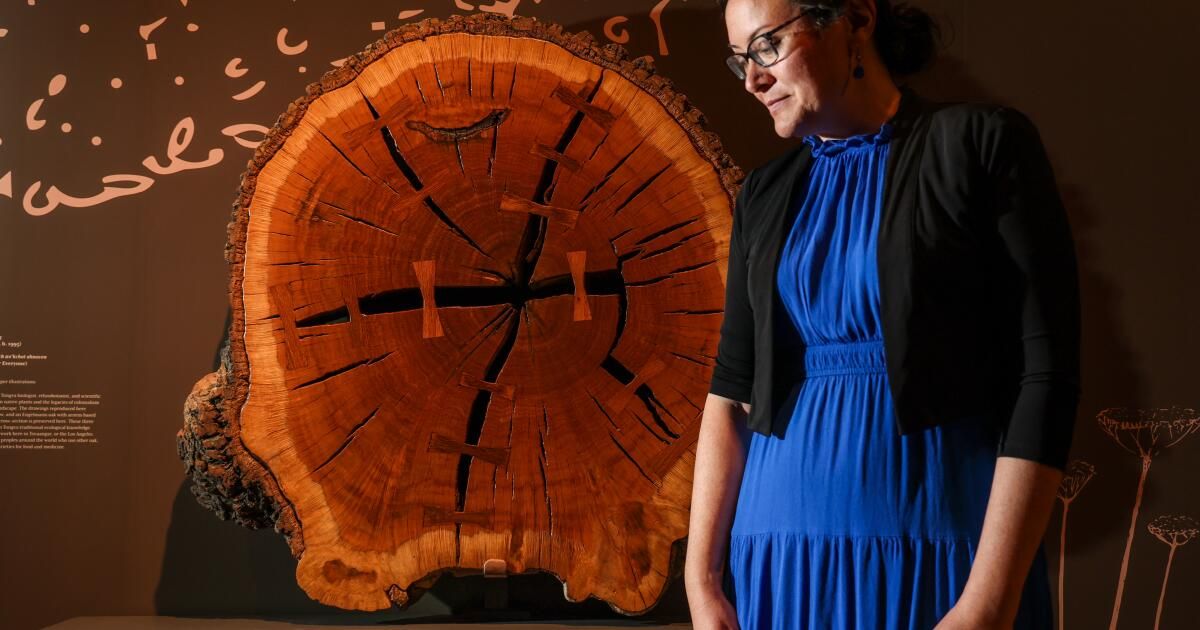
A cross section of a 250-year-old Pasadena oak tree that was uprooted in a 1993 windstorm is one of the first things visitors will see upon entering the Huntington's new exhibit, “This Land Is…”. Jagged cracks in the trunk, once rooted in Huntington's lawn, are held loosely together by wooden joints.
It is a fitting emblem of what is to come in a long-planned exhibition, curated to coincide with the country's upcoming semi-quincentenary and designed to present the land itself as central to the country's complex past. After viewing the exhibition, attendees can draw their own conclusions about the role of the earth as a “geographical and metaphorical space of promise, struggle, and belonging.”
-
Share via
For the record:
20:39 June 12, 2026An earlier version of this article said the Huntington is in Pasadena; It's in San Marino.
On a recent afternoon, the San Marino sun beat down on the façade of Huntington's MaryLou and George Boone Gallery, where exhibition organizers waited beside four chiseled columns with their hands behind their backs, swaying in anticipation.
“It's the first time anyone has seen it,” said Linde B. Lehtinen, the museum's senior curator of photography.
She is joined by Josh Garrett-Davis, curator of Western American history, and Armando Pulido, assistant curator of special projects. The three smile excitedly.
For most of the past two and a half years, Lehtinen and Garrett-Davis have led the curation of “This Land Is…”, which opens Sunday and runs through early next year.
To them, the fallen oak represents hope amid unrest: another once-imposing elder in the museum's North View was uprooted during a windstorm in 2025; one of her acorns has since sprouted and is now over 6 feet tall.
Still, this only scratches the surface of an exhibition that draws seamlessly from a wealth of works crafted throughout American history. Do you want to plan a visit? Here are five things you shouldn't miss.


Woody Guthrie's guitar, with the inscription “This Machine Kills Fascists”
In 1940, Woody Guthrie was sitting in a midtown Manhattan hotel, hard at work on the lyrics for what would become “This Land Is Your Land.” Today, it has been adopted as almost an anthem for America and the epitome of American progressivism.
For this exhibit, the museum borrowed Guthrie's CF Martin and Co. guitar, a perfect blend of spruce, mahogany, celluloid, ebony and mother-of-pearl. On its back, a carved inscription reads: “This machine kills fascists.”
“The idea for 'This Land Is…' came about… because of the reach and breadth of his voice in terms of his activism and how prolific he was… and thinking about how he reflected on and experienced the American land,” Lehtinen said.
Next to the guitar is a copy of the Declaration of Independence, annotated by John McKesson, secretary of the Fourth Provincial Congress of New York, in the days after July 4, 1776. According to Lehtinen, the two objects were paired as instruments of protest and change.
“We spoke with [Guthrie’s] granddaughter Anna Canoni, and she told us at one point that he used guitars as pens or tools, and that was very appropriate for the way we thought about his relationship with this document,” he added.

A map of the Butte community, Gila River relocation center drawn by a prisoner.
(Robert Gauthier/Los Angeles Times)
Japanese flower farmers photographed before, during and after imprisonment
Not far from the Guthrie guitar is a panoramic portrait of the Kuromi family, posing in the middle of a flower farm that stood where Los Feliz Boulevard now stands. To his right is a watercolor of the Gila River War Relocation Center in Arizona, where many family members were forcibly transported and imprisoned during World War II.
“I was looking at a historic preservation report and the name was the same as my mechanic in Los Feliz,” Garrett-Davis said. “The next time I went to get my oil changed, I took a printout of that scenario, and I was going to show it to them and ask them, 'Do you know anything about this? Is it related?'
“I walked into his office and there was a copy of that photo on the wall for years. In 10 years, I never noticed it,” he said, laughing.
After their imprisonment, the Kuromi family returned to their farm in 1945 to find their equipment stolen. The process of regaining access to their land was slow, but they eventually settled again and operated the farm until they lost the lease in 1961.
'A harvest of death' and mail from home on the Civil War front
One of the most grotesque exhibits on display is an albumen copy of an 1863 photograph titled “A Harvest of Death,” taken by Timothy H. O'Sullivan after the Battle of Gettysburg. Within its frame are the bodies of fallen soldiers, lying lifeless on the grass.
“That evocative title points to some of the other things we've been thinking about, whether it's looking at gardens or loss… in this case, it's about bodies that have been left abandoned and are decomposing,” Lehtinen said.
Accompanying the print is a letter from a young woman named Harriet Bailey to her uncle on the front lines of the Civil War, containing seeds delicately engraved with drawings of a ship, faces and a dog. The two pieces represent a stark contrast in experiences during the same conflict, once again touching on the theme of hope in the midst of turmoil.
“This is a remnant of his home that was actually shipped while he was on the battlefield,” he continued. “So the joy and the levity of what is an incredibly bleak time in American history.”

“Archiving the Watershed” is a collection of Colorado River artifacts assembled by Otis R. “Dock” Marston on display.
(Robert Gauthier/Los Angeles Times)
The Colorado River, traced through the eyes of an adventurer
This exhibit is described as a “small portion” of the Huntington’s archive on Otis Reed “Dock” Marston, a historian and river runner who made it his life’s goal to gather information about the Colorado River. According to Garrett-Davis, Marston had about 185 folders full of photographs, often placed on a cutout map of where they were taken and organized mile by mile, from below the US-Mexico border to Utah.
This takes advantage of a focal point of the exhibition: adapting it to a West Coast perspective. In this way, the idea of independence is seen broadly as it develops over time and place.
“The Huntington has a wonderful collection of presidential papers and documents related to the colonial era, but we also have materials about California… from the perspective of the West,” said Huntington President Karen R. Lawrence.
“We can show the visual culture of the West at the same time we can show the original copies of the Declaration of Independence…we have a breadth that is quite rare.”

Mural on canvas “Island in Trouble” by artist Noni Olabisi, which represents the struggle of the Haitian revolution.
(Robert Gauthier/Los Angeles Times)
'Island in Trouble' and a reflected struggle
The Haitian Revolution may seem out of place in an exhibit celebrating the United States, but Haiti was the second independent nation in the Western Hemisphere. Its independence from the French was proclaimed in 1804, just two decades after the American colonies signed the Treaty of Paris.
In the mural “Troubled Island,” Noni Olabisi chronicles the Haitian struggle for independence, including how suffering under French settlers led to the slave rebellion of 1791. The piece was first painted for the William Grant Still Arts Center in West Adams in 2003, referencing an opera of the same name.
The opera was composed by Still with a libretto by Missouri-born poet, playwright, novelist, and social activist Langston Hughes, who connected Haiti's struggle for freedom with that of his home country.
“We wanted to focus on parts that might seem peripheral but are actually quite central to American history,” Garrett-Davis said.
Three years later, Olabisi would create the same powerful mural on canvas.
'This land is…'
Where: The Huntington
When: June 14 to January 11, 2027
Cost: $29 to $34, depending on date and season
Information: huntington.org