The 2026 World Cup is imminent, with the first game kicking off on June 11 (next week!) and while it may be difficult to choose what your next TV upgrade should be, here at TechRadar we're leaning towards mini-LED as the TV technology you should choose.
Not only can you get giant 100+ inch screens at reasonable prices, but their high full-screen brightness helps show sports in brighter rooms (perfect for daytime World Cup matches) without suffering from mirror reflections as bad as OLEDs. Don't get me wrong, the best OLED TVs can still be great for watching sports – it's just that mini-LED covers a lot of the bases better.
While we often talk about mini-LED TVs from Hisense and TCL, thanks to their balance of price and performance, I can't overlook Samsung, one of the most premium providers of mini-LED TV technology on the market. In fact, the Samsung QN90F, last year's 4K Neo QLED (mini-LED) flagship, remains our pick for the best TV for sports due to its excellent motion handling, matte screen for reflections, and solid brightness.

But what about some new, more affordable mini-LED options from the brand? Fortunately, the Samsung QN80H and Samsung M80H have arrived in our test rooms. Interestingly, the QN80H is a Neo QLED, which uses mini-LEDs in its panel, and the M80H is labeled simply as “mini-LED.” So how do the two compare? Are they a good option for the World Cup?
The right televisions for the World Cup?

I decided to start my testing with some football to see how these affordable Samsungs could handle the fast-paced action. BBC iPlayer is running a 'Classic World Cup' channel at the moment with tons of match highlights from previous World Cups, so I used that as a test.
I set both TVs to Standard mode, as I find it to be the best mode for watching sports, and set the motion settings to Blur Reduction 0 and Vibration Reduction to 3, as I've found them to be effective with Samsung TVs in the past.
Across the various highlights I watched, which included Italy vs France in the infamous 2006 final, both TVs demonstrated solid motion handling, although the M80H was prone to some juddering no matter the settings. As the players frantically wiped the ball around the field and the camera followed them, both TVs showed only minimal vibration with no obvious artifacts. Vibration reduction could be increased to 5 before artifacts such as ball ghosting appeared.
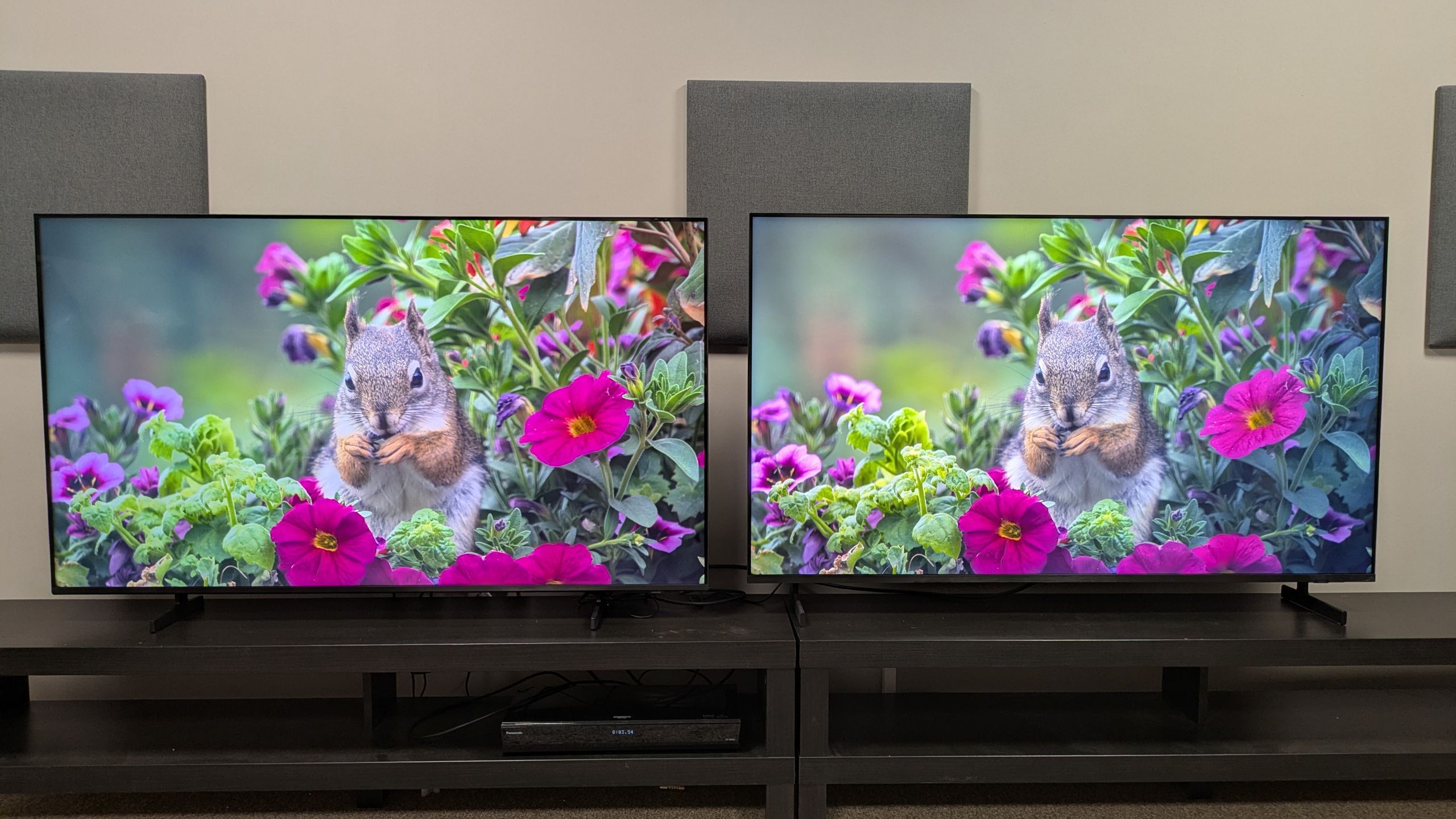
In terms of actual image quality, the QN80H was the most impressive. It was much brighter and bolder in color, which meant the players' uniforms actually appeared on the screen. Field green was also more striking on the QN80H, again due to its greater perceived brightness. However, the M80H image had a natural look, with the green of the field more realistic. The same thing happened with the player's skin tones. Still, the QN80H had the more visually appealing image.
New from Samsung in 2026 is AI soccer mode, and while I don't normally use AI image enhancements, I gave it a try. Not only did it brighten the picture on both TVs, it also sharpened the textures and made the colors a little more vibrant. At times it bordered on artificial, but it was impressive nonetheless. The most impressive part was what he did with the comment. The AI Football mode brought the commentator's speech to the front of the TV, making it very clear, and it did so without affecting quality, as I've found can happen with some AI Voice modes on several TVs I've tested.
However, throughout my testing, one thing became very obvious: the M80H was prone to glare, even in bright scenes. In fact, for a mini-LED, it seemed very dim, especially next to the QN80H.
Bright scenes and bright room visualization

When measuring the brightness of both TVs, focusing on SDR and HDR full-screen brightness as they will be relevant for the World Cup, the QN80H recorded 634 nits HDR and 325 nits SDR full-screen brightness (in standard mode). The M80H, on the other hand, recorded a full-screen brightness of 179 nits SDR and 269 nits HDR, also in standard mode.
Elsewhere, the M80H recorded a maximum HDR brightness of 252 nits in Movie mode and a maximum HDR brightness of 259 nits in Filmmaker mode, which are generally disappointing results. The QN80H, on the other hand, recorded a maximum HDR brightness of 1152 nits and 1149 nits in Movie and Filmmaker mode respectively – more in line with what I expected.
These brightness measurements go some way to explaining why the M80H struggled with reflections in our brightly lit test rooms. When testing some brighter scenes with these TVs, the brightness gap really showed. snow scenes Spears and Ammunition HDR images looked more vibrant and punchy on the QN80H, and whites looked much brighter compared to the M80H.
In another scene, when the sun hits a light-colored tree, the M80H showed signs of clipping (where details are lost in brighter scenes). It was impossible to see any cracks or marks in the tree bark, while the QN80H did a much better job of maintaining these details. This was using the 1000 nits HDR10 footage from Spears and Ammunitionmy favorite footage for all televisions. While the M80H offered some bright highlights, such as a sunset, the QN80H was obviously better.
Watch movies

I then tested both TVs using reference 4K Blu-rays that I use to test TVs. My first stop was to give them an effective torture test with the batmana dark film with low brightness I've found can be a real banana peel for some TVs, particularly the cheaper mini-LED and QLED ones.
One thing I discovered was that each TV benefited from different picture modes than the other. The M80H needed to be in Movie mode (its Filmmaker mode was too dim) and the QN80H needed to be in Filmmaker mode (its Movie mode was too bright for some dark scenes). With these settings in place, both TVs demonstrated solid contrast, but the QN80H's brighter lights made high-contrast scenes appear more dynamic.
However, I found that the M80H had more natural contrast, as its lower brightness suited the dim nature of the the batman. However, it showed signs of black crush, where the details of Batman's suit were lost when he was in shadow.
The M80H struggled in dark conditions as it does not have a local dimming setting, while the QN80H does. This meant that during dark scenes, such as Batman on the subway, there was a clouding effect, with the backlight showing in dark areas, indicating poor screen uniformity. The QN80H's black levels were much more accurate.

I then moved on to colorful scenes and the QN80H demonstrated more vibrant colors. In The sound of musicwhere Maria and the children are at a market stall, the fruits and vegetables on display were bolder and brighter in the QN80H. They looked accurate on the M80H and had good color depth, but they lacked the visual punch I'd expect from this scene. It's the same story with The wild robot Also: more dynamic colors on the QN80H, but a nice authenticity on the M80H. Ultimately, though, the animation deserved the much bolder QN80H.
Interestingly, for colorful scenes, the picture modes were switched on the two TVs. The M80H suddenly seemed much brighter in Filmmaker mode, while the QN80H suited the more vibrant Movie mode. The other modes didn't look bad, but all the vibrant colors needed more vibrancy.
an opportune moment

As for which TV I would recommend, it's the QN80H. The M80H produces some natural images, but it's not as good for movies as the QN80H and it doesn't have the motion handling or brightness of the QN80H. But there is a third option to consider: the QN90F that I mentioned in the introduction.
Since the QN90F is a year old, its prices have dropped significantly. In fact, it is cheaper than the QN80H. A 55-inch QN80H costs $1,299 / £1,299 / AU$1,795, while a 55-inch QN90F costs $1,299 / £999 in the US and UK (sadly it's out of stock in Australia). And with Prime Day starting midway through the World Cup (June 23-26), there's no better time to pick one up.
The M80H is a tempting option at $699 / £799 / AU$1,199, but this is a situation where it's worth investing more. If you have the option, the QN90F is the obvious choice, but if you don't, the QN80H is easily the best option.
You could also consider the TCL and Hisense TVs I mentioned above, as 2025 models like the TCL QM7K/C7K still exist at affordable prices. However, if you want a Samsung mini-LED, go for the options I mentioned above.
Are you thinking of buying a new television?
Try our TV size and model finder! You tell you how far you sit from your TV, we'll tell you what size to buy based on viewing angle advice from picture quality experts, and we'll recommend our three best TVs in that size at different prices.

Follow TechRadar on Google News and add us as a preferred source to receive news, reviews and opinions from our experts in your feeds.