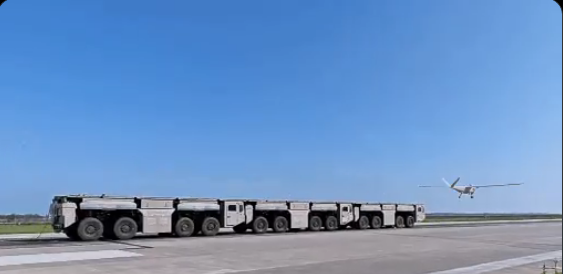
- Video shows China's road-mobile electromagnetic catapult launching a plane for the first time
- The images come from a now-deleted social media post from the School of Mechanical Engineering at the Beijing Institute of Technology.
- It takes advantage of the existing EMALS technology in China by miniaturizing what it already uses on its aircraft carrier.
China appears to have solved one of the biggest challenges facing modern drones: deploying trackless anywhere on the planet, thanks to a miniaturized version of the EMALS catapults found on its newest aircraft carrier.
A short video clip that appeared late last month, from a social media post by the School of Mechanical Engineering at the Beijing Institute of Technology, shows three eight-wheeled trucks linked together like Lego to form a track that allows a propeller-driven drone to take flight.
The images also show the three trucks uncoupled, coupled together and with four-wheel steering which, in principle, allows them, if given enough space, to launch drones or small planes in any direction.

Replace a landing strip on the modern battlefield?
China's move did not come in a vacuum: The United States was the first country in the world to deploy an electromagnetic aircraft launch system (EMALS), sparking an arms race when it launched its first aircraft in 2017 aboard the USS Gerald R. Ford.
China did the same with its own aircraft carrier, the Fujian, which has three EMALS catapults compared to the United States' four, possibly explaining the smaller size of the Chinese aircraft carrier relative to the larger one of its main naval rival.
However, China has moved ahead of the United States when it comes to demonstrating a portable EMALS, it seems, and its three-truck solution essentially marks a first for both countries.
Chinese state giants represent a significant portion of the more than 70 organizations directly involved in an impressive achievement that sets the stage for the next generation of drone-based combat.
Although the video made its way onto social media, it was removed by the School of Mechanical Engineering at the Beijing Institute of Technology, which originally posted it. The move, however, has not stopped Chinese defense forums and analysts from offering insights into what is clearly a major technological achievement for the country.
With France and India committed to launching EMALS (albeit for now on future aircraft carriers), only two countries currently have the technology deployed on a ship, and only one of them has a land-based portable option in play for now: China.

Follow TechRadar on Google News and add us as a preferred source to receive news, reviews and opinions from our experts in your feeds.