A new GSMA report highlights how AI, digital services and mobile connectivity are driving economic growth in Africa, while affordability remains a key barrier to digital inclusion.
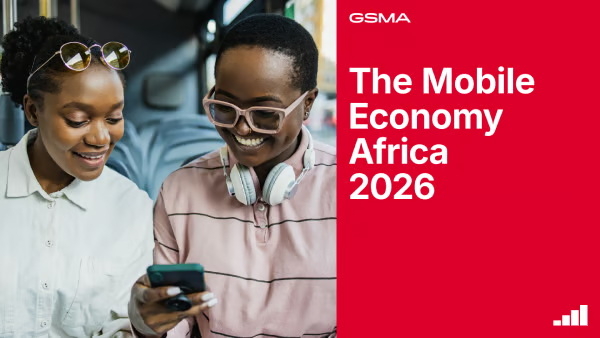
June 16, 2026, London: Mobile technologies and services will contribute $240 billion to the African economy in 2025, equivalent to 7.8% of GDP, according to the GSMA Africa Mobile Economy 2026 report. The sector also supported approximately 13 million jobs and generated $45 billion in public revenue, underscoring the growing role of mobile connectivity in driving economic growth, innovation and digital transformation across the continent.
The report concludes that Africa's mobile industry is entering a new phase of development. After spending the last decade expanding connectivity, operators are increasingly focused on unlocking the full value of digital networks for consumers, businesses and governments. Across the continent, operators are evolving beyond their traditional role as connectivity providers to become digital transformation partners, deploying artificial intelligence (AI), expanding digital services and opening up network capabilities to developers through standardized APIs. According to research by GSMA Intelligence, 79% of operators in Africa identify becoming a digital transformation partner as their main business objective.
By 2030, mobile technologies and services are expected to contribute $290 billion to Africa's economy as digital adoption deepens and connectivity continues to support productivity, innovation and economic development across the region. Today, Africa's digital challenge has shifted from expanding network coverage to ensuring that people, businesses and governments can fully benefit from the connectivity that already exists.
Vivek Badrinath, Director General of the GSMAsaying: “Africa's mobile industry is entering a new phase of development. Having connected millions of people and businesses over the last decade, the focus is increasingly shifting towards unlocking greater value through artificial intelligence, digital services and new forms of innovation. Seizing this opportunity will require continued investment, policies that encourage innovation and a shared commitment to ensuring that everyone can benefit from the opportunities created by digital technologies. We also call on the broader technology supply chain, including those who manufacture the components that make devices possible, to reflect on how your own success is tied to a connected world, and to join us in closing the usage gap and making the world more accessible and affordable for everyone.”
Across the continent, operators are increasingly deploying AI to improve network performance, strengthen customer experiences and support new digital services. However, Africa is home to more than 30% of the world's languages, while today's leading AI models are still predominantly trained in English and other high-resource languages. Through initiatives such as theAI language models in Africa, by Africa, for Africa”, industry stakeholders are working to strengthen the data, computing, talent and policy foundations needed for African-led AI development.
The report also highlights the growing momentum behind GSMA Open Gateway, which allows operators to provide standardized network APIs to developers and enterprises. These capabilities are helping to unlock new digital services while supporting fraud prevention, identity verification and digital trust across sectors, including financial services, e-commerce and digital government.
Political decisions will play a key role in determining whether Africa can fully capture this next wave of digital growth. Investment incentives, spectrum availability, affordability measures and regulatory certainty will influence the pace of innovation, digital adoption and infrastructure deployment across the continent.
Despite this progress, the report warns that Africa's biggest digital challenge is no longer network coverage, but adoption. While mobile broadband networks now cover the vast majority of the population, approximately 63% of Africans live within coverage but do not use mobile Internet. In comparison, only 9% remain outside mobile broadband coverage.
Affordability remains the biggest barrier to mobile internet adoption across much of the continent, along with digital skills gaps and other social barriers. The report highlights the importance of initiatives aimed at improving device affordability, expanding digital skills and creating a more inclusive digital ecosystem.
To support the next phase of digital growth, the GSMA calls for policies that encourage investment, improve affordability and accelerate digital adoption. Mobile operators across Africa are expected to invest more than $76 billion in network infrastructure between 2024 and 2030. Evidence from several African markets also shows that reducing taxes on digital devices and services can help accelerate adoption and expand access to the benefits of the digital economy.
Key findings from the Mobile Economy Africa 2026 report:
- Mobile technologies and services will contribute $240 billion to the African economy in 2025, equivalent to 7.8% of GDP.
- The economic contribution of mobile telephony is expected to reach $290 billion by 2030.
- The mobile ecosystem will support approximately 13 million jobs in 2025.
- The sector generated 45 billion dollars in public revenue.
- Mobile operators are expected to invest more than $76 billion in network infrastructure between 2024 and 2030.
- About 63% of Africans live within mobile broadband coverage but do not use mobile Internet, compared to a coverage gap of 9%.
- 5G adoption is expected to reach 21% of total mobile connections by 2030.
-ENDS-
About the GSMA
The GSMA is a global organization that unifies the mobile ecosystem to discover, develop and deliver critical innovation for positive business environments and social change. Our vision is to unlock the full power of connectivity so that people, industry and society thrive. Representing mobile operators and organizations across the mobile ecosystem and adjacent industries, the GSMA offers its members three broad pillars: connectivity for good, industry services and solutions, and outreach. This activity includes policy advocacy; address today's biggest social challenges; underpin the technology and interoperability that make mobile devices work; and provide the world's largest platform to bring together the mobile ecosystem at the MWC and M360 series of events.
Media contact
GSMA Press Office
press [email protected]