ChatGPT and other AI platforms can produce some funny, disturbing, and even adorable images (although often in possibly copyright-infringing ways). But, just as AI tends to adopt an overly optimistic and encouraging tone in its written responses, there is a tendency to soften or flatten image styles without explicit instructions, even when the source is as quirky and unique as, say, a toddler's scribbling.
You can overcome ChatGPT's preference for generic drawing recreation with a little extra effort. Several people have shared their successes in bringing their children's drawings to life, without ChatGPT turning a silly drawing of a bird into just another robin you'd see in your garden. Based on that and after some experimentation, with the help of my young son and his enthusiastic doodling, I came up with a fairly successful, if still inconsistent, template for accurately converting his interpretations of a dog, a bear, and a dragon into a simulacrum of reality. The message is not short, but to fix ChatGPT preferences, everything is necessary and could even benefit from being longer:
Turn this child's drawing into a photorealistic biological creature, using it as a strict model: preserve the exact silhouette, proportions, feature placement, asymmetry and color intent so that the result aligns if overlapped. Turn lines into natural anatomical edges, flat shapes into volume within the same boundaries, simple eyes into realistic wet eyes in the same position and size, mouths into subtle skin folds and glue limbs into thin but believable anatomy. Translate original colors to natural pigmentation within the same family using only tonal variations. Add realistic surface details, such as fur or skin texture, soft folds, small imperfections, natural color variation, and eye reflections. Present it as a serious wildlife photograph of a credible species, taken with an 85mm lens, shallow depth of field, natural lighting, great detail and a simple natural background so the creature remains the center of attention.
Article continues below.
chihuahua toy
It is worth mentioning that the drawings were the result of much negotiation with my son, whose initial attempts were, charitably, from the surrealist impressionist school of art. And to keep it simple, we stuck to black and white, but the AI understood quite well what was required to create colors.
My son's attempt to draw a Chihuahua wasn't far off the mark, although the giant head and uneven stance suggested a creature in mid-wobble. The photorealistic version did not correct a single one of those problems. Instead, he leaned towards them. The oversized ears became finely detailed. The eyes, which were once simple circles, became bright and alert. The tiny body and slightly unbalanced posture remained exactly as drawn, giving the entire image an odd credibility.
What stood out the most was how natural he seemed even though everything was wrong. The proportions were still exaggerated, but the realism made them seem like a deliberate quirk of the animal rather than a mistake. It looked like a real creature that had simply evolved in a slightly different direction.
My son's reaction was immediate recognition. That, more than anything, seemed to be the point.
bear in the forest

The bear started out as the simplest of the three drawings. No matter how many times the drawing started out as an adult bear, the resulting drawings looked more like a Teddy than a grizzly bear.
ChatGPT's interpretation seemed halfway between a Paddington doll and a real bear. The head looked like something real, although it looked like a much more intelligent creature. The rest ended up being more of a magical stuffed animal that came to life than a natural beast.
Still, although the proportions were those of a child's imagination, the realism gave them weight. My son still thought of him as cute. From a distance, me too. Up close, he looked like he might have his own opinions.
dragon fire

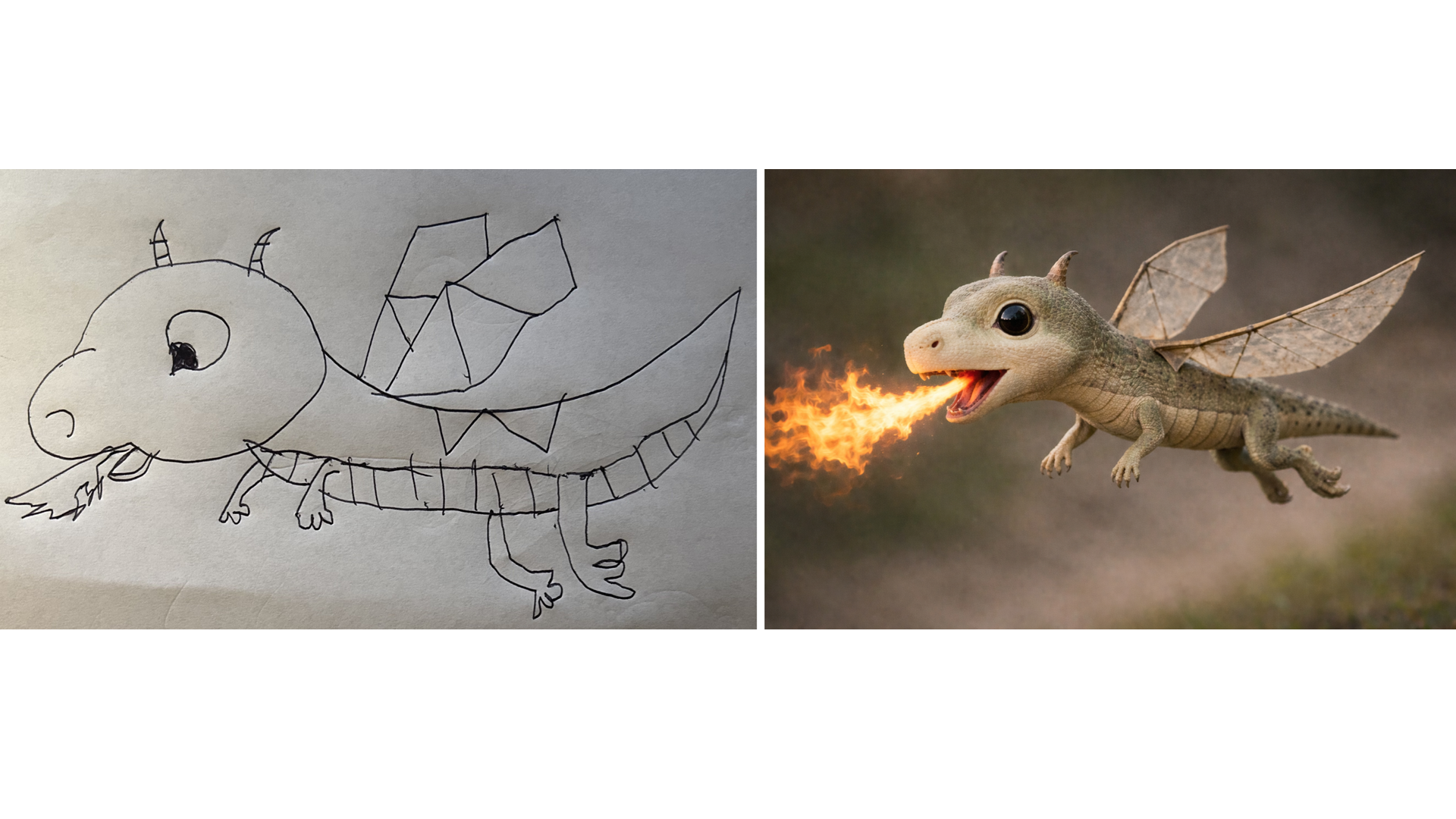
Without deliberately influencing the choice of subject, it would have been difficult for me to realize that my son was trying to draw a dragon over and over again. While letting him take the lead as much as possible, I gave him a little extra push to produce a paper dragon.
Of course, dragons were never actually in a natural landscape looking like real biological species, but this virtual one checked all the boxes for my son. Personally, I found this interpretation a little creepy. Unequal wings and legs, and a curved spine of shapes that were uncomfortable to look at. But since that was basically what I had asked for, I appreciated the effort. And at least the flames seemed cold.
If you're wondering why I might have put so much effort into the dragon in particular, it was mainly to try to erase the memory of ChatGPT's attempt to produce a hypothetically real version of my son's artistic rendition. As you can see below, there are much scarier things than a slightly unbalanced dragon on top of you.

Follow TechRadar on Google News and add us as a preferred source to receive news, reviews and opinions from our experts in your feeds. Be sure to click the Follow button!
And of course you can also follow TechRadar on TikTok for news, reviews, unboxings in video form and receive regular updates from us on WhatsApp also.

The best business laptops for every budget